


Introduction:
The Supreme Court, in Tamil Nadu Hotels Association vs. G. Subramania Koushik and Ors., Diary No. 15768-2025, declined to entertain a challenge to the Madras High Court’s order restricting the number of vehicles allowed into the Nilgiris and Kodaikanal during the peak tourist season. The Court, comprising Justices Surya Kant and N. Kotiswar Singh, held that the High Court’s order was “perfectly correct” and refused to intervene. The petitioner, Tamil Nadu Hotels Association, argued that the order was based on incomplete data and that an IIT study on traffic congestion was still awaited. However, the Supreme Court found no merit in this claim, questioning why the petitioner had not approached the High Court earlier. When the Court refused to stay the order, the petitioner withdrew the case with liberty to approach the High Court.
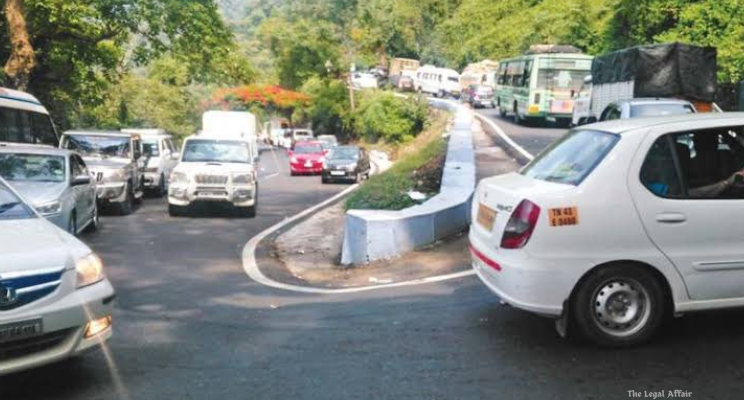
The High Court’s impugned order, issued on March 13, 2025, had imposed limits of 6,000 vehicles for Nilgiris and 4,000 for Kodaikanal on weekdays, increasing to 8,000 and 6,000, respectively, on weekends. The restriction, however, did not apply to government buses carrying tourists, government vehicles, or vehicles engaged in trade and business. Additionally, residents’ vehicles were entirely exempt. The High Court had previously directed the Tamil Nadu government to implement an e-pass system for vehicles entering these hill stations and had emphasized the importance of prioritizing electric vehicles for these passes. The Court underscored the need to protect the Nilgiris biosphere and the Western Ghats, stressing that biodiversity conservation was crucial for human survival.
Arguments of Both Sides:
The petitioner, Tamil Nadu Hotels Association, contended that the High Court’s decision was arbitrary and based on outdated data. They argued that the order was issued in March 2025 using traffic data from February, whereas the actual tourist surge occurs in April, May, and June. The petitioner highlighted that a report from the Indian Institute of Technology (IIT) was still pending and should have been considered before implementing restrictions. The petitioner also raised concerns about the lack of accurate vehicle entry data, as surveillance cameras were still being installed to track vehicle movement. The High Court, they claimed, had imposed restrictions preemptively, without waiting for actual figures from the tourist season.
Additionally, the petitioner pointed out that businesses in the Nilgiris and Kodaikanal heavily depend on tourism, and the vehicle cap would negatively impact the hospitality industry. The restriction, they argued, would reduce the number of visitors, thereby affecting hotels, restaurants, and local businesses. They also criticized the process by which the decision was made, stating that only the Tamil Nadu government had notice of the High Court proceedings, while stakeholders like the hotel industry were not allowed to present their case. Finally, the petitioner requested that the order be stayed until further studies were conducted to determine the actual carrying capacity of these hill stations.
On the other hand, the respondents, represented by the Tamil Nadu government and other parties, defended the High Court’s decision, stating that it was essential to manage congestion and protect the fragile ecosystem of these hill stations. They argued that the Nilgiris and Kodaikanal had been facing increasing pressure due to excessive tourism, leading to environmental degradation, traffic congestion, and waste management issues. The respondents emphasized that the restrictions were not arbitrary but were based on an assessment of the carrying capacity of the region.
The Tamil Nadu government further justified the decision by arguing that even if the data was based on February figures, the vehicle limits set by the High Court were more than adequate to accommodate peak-season traffic. They pointed out that allowing unrestricted entry of vehicles would cause severe congestion, increase pollution, and diminish the quality of the tourist experience. The respondents also emphasized that the restrictions did not apply to residents or essential services and that an e-pass system was being introduced to ensure smoother vehicle regulation.
Court’s Judgment:
The Supreme Court, after hearing both sides, found no reason to interfere with the High Court’s decision. Justice Surya Kant questioned the petitioner on why they had not approached the High Court earlier, given that the matter directly impacted them. The Court also dismissed the argument that the February data was irrelevant, stating that the High Court had used it as a minimum benchmark and that the tourist influx would only be higher in the following months.
Justice Kant remarked, “6000 vehicles you take there, and still you are not satisfied! You want to have havoc there.” The bench emphasized that traffic congestion in the Nilgiris and Kodaikanal had been a long-standing issue, and the High Court’s proactive measures were justified. The Court also pointed out that the High Court had taken a balanced approach by increasing the vehicle limits on weekends and ensuring that residents and essential services were not affected.
The Supreme Court expressed its reluctance to keep the order in abeyance, even temporarily. When the petitioner’s counsel argued that the order had “come out of the blue” and sought time to approach the High Court, the bench refused to grant any relief. Faced with no other option, the petitioner withdrew the case with liberty to challenge the order before the High Court.