


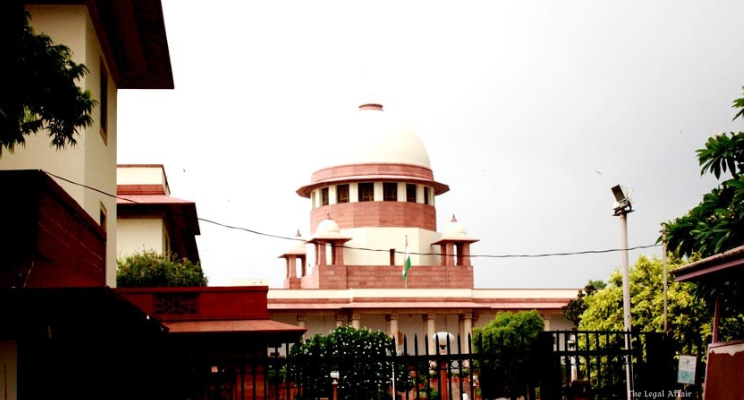
Introduction:
The Supreme Court of India, in the landmark judgment of Metpalli Lasum Bai (since dead) and others versus Metpalli Muthaiah (deceased) by LRs, has reiterated the fundamental legal principle that a registered Will carries a strong presumption of due execution and genuineness. The bench, comprising Justice Vikram Nath and Justice Sandeep Mehta, on July 21, 2025, set aside the Andhra Pradesh High Court’s judgment that had curtailed the share of the Appellant, Lasum Bai, in a contested 4-acre 16-gunta agricultural land. Upholding her claim to absolute ownership, the Supreme Court restored the Trial Court’s ruling based on the registered Will executed by Rajanna in 1974 and an oral family settlement that had divided the property among his heirs. The dispute revolved around whether the property should be treated as self-acquired property governed by the Will or as ancestral joint family property under the Hindu Succession Act. The respondent, Muthaiah, son of Rajanna from his first marriage, contested Lasum Bai’s claim, arguing that he, being the surviving coparcener, had an exclusive right over the estate. This case highlights the legal weight carried by a registered Will and the evidentiary burden placed on those who challenge its validity.
Arguments by the Appellant:
The appellant, Lasum Bai, asserted her absolute ownership over the disputed land by relying on the registered Will executed by her husband, Metpalli Rajanna, on July 24, 1974. She argued that Rajanna, being the absolute owner of the agricultural land, had the right to distribute his property as per his wishes, and the registered Will clearly bequeathed the northern portion of the land to her. She further emphasized the oral family arrangement, which mirrored the division of land as per the Will, thereby strengthening her claim of possession and ownership. Her legal counsel highlighted that the respondent himself had admitted in court that the Will bore the genuine signature of his father, Rajanna, and that the land had been divided between the parties, with Lasum Bai cultivating her share while Muthaiah cultivated his. It was also pointed out that the Will was registered, and as per the settled principles of law, a registered Will enjoys a presumption of genuineness and proper execution, unless proven otherwise by the party disputing it. The appellant contended that there were no suspicious circumstances surrounding the Will and that the distribution of assets was fair, as it benefitted not only her but also the children of Rajanna’s first marriage. The trial court had rightly upheld her ownership, and the High Court erred in reversing this well-reasoned decision by treating the land as ancestral property without sufficient legal basis.
Arguments by the Respondent:
On the other hand, the respondent, Muthaiah, contested the validity of the Will, claiming that the property in question was joint family property and not the self-acquired property of Rajanna. He argued that as the sole surviving coparcener under the Hindu Succession Act, he was entitled to inherit the entire estate. According to him, any testamentary disposition made by Rajanna could not affect the ancestral nature of the property, and the Will should be viewed with suspicion. The respondent’s counsel also questioned the authenticity of the oral family settlement, suggesting that it was fabricated to bolster Lasum Bai’s claim. He argued that the High Court was correct in its finding that Lasum Bai was entitled to only 1/4th share, as she could not claim more than what would have devolved upon her under the law of succession. Furthermore, he asserted that the burden of proof rested upon Lasum Bai to establish the valid execution of the Will, and she had failed to discharge this burden to the satisfaction of the appellate court.
Court’s Judgement:
The Supreme Court, after a careful examination of the facts, documentary evidence, and testimonies, found in favor of Lasum Bai. Justice Sandeep Mehta, writing the judgment for the bench, underscored that a registered Will, by virtue of its nature, carries a presumption of due execution and genuineness. The Court emphasized that the burden of proof lies heavily on the party challenging the Will to demonstrate that it was not executed in the proper manner or that there were suspicious circumstances casting doubt on its authenticity. In this case, Muthaiah had failed to discharge this burden. Instead, his admission during the proceedings that the Will bore his father’s signature and that the land had been divided between the parties significantly weakened his challenge. The Court observed that both documentary and oral evidence supported the appellant’s case. The oral family arrangement, as testified by witnesses, aligned with the distribution outlined in the Will, thereby reinforcing its authenticity. The Court noted that Rajanna’s distribution of the property was fair and balanced, as it provided shares to both his second wife, Lasum Bai, and the children of his first marriage. Furthermore, the respondent’s admission that Lasum Bai was in possession of 6 acres and 16 guntas of land, which corresponded to her share under the Will, further corroborated the appellant’s claim. The Court criticized the High Court for disregarding the settled principle that a registered Will enjoys a presumption of validity. The High Court, in the Supreme Court’s view, had erroneously treated the property as ancestral and reduced Lasum Bai’s share without sufficient legal grounds. Accordingly, the Supreme Court restored the trial court’s judgment, declaring Lasum Bai the absolute owner of the disputed land. The Court also acknowledged the significance of oral family settlements in resolving property disputes, stating that such arrangements, if proved by credible evidence and followed by possession, carry strong legal weight. In this case, the family settlement was not only corroborated by oral testimony but also by the respondent’s own admissions. The Court further reiterated that the Hindu Succession Act does not automatically convert self-acquired property into joint family property unless clear evidence of such intention exists. In this case, the property was self-acquired by Rajanna, and he had every right to dispose of it through a Will.
The judgment is a significant reaffirmation of the legal principle that a registered Will carries a presumption of genuineness. The Court’s detailed reasoning highlights that when the execution of the Will is admitted, and the distribution under the Will is equitable, the burden shifts to the challenger to prove invalidity. In the absence of any suspicious circumstances or evidence of coercion, such a challenge cannot succeed. The Court’s reliance on both documentary evidence and oral testimony demonstrates the holistic approach it adopts while adjudicating property disputes. The judgment also highlights the interplay between testamentary succession and oral family arrangements, showing how both can coexist to resolve inheritance issues.
The bench clarified that the role of the courts in such cases is to ensure that the testator’s intent is honored, provided the Will is executed as per the legal requirements under the Indian Succession Act. The registration of a Will, though not mandatory, provides significant evidentiary value, as it reduces the chances of forgery and raises a presumption of validity. The Supreme Court’s decision thus sends a strong message that registered Wills cannot be lightly dismissed or doubted without substantial evidence. Moreover, the case reinforces the principle that oral family settlements, when followed by long-standing possession and recognition by all parties, can operate as binding arrangements that the courts will respect. In this case, the respondent’s own conduct—admitting the signatures on the Will and acknowledging the division of land—was sufficient to negate his claims. The judgment also clarifies that in the absence of any suspicious circumstances, such as undue influence, fraud, or coercion, the courts must respect the sanctity of a registered Will and the wishes of the testator.
Another important aspect of the ruling is its treatment of the Hindu Succession Act. The Court observed that the High Court’s assumption that the land was ancestral was not backed by evidence. Rajanna’s ownership of the land was absolute, and therefore, his testamentary rights were unimpaired. The Court reaffirmed that the concept of coparcenary rights applies only when the property is ancestral in the strict sense, i.e., inherited from paternal ancestors without any partition or independent acquisition. The respondent’s argument that he was the sole coparcener entitled to the entire estate was thus rejected.
In conclusion, the Supreme Court’s judgment in this case is a landmark ruling on the evidentiary value of registered Wills and the burden of proof in disputes over testamentary succession. By restoring Lasum Bai’s absolute ownership of the property, the Court not only upheld the testator’s intent but also clarified key legal principles surrounding family settlements, testamentary succession, and the Hindu Succession Act. This decision will serve as an important precedent for future cases where the validity of registered Wills is challenged, especially when supported by oral family arrangements and possession.