


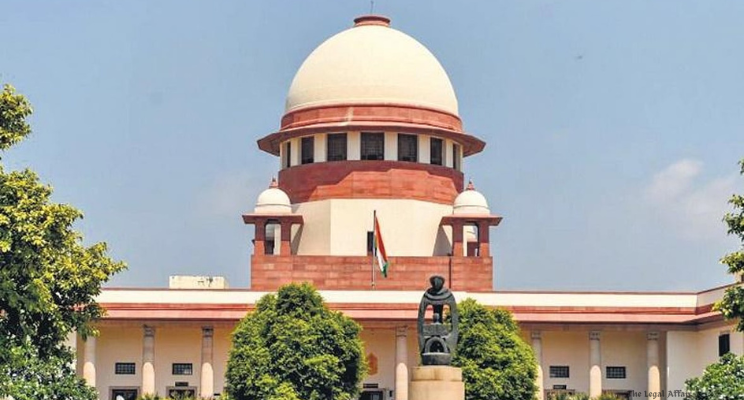
Introduction:
In The Kerala Water Authority & Ors. v. T I Raju & Ors., 2026 LiveLaw (SC) 172, the Supreme Court of India has reiterated a significant principle governing contractual disputes—where a contract expressly prohibits payment of interest on delayed payments, courts cannot award such interest by invoking general statutory provisions.
The dispute arose out of a works contract executed in April 2013 between the Kerala Water Authority and the respondent-contractor, T.I. Raju, for construction of a sewage treatment plant at the Government Medical College, Calicut. The work was completed in July 2014. However, the admitted principal amount of ₹86.64 lakh was released only in March 2016, after the contractor approached the High Court by way of a writ petition seeking release of payment.
Following receipt of the principal amount, the contractor instituted a civil suit claiming interest at 14% per annum on account of the delay in payment. The trial court decreed the suit in his favour. On appeal, the Kerala High Court reduced the interest rate to 9% per annum but upheld the entitlement to interest. Aggrieved by this finding, the Kerala Water Authority approached the Supreme Court, contending that the contract itself contained an explicit clause barring any claim for interest on delayed payments.
The central question before the Supreme Court was whether, in the face of an express contractual prohibition, a court could award interest under Section 3(1) of the Interest Act, 1978 or by invoking Section 34 of the Code of Civil Procedure, 1908.
Arguments on Behalf of the Petitioners (Kerala Water Authority):
On behalf of the Kerala Water Authority, it was argued that the High Court had committed a manifest error in overlooking the explicit terms of the contract. The relevant clause stipulated that payment of bills would be subject to availability of funds and seniority of bills and that “no claims or interest for damages whatsoever shall be made for the belated settlement of claims.”
The petitioners contended that this clause was unequivocal and binding. The contractor, having entered into the contract with open eyes and having accepted its terms, could not subsequently resile from the contractual arrangement and seek interest contrary to the agreement.
It was further submitted that the High Court wrongly invoked Section 3(1) of the Interest Act, 1978, without considering Section 3(3) of the same statute. Section 3(1) empowers a court to award interest in certain cases where a debt or sum certain is payable. However, Section 3(3) specifically bars the grant of interest where payment of interest is “barred by virtue of an express agreement.”
According to the petitioners, once there exists a contractual prohibition, Section 3(1) becomes inapplicable by virtue of Section 3(3). The statutory scheme does not override a mutually agreed contractual exclusion.
The petitioners also argued that Section 34 of the Code of Civil Procedure does not create a substantive right to interest. It merely enables a court to determine the rate of interest once the entitlement to interest is otherwise established. Therefore, Section 34 cannot be invoked to circumvent a contractual bar.
Emphasising the principle of sanctity of contract, the petitioners maintained that courts must enforce contractual terms as agreed between the parties, especially in commercial matters. To hold otherwise would undermine certainty in contractual relationships and impose liabilities never contemplated by the parties.
The Kerala Water Authority further submitted that the delay in payment was not arbitrary but was subject to availability of funds and internal administrative processes, as clearly envisaged under the contract. Hence, the contractor was always aware that payments might be deferred and had expressly waived any claim to interest arising from such delay.
Accordingly, it was prayed that the judgment of the High Court be set aside to the extent it awarded interest.
Arguments on Behalf of the Respondents (Contractor):
The respondent-contractor contended that the delay of nearly two years in releasing the admitted amount was unjustified and caused financial hardship. It was argued that once the principal amount was admitted and payable, withholding it for an extended period warranted compensation in the form of interest.
The respondent relied heavily on Section 3(1) of the Interest Act, 1978, which empowers courts to award interest on debts or sums certain payable by virtue of a written instrument. It was argued that the provision was designed to ensure fairness and to compensate parties deprived of legitimate dues.
The respondent further contended that contractual clauses barring interest should not be interpreted in a manner that enables arbitrary or unreasonable delay in payment. Such clauses, it was argued, cannot operate as a licence for public authorities to indefinitely withhold admitted amounts.
Additionally, reliance was placed on Section 34 of the Code of Civil Procedure to contend that courts possess discretion to award interest in order to do complete justice between the parties.
The respondent also sought to justify the High Court’s reasoning by submitting that the Interest Act is a beneficial legislation meant to fill gaps where parties suffer due to delayed payments. It was urged that the clause in the contract did not oust the jurisdiction of courts to award reasonable interest, particularly where the delay was substantial and unexplained.
On this basis, the respondent prayed for dismissal of the appeal.
The Supreme Court’s Judgment:
The Supreme Court, speaking through a Bench comprising Justice M.M. Sundresh and Justice N. Kotiswar Singh, allowed the appeal and set aside the award of interest granted by the High Court.
At the outset, the Court examined the contractual clause in question and noted that it was explicit and categorical. The clause clearly provided that payments would be subject to availability of funds and seniority of bills and that no claim or interest for damages whatsoever shall be made for belated settlement of claims.
The Court held that such a clause leaves no room for ambiguity. The parties, being bound by their contractual commitments, cannot seek to rewrite the terms through judicial intervention.
Turning to the Interest Act, 1978, the Court emphasised the significance of Section 3(3). While Section 3(1) empowers courts to grant interest in certain situations, Section 3(3) expressly prohibits such grant where payment of interest is barred by an agreement.
The Court observed:
“The object of the Interest Act, 1978 is to mandate the payment of interest to the parties in the absence of, or any vacuum in the agreement, or where the interest so fixed is contrary to law, being in the nature of an exorbitant charge.”
Thus, the Act operates only in situations where the contract is silent or where there is a vacuum. It cannot override an express contractual prohibition. The High Court, according to the Supreme Court, had erred in ignoring this limitation and mechanically applying Section 3(1).
The Bench clarified that statutory provisions like the Interest Act are meant to supplement contracts, not supplant them. Where parties have consciously agreed to exclude interest on delayed payments, courts must respect such exclusion unless it violates law or public policy.
The Court also addressed the reliance placed on Section 34 of the Code of Civil Procedure. It categorically held that Section 34 deals with the rate of interest once entitlement is established. It does not confer a substantive right to claim interest. Therefore, in the absence of entitlement due to a contractual bar, Section 34 cannot be invoked to create such a right.
In reinforcing the principle of contractual autonomy, the Court underscored that commercial contracts entered into by parties must be honoured in their entirety. Judicial interference is unwarranted when the terms are clear and unambiguous.
Consequently, the Supreme Court set aside the High Court’s judgment awarding interest and allowed the appeal filed by the Kerala Water Authority.