


Introduction:
The Supreme Court of India, in Yashovardhan Azan and Others v. Union of India and Others and connected cases, has exercised its extraordinary powers under Article 142 of the Constitution to bring an end to criminal proceedings arising from student protests held between July 20 and July 25 across the country. A Bench comprising Chief Justice of India Surya Kant, Justice Joymalya Bagchi and Justice V. Mohana directed that FIRs registered anywhere in India in connection with the specified student protests during this period shall not be pursued or investigated and shall be treated as closed for all purposes.
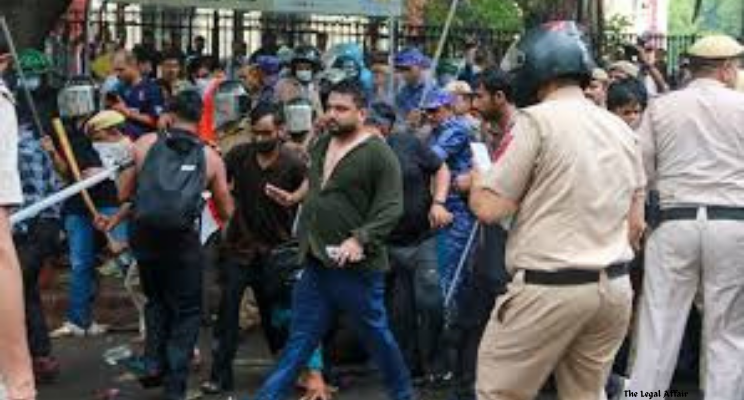
The proceedings arose against the backdrop of widespread student protests following the cancellation of the NEET-UG 2026 examination. The protests resulted in the registration of criminal cases in several States and Union Territories. While applications seeking quashing of the FIRs were filed by the Centre, represented through the Delhi Police, as well as the Governments of Bihar, West Bengal, Maharashtra and Assam, the Supreme Court extended the benefit of its order to similarly situated cases throughout the country.
The controversy before the Court involved not merely the question of whether individual FIRs could be withdrawn, but also the larger issue of how criminal proceedings arising out of bona fide student protests should be dealt with once the Government had assured the protesters that such cases would be withdrawn. The Solicitor General of India, Tushar Mehta, informed the Court that the applications had been filed pursuant to assurances given by the Central Government to the leaders of the Cockroach Janata Party on July 25. According to the Centre, the Government had undertaken that cases registered against the student protesters would be withdrawn and that no fresh FIR would be registered in relation to the same protest incidents.
A legal difficulty, however, arose because an FIR, once registered, cannot ordinarily be erased merely through an executive direction. Criminal procedure contemplates investigation and, depending on the circumstances, submission of a closure report before the competent Magistrate. The Magistrate is not necessarily bound to accept such a report. The Supreme Court had therefore been asked to determine how the Government’s assurance could be translated into an effective legal remedy.
During an earlier hearing on August 18, the Bench had indicated its inclination to exercise its constitutional powers under Article 142. The Court was conscious that the ordinary criminal process could create practical and legal hurdles in giving effect to the Government’s assurance. At the same time, the Court was required to distinguish genuine student protesters from persons who may have exploited the protests to commit serious criminal offences.
The Centre accordingly placed before the Court a distinction between ordinary protesters and 2,873 persons whose criminal antecedents were allegedly grave. The latter category included persons facing allegations involving offences such as murder, rape and abduction. The Government submitted that proceedings against bona fide student protesters could be brought to an end, while serious criminal cases involving persons with substantial criminal antecedents should not be permitted to disappear merely because they had participated in a protest.
The Supreme Court ultimately adopted a balanced approach. It granted broad protection to the students by directing the closure of FIRs arising from the protests between July 20 and July 25, while permitting the Delhi Police to continue one specified FIR concerning 2,873 individuals with serious criminal antecedents. It further restrained all States and Union Territories from registering fresh FIRs in relation to incidents connected with the protests during the relevant period.
The decision is significant because it demonstrates the Supreme Court’s willingness to use Article 142 where the ordinary legal mechanism may be inadequate to achieve complete justice in the peculiar circumstances of a case. At the same time, the Court expressly clarified that its directions were based on the peculiar facts and circumstances before it and would not operate as a precedent.
The proceedings also acquired an additional dimension concerning compensation to families of students who died by suicide following the cancellation of NEET-UG 2026. The Solicitor General informed the Court that the Central Government would formulate a policy for providing compensation to such families within three months. The Court recorded this assurance.
The development also resulted in the withdrawal of a proposed protest march in Delhi. Saurav Das, Co-Convener and spokesperson of the Cockroach Janata Party, who was present before the Court, stated that the organisation had decided to withdraw its September 5 protest in view of the assurances given by the Government and the judicial sanctity attached to them through the Supreme Court’s order.
Thus, the case represents an unusual intersection of constitutional powers, criminal procedure, student protests, governmental assurances and the protection of young persons from the potentially lasting consequences of criminal prosecution.
Arguments of the Parties:
The submissions before the Supreme Court centred substantially on the Government’s commitment to withdraw criminal cases against student protesters and the practical difficulties involved in implementing that commitment through the ordinary criminal process. The Solicitor General, appearing for the Union of India, explained that the applications seeking quashing of the FIRs had been filed pursuant to assurances given by the Central Government to the representatives of the Cockroach Janata Party on July 25.
The Union Government maintained that it was committed to honouring the assurances made to the protesting students. According to the Solicitor General, the Government had agreed that criminal cases registered against protesters in connection with the relevant demonstrations would be withdrawn and that no future FIR would be registered in relation to those incidents. The applications filed before the Court were therefore presented as an attempt to give legal effect to that commitment.
At the same time, the Centre did not seek an indiscriminate termination of every criminal proceeding involving every person who had been present during the protests. The Solicitor General drew the Court’s attention to 2,873 individuals whose antecedents, according to the Government, involved grave offences. The Government’s position was that persons accused or involved in serious criminal conduct could not automatically receive immunity merely because the alleged offences arose in the context of a larger student protest.
The distinction advanced by the Union was therefore between bona fide student protesters and persons whom the Government characterised as anti-social elements who had infiltrated the demonstrations. The Solicitor General had previously submitted before the Court that FIRs against genuine student protesters should be quashed, while persons involved in serious offences should remain subject to investigation and prosecution.
This distinction was important from the standpoint of criminal justice. A blanket direction terminating every case could potentially prevent the investigation of offences wholly unrelated to peaceful participation in a protest. The Government therefore sought to preserve the investigative process in relation to individuals against whom allegations of grave criminality existed.
The Centre also addressed the issue of compensation to families of students who had died by suicide following the cancellation of the NEET-UG 2026 examination. The Solicitor General stated that the Government was committed to the assurance concerning compensation but required three months to formulate the modalities and policy framework. The Government’s submission was that it was already acting upon the assurances given to the protesters and that sufficient time should be granted to work out the details of the compensation mechanism.
The petitioners and protest representatives, on the other hand, sought effective implementation of the assurances relating to the withdrawal of criminal cases. The larger concern was that students who had participated in the protests should not be compelled to undergo criminal investigation and proceedings for acts arising from their participation in the demonstrations.
The issue assumed particular importance because an FIR, once registered, does not ordinarily cease to exist simply because the executive government subsequently decides that it should not be pursued. The ordinary procedure would require the investigating agency to complete the investigation and submit an appropriate report before the Magistrate. The Magistrate would then have the authority to accept or reject the closure report. Consequently, an executive assurance to withdraw cases could encounter procedural obstacles.
It was against this backdrop that the Supreme Court’s intervention under Article 142 became significant. The petitioners effectively required a solution that would provide finality rather than merely directing the authorities to commence a process that could potentially result in prolonged litigation.
The protest representatives also responded to the Government’s assurance concerning compensation. Saurav Das, Co-Convener of the Cockroach Janata Party, made a statement before the Bench that the organisation would withdraw its proposed September 5 protest march in Delhi. He stated that the decision was being taken in light of the Government’s assurances, the judicial recognition given to those assurances, and the directions being issued by the Supreme Court.
The State Governments that had approached the Court, including Bihar, West Bengal, Maharashtra and Assam, sought quashing of the FIRs identified in their respective applications. The fact that these States had separately approached the Supreme Court demonstrated that the issue was not confined to one jurisdiction. However, the Court was ultimately confronted with a broader question: whether similarly placed students in States and Union Territories that had not independently approached the Court should also receive the benefit of the protection.
The Supreme Court answered that question affirmatively. Rather than restricting the relief to the applicants before it, the Bench considered the circumstances surrounding the protests and the future of students who had bona fide participated in them. The Court therefore extended the operation of its directions throughout the country.
The submissions thus presented two competing considerations. On one side was the need to honour governmental assurances and protect students from the continuing consequences of criminal proceedings arising from protests. On the other was the State’s obligation to investigate serious criminal conduct and ensure that individuals accused of grave offences did not obtain an unintended immunity merely by associating themselves with student demonstrations.
The Court’s eventual order sought to reconcile these competing considerations by granting comprehensive relief to bona fide protesters while preserving the investigation of the specifically identified persons with serious criminal antecedents.
Court’s Judgment:
The Supreme Court exercised its extraordinary jurisdiction under Article 142 of the Constitution and directed that FIRs registered anywhere in India in relation to student protest incidents occurring between July 20 and July 25 should not be pursued or investigated. Such FIRs were directed to be treated as closed for all intents and purposes.
The significance of the direction lies in its nationwide application. Although the applications placed before the Court were filed by the Centre, through the Delhi Police, and by the Governments of Bihar, West Bengal, Maharashtra and Assam, the Bench did not confine the relief to those particular jurisdictions. Instead, it extended the benefit of the order to all States and Union Territories.
The Court also imposed a prospective safeguard. It directed that no State or Union Territory should register any fresh FIR concerning protest incidents falling within the July 20 to July 25 period. This ensured that the relief granted by the Court could not be undermined by subsequent registration of new criminal cases relating to the same incidents.
The Bench’s decision was substantially influenced by its concern for the future of students who had participated in the protests bona fide. Criminal proceedings can have consequences extending far beyond the immediate investigation. For students, an FIR and the prospect of prosecution can affect education, employment opportunities and social standing. The Court therefore considered it appropriate, in the peculiar circumstances before it, to bring the proceedings to a definitive conclusion rather than leave students to navigate potentially prolonged criminal proceedings.
Article 142 played a central role in the judgment. The provision empowers the Supreme Court to pass such decree or make such order as is necessary for doing complete justice in any cause or matter pending before it. The Court’s invocation of this power was particularly relevant because the ordinary criminal process presented difficulties in giving immediate effect to the Government’s assurance.
The Court had earlier been informed that once an FIR is registered, it cannot simply be withdrawn through an administrative direction. The investigating agency ordinarily has to follow the statutory procedure and submit a closure report before the competent Magistrate. The Magistrate, in turn, has discretion regarding whether to accept the report. Consequently, directing the Government merely to “withdraw” the FIRs could leave the students exposed to continuing uncertainty.
By invoking Article 142, the Supreme Court was able to provide a direct and final resolution. The Court’s approach avoided requiring thousands of students to individually approach different High Courts or criminal courts seeking termination of proceedings arising from the same set of protest events.
However, the Court did not extend an unrestricted immunity to every person connected with the protests. It specifically permitted the Delhi Police to pursue one FIR concerning 2,873 individuals who were stated to have serious criminal antecedents. The allegations against persons in this category included grave offences such as murder, rape and abduction.
This exception reflects an important principle underlying the Court’s approach. The right to protest, even when constitutionally protected, does not provide immunity for serious criminal conduct. Participation in a protest cannot become a shield against investigation into grave offences merely because those offences occurred in the broader environment of a demonstration.
The Court therefore adopted a distinction between bona fide student protesters and persons whose involvement raised substantially different criminal concerns. The former category received the benefit of the nationwide closure direction, whereas the latter category remained subject to the criminal process.
The Court’s order also demonstrates the importance of proportionality in exercising constitutional powers. Rather than choosing between complete immunity and complete prosecution, the Bench crafted a solution that protected students while preserving the State’s ability to investigate serious criminality.
Another important aspect of the judgment is the Court’s express clarification that the order would not constitute a precedent. The Bench stated that the directions were being issued because of the peculiar facts and circumstances of the case. This qualification is significant because Article 142 is an extraordinary constitutional power and cannot ordinarily be treated as a substitute for statutory criminal procedure.
The clarification prevents the order from being mechanically relied upon in unrelated cases to argue that FIRs arising from protests must invariably be quashed. Future cases will continue to be decided on their own facts, applicable statutory provisions and constitutional principles. The present order is therefore best understood as an exceptional exercise of constitutional power designed to achieve complete justice in a specific factual setting.
The Court also recorded the Solicitor General’s statement concerning compensation for families of students who died by suicide following the cancellation of NEET-UG 2026. The Union Government undertook to formulate a policy for providing compensation within three months. The Court recorded the assurance as part of the proceedings.
The compensation issue added a humanitarian dimension to the litigation. The dispute was not limited to criminal proceedings against protesters but was also connected with the consequences of the examination cancellation and the distress experienced by affected students and their families. By recording the Government’s assurance, the Court ensured that the commitment was placed on the judicial record.
The Court further recorded the statement of Saurav Das that the September 5 protest march announced by the Cockroach Janata Party had been withdrawn. Das stated that the organisation was taking this step in view of the Government’s assurances and the judicial sanctity attached to them by the Supreme Court’s order.
The sequence of events illustrates the role of constitutional adjudication in resolving disputes that extend beyond strictly adversarial litigation. The Court’s intervention resulted not only in the closure of criminal proceedings but also in the formalisation of governmental assurances and the withdrawal of a proposed future protest.
The judgment also reinforces the principle that constitutional remedies may be shaped according to the circumstances of a particular case. Article 142 allows the Supreme Court to move beyond the limitations of ordinary procedural mechanisms where doing so is necessary to secure complete justice. Yet the Court’s own caution that the order is fact-specific ensures that such extraordinary intervention remains exceptional.
The final result was therefore a carefully calibrated order. FIRs relating to student protest incidents between July 20 and July 25 were directed to be closed throughout India; no fresh FIRs concerning those incidents could be registered by any State or Union Territory; the FIRs specifically identified in the applications of the Centre, Bihar, West Bengal, Maharashtra and Assam were quashed; and the Delhi Police was permitted to proceed against the 2,873 individuals identified as having serious criminal antecedents.
The order provides immediate relief to students who participated in the protests bona fide and prevents them from being subjected to prolonged criminal proceedings over the specified incidents. At the same time, it preserves the criminal justice process for individuals against whom allegations of serious criminality exist.
Ultimately, the decision in Yashovardhan Azan and Others v. Union of India and Others represents an exceptional exercise of the Supreme Court’s constitutional jurisdiction. It reflects the Court’s attempt to balance the importance of student participation in public protests with the State’s legitimate interest in investigating grave offences. More importantly, it shows how Article 142 can be employed to overcome procedural obstacles and provide a final remedy where ordinary legal mechanisms may not adequately address the circumstances before the Court.
The decision is therefore significant not merely for the immediate relief granted to thousands of students, but also for he broader constitutional conversation surrounding