


Introduction:
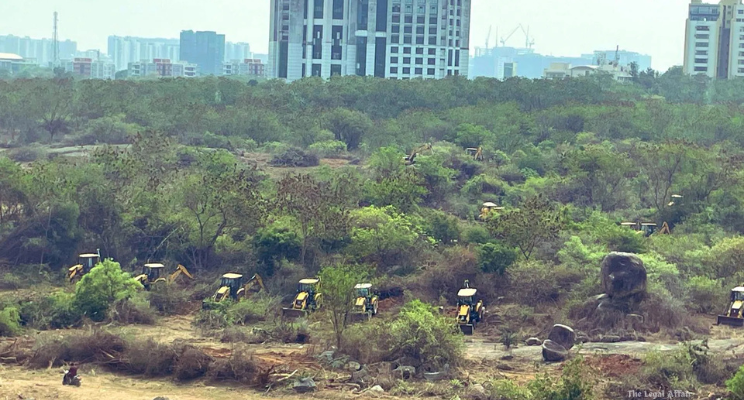
In the matter of SMW(C) No. 3/2025 and connected cases, the Supreme Court of India addressed the large-scale deforestation in the Kancha Gachibowli area of Telangana. The bench, comprising Justices B.R. Gavai and A.G. Masih, emphasised the restoration of the status quo and immediate protection of wildlife affected by deforestation. The State of Telangana, represented by Senior Advocate Dr. Abhishek Manu Singhvi, acknowledged the voluminous nature of the latest CEC report and requested time to respond. The Court granted four weeks for the state to file its reply and directed the Wildlife Warden to undertake immediate steps to safeguard the affected wildlife.
Arguments:
Petitioners’ Arguments:
The petitioners contended that the Telangana government’s actions violated the Supreme Court’s 1996 judgment in T.N. Godavarman Thirumulpad v. Union of India, which defined ‘forest’ based on its dictionary meaning, irrespective of official classification. They highlighted that the land in question, despite being labelled as ‘industrial land’, possessed significant forest characteristics and biodiversity. The petitioners also pointed out the absence of requisite environmental clearances and permissions for tree felling, emphasising that the activities commenced during a holiday period, raising concerns about transparency and urgency.
State of Telangana’s Defence:
Represented by Senior Advocate Dr. Abhishek Manu Singhvi, the State of Telangana argued that development activities had been halted and any errors were unintentional. The state claimed that permissions were obtained for most of the tree felling, with a small number exempted under self-certification as per the WALTA Act/Rules. The defence maintained that the land was designated for industrial use and that the actions were in line with state regulations.
Court’s Judgment:
The Supreme Court expressed serious concerns over the state’s actions, questioning the legality of self-certification and the urgency of the deforestation activities. Justice Gavai emphasised that no further tree felling should occur and warned of potential consequences for non-compliance, including holding the Chief Secretary personally liable. The Court directed the Wildlife Warden to implement immediate measures to protect displaced wildlife and called for a comprehensive plan to restore the lost forest cover. The bench underscored the importance of adhering to environmental laws and prior judgments, stating that any enactment conflicting with the 1996 ruling would not be tolerated. The matter was posted for further hearing on May 15.