


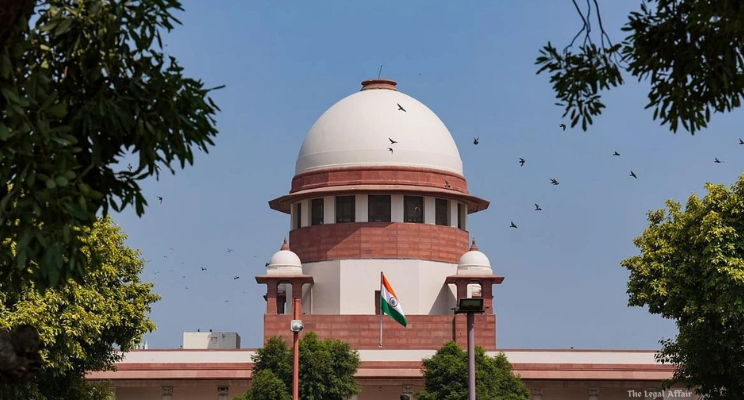
Introduction:
The Supreme Court of India recently extended the stay on the recovery of Rs 2.66 crores from the Uttar Pradesh Congress Committee (UPCC) in a case dating back to 1981-1989. This amount is reportedly owed to the Uttar Pradesh State Road Transport Corporation (UPSRTC) for the use of its buses and taxis by the Congress Party for political purposes during a period when the party was in power in the state.
The legal battle has its roots in the early 1980s, a time when the Congress Party held a dominant political position in Uttar Pradesh. The controversy involves the provision of public transportation services to the UPCC on the instructions of the then Chief Minister and other high-ranking ministers, all affiliated with the Congress Party. The UPSRTC claimed that it had provided these services under governmental directives, with bills regularly issued for payment. However, these bills allegedly remained unpaid for decades.
Arguments from Both Sides:
Arguments by the State of Uttar Pradesh:
The State of Uttar Pradesh, through the UPSRTC, has maintained that the UPCC utilized public transportation services extensively between 1981 and 1989 without making the required payments. According to the State’s submission, the UPCC owes Rs 2.66 crores for the services provided, which include the use of buses and taxis for political purposes.
The State argued that, following governmental directives, the UPSRTC provided the necessary vehicles to the UPCC, with bills regularly raised during that period. Despite repeated reminders, the Congress Party allegedly did not clear these dues. As a result, the State initiated recovery proceedings in 1998 under the Uttar Pradesh Public Moneys (Recovery of Dues) Act, 1972.
Furthermore, during the Supreme Court hearing, the counsel representing the State pointed out that although efforts were made to arbitrate the matter, gathering evidence from over three decades ago has proven exceedingly difficult. Despite this, the State defended its position, emphasizing the importance of recovering the dues owed to the public exchequer.
Arguments by the Uttar Pradesh Congress Committee (UPCC):
On the other hand, the UPCC has strongly contested the claims made by the UPSRTC and the State of Uttar Pradesh. The Congress Party, represented by Senior Advocate Salman Khurshid, argued that the State’s actions in determining the dues were highly questionable. According to the UPCC, the State assumed the roles of claimant, prosecutor, and judge in this case, unilaterally determining the amount owed without proper arbitration or independent assessment.
The UPCC also questioned the State’s decision to revive the recovery proceedings after more than two decades. The Party argued that if the State itself admits difficulty in gathering evidence after such a long time, then it should not be justified in imposing the dues. The UPCC viewed the recovery proceedings as politically motivated and unjust, further challenging the calculations and the interest levied on the amount.
Moreover, the UPCC submitted a Special Leave Petition (SLP) before the Supreme Court, seeking relief from the judgment of the Allahabad High Court. The High Court had previously ordered the UPCC to pay the outstanding amount with an additional 5% interest from the due date within three months. The UPCC sought the Supreme Court’s intervention, arguing that an independent arbitrator should be appointed to ascertain the actual liability, if any, rather than enforcing a possibly exaggerated and outdated claim.
Court’s Judgement:
The Supreme Court, while hearing the SLP filed by the UPCC, extended the stay on the recovery proceedings, thereby providing temporary relief to the Congress Party. The Bench, comprising Justices Surya Kant and KV Viswanathan, took note of the concerns raised by the UPCC regarding the fairness of the recovery process. The Court expressed skepticism over the State’s unilateral determination of dues, highlighting the problematic nature of the State acting as “claimant, prosecutor, and judge.”
Justice Surya Kant, addressing the State’s counsel, emphasized that if the State itself admits to difficulties in revisiting the old records and evidence, it raises questions about the legitimacy of imposing such a substantial financial liability on the UPCC. The Bench indicated a willingness to either quash the entire recovery process or settle the matter if the UPCC agrees to pay Rs 1 crore, a figure far less than the original amount claimed by the UPSRTC.
The Supreme Court also recognized the potential implications of the case on political dynamics, with Justice Kant humorously remarking that it would be a “reverse situation” where a political party would be making a donation to a public corporation. However, despite these observations, the Court refrained from issuing a final order, instead listing the matter for further consideration on a non-miscellaneous day, allowing the stay on recovery to continue in the interim.
The Bench’s approach appeared to favor resolving the matter amicably, potentially through an arbitrated settlement, rather than allowing the recovery proceedings to drag on indefinitely. This indicates a preference for a resolution that acknowledges the complexities of the case while also addressing the long-standing dues owed to the UPSRTC.
The Allahabad High Court had previously ruled in favor of the UPSRTC, directing the UPCC to clear the dues with interest. The High Court’s judgment was based on the premise that the Congress Party, then in power, had used public resources for its political activities and should therefore be held accountable for the costs incurred. The Court noted that the amount was recoverable under the provisions of the Uttar Pradesh Public Moneys (Recovery of Dues) Act, 1972. However, given the extended period of non-payment, the Court deemed it appropriate to enforce the payment along with interest, even though the original recovery proceedings had been stayed since 1998.
The High Court’s decision had put the UPCC in a difficult position, prompting the party to seek relief from the Supreme Court. The UPCC’s SLP argued that the High Court’s ruling was unfair and that the amount claimed by the UPSRTC was not accurately determined.