


Introduction:
The Supreme Court of India recently addressed a significant matter surrounding the use of images and campaign material involving prominent political figures of the Nationalist Congress Party (NCP) amid an ongoing family and political feud. The Court’s focus was on preventing confusion among voters by ensuring that both factions operate with clear distinctions in identity, with particular emphasis on the use of images and symbols in campaign materials. This case reflects the court’s vigilance in upholding electoral transparency and protecting political identities, particularly when factions or schisms within parties arise.
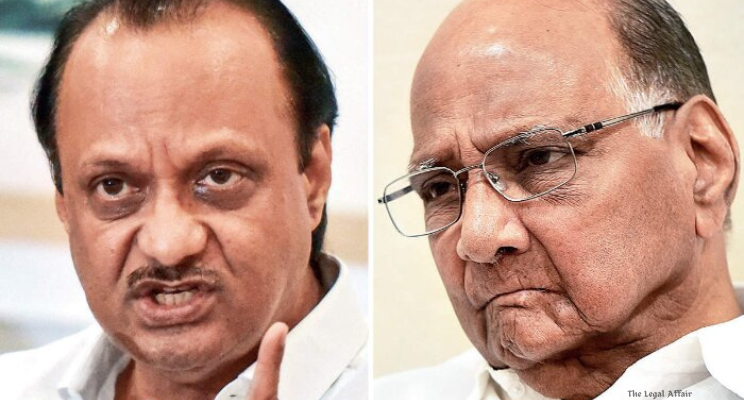
Following a contentious division within the NCP, the Ajit Pawar faction had secured official recognition from the Election Commission of India (ECI) to use the party’s original clock symbol, while the Sharad Pawar-led group was assigned a new symbol. However, disputes arose over the alleged use of Sharad Pawar’s image by the Ajit Pawar faction in campaign materials. These developments led to a formal appeal by the Sharad Pawar group to the Supreme Court, which subsequently examined the appropriateness of using the senior Pawar’s image as a potential influence over voters and a possible means to “piggyback” on his legacy.
Arguments Presented by Sharad Pawar’s Side:
Represented by Senior Advocate Abhishek Manu Singhvi, the Sharad Pawar faction argued that the Ajit Pawar faction’s use of Sharad Pawar’s image in campaign posters and social media posts violated the Supreme Court’s earlier directions. Singhvi presented materials showing Ajit Pawar faction members, such as candidate Amol Mitkari, allegedly using photos and videos of Sharad Pawar in campaign material, implying a false continuity or endorsement. The Sharad Pawar faction argued that these tactics were designed to exploit the goodwill and public image of Sharad Pawar, potentially misleading voters into believing there was no fundamental schism within the party.
Singhvi contended that the Ajit Pawar faction was deliberately creating the perception that both factions were unified, leading voters to assume that a vote for the Ajit Pawar side would align with the interests of the senior Pawar. He further noted that such implications are misleading and disrespectful to the court’s previous ruling, which mandated both factions to maintain separate identities and avoid using each other’s symbols or associated figures. In support of these arguments, Singhvi highlighted instances in which Ajit Pawar’s side purportedly used the clock symbol without explicit disclaimers about the division, contradicting court guidelines on the need for public clarity regarding factional distinction.
Counter-arguments by Ajit Pawar’s Sid:
Representing the Ajit Pawar faction, Senior Advocate Balbir Singh refuted these allegations, asserting that the alleged images and videos were manipulated or “doctored” by third parties and did not originate from his clients’ official channels. Singh argued that the Ajit Pawar group had no intention of using the images in question and that the materials being shown were likely circulated by unknown sources, thus disclaiming direct involvement. He maintained that the Ajit Pawar faction respects the Supreme Court’s order and reiterated that any materials shared in breach of this were unintended or altered by individuals outside of his clients’ control.
Additionally, Singh raised concerns about the potential for AI-based “deep fake” videos or manipulated images, which he claimed could have been used to create misleading impressions. He underscored the rapid advancements in technology and the potential for individuals or opposing groups to digitally alter content, thereby creating confusion around the Ajit Pawar faction’s campaign approach. Balbir Singh further argued that the voters in Maharashtra, especially in rural areas, are well-aware of the division and are unlikely to be swayed by social media content. He argued that Singhvi’s evidence did not directly connect the Ajit Pawar faction to the images of Sharad Pawar that were shown in court.
Court’s Judgement:
The Supreme Court bench, consisting of Justices Surya Kant and Ujjal Bhuyan, emphasized the need for both sides to uphold clarity and respect the principle of transparent electoral campaigns. Justice Kant questioned whether the Ajit Pawar faction, despite representing a political split, should utilize materials that may blur lines between the factions, potentially confusing voters about which faction represents the legacy of Sharad Pawar. Observing that public clarity was essential, Justice Kant remarked that it was essential for both sides to respect each other’s ideological differences and separate identities in campaign efforts.
The Court issued a clear direction to the Ajit Pawar faction to cease using any materials containing Sharad Pawar’s image or likeness. This move was aimed at preventing any misleading implications that could arise from the use of the senior leader’s image by Ajit Pawar’s supporters. The Court reinforced that the Ajit Pawar faction was obliged to “stand on its own legs” in campaigning, without leveraging Sharad Pawar’s legacy or persona to attract votes. Emphasizing that the orders were not arbitrary, Justice Kant stated that all factions and candidates were expected to strictly adhere to the Court’s directive, refraining from any portrayal that could potentially violate previous judicial instructions.
In addition, the Court acknowledged Singhvi’s concerns regarding AI-based manipulations and recognized the potential for misuse of images and videos. However, Justice Kant noted that any deviation from the instructions on either side would be seen as a lack of compliance and would face legal consequences. He encouraged the Ajit Pawar faction to communicate these directives clearly to party members and candidates to prevent unauthorized usage of the senior leader’s image in any form.
The Court also issued further guidance, stressing that all candidates representing Ajit Pawar’s NCP faction must instruct their teams to avoid the use of Sharad Pawar’s photos in all campaign materials. Justice Kant’s comments underscored that “India’s voters are informed and aware,” yet it was the responsibility of the candidates and the party apparatus to ensure their campaigns upheld these standards. In a final remark, Justice Kant alluded to the notion that any breach of orders, deliberate or accidental, could lead to contempt of court proceedings, highlighting the gravity of judicial compliance.
Conclusion:
The Supreme Court’s direction to the Ajit Pawar faction in this case underscores the importance of maintaining clear and distinct political identities, especially during electoral campaigns where factional disputes can cause confusion among voters. By instructing Ajit Pawar’s side to abstain from using Sharad Pawar’s image, the Court reinforced the significance of electoral integrity and transparency. This ruling establishes a strong precedent for factions emerging from party splits, emphasizing their obligation to communicate their distinct positions without leveraging the reputation or image of former allies.
In an age of rapid technological advancement, the ruling also highlights judicial awareness of issues like AI-driven “deep fakes” and doctored images that can impact public perception. Ultimately, the Court’s directive calls for strict compliance, ensuring that political factions engage in honest, independent campaigns, underscoring the judiciary’s role in upholding fair electoral practices.