


Introduction:
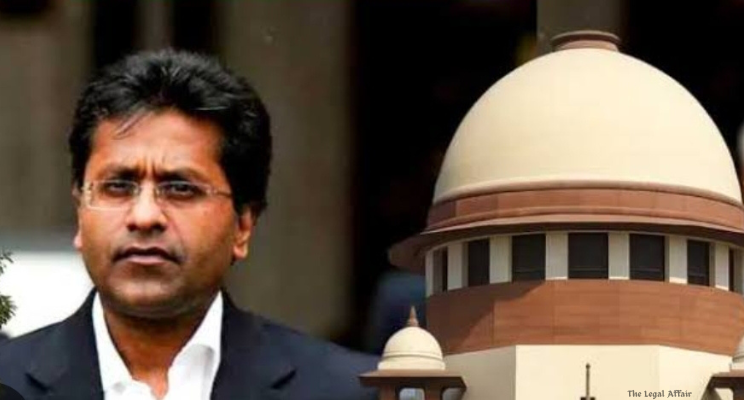
In the high-stakes legal battle titled Lalit Kumar Modi versus Board of Control for Cricket in India and Others, Diary No. 14199-2025, the Supreme Court of India on June 30, 2025, declined to entertain a writ petition filed by former Indian Premier League (IPL) Chairman Lalit Kumar Modi.
Arguments:
Modi had approached the apex court challenging the Bombay High Court’s December 2024 decision that dismissed his plea seeking indemnification from the Board of Control for Cricket in India (BCCI) for a ₹10.65 crore penalty imposed on him by the Enforcement Directorate (ED) under the Foreign Exchange Management Act (FEMA) for alleged financial irregularities committed during the 2009 IPL season in South Africa. Modi’s petition contended that under Rule 34 of the BCCI Constitution, he was entitled to indemnification since the penalties arose from his actions in his official capacity as IPL Chairman, a post he claimed he held on behalf of BCCI. He argued that the BCCI had indemnified other former officials in similar circumstances and that denying him indemnification violated principles of equity.
The BCCI, on the other hand, opposed the writ petition on the ground that it is a private body not amenable to writ jurisdiction under Article 226 of the Constitution, relying on the Supreme Court’s seminal decision in Zee Telefilms Ltd. & Anr. v. Union of India & Ors., 2005 4 SCC 649, where it was held that the BCCI does not qualify as “State” under Article 12.
Judgement:
The Supreme Court bench comprising Justices PS Narasimha and R Mahadevan observed at the outset that BCCI’s private character shields it from writ jurisdiction, except when performing limited public duties like organizing cricket tournaments, which were not implicated in Modi’s indemnity claim. Conceding that his claim might not be maintainable as a writ, Modi’s counsel argued that Article 226 could still apply because the BCCI, while private, performs functions in the nature of public duties and cited precedents where courts had entertained writs against the BCCI in the context of selection processes and issues impacting the integrity of cricket administration. He highlighted that Modi’s actions were performed during official discharge of his duties as IPL Chairman, which should entitle him to indemnification under BCCI Rule 34. Further, Modi’s counsel pointed to the PMLA appellate proceedings involving other BCCI officials, including N. Srinivasan, where the BCCI was directed to deposit sums to protect its office-bearers, and argued that a similar approach should apply to the FEMA penalty against Modi. Counsel insisted that the BCCI’s refusal to extend the same protection to Modi, while extending it to others, was arbitrary and discriminatory, undermining principles of fair treatment and equal protection. The counsel maintained that while the BCCI may not be a “State” per se, it exercises quasi-public functions warranting judicial scrutiny under writ jurisdiction, particularly when it deals with liabilities incurred by officials in the course of performing their duties as part of an organization that governs a major sport with significant public interest. Conversely, counsel for the BCCI strenuously argued that the Bombay High Court rightly dismissed Modi’s petition, emphasizing that indemnification for a penalty imposed for financial irregularities falls outside the scope of public law remedies and squarely within the domain of private contractual disputes. The BCCI contended that Rule 34 of its Constitution does not create an absolute obligation to indemnify all actions by office-bearers but is limited to liabilities incurred in bona fide discharge of official duties, excluding liabilities arising from acts in violation of law such as FEMA contraventions. The BCCI counsel underscored that the High Court correctly relied on Zee Telefilms, holding that the BCCI is not State under Article 12 and that writs cannot be issued against it in purely private disputes. He further noted that the High Court had rightly pointed out that no element of public duty was involved in the indemnity claim since the penalty related to alleged violations of foreign exchange regulations for private commercial gain, unconnected with BCCI’s public functions like organizing cricket. The Supreme Court, after hearing detailed submissions, agreed with the High Court’s analysis that BCCI does not fall within the definition of State under Article 12 and therefore cannot be compelled by writ to indemnify Modi for the FEMA penalty. The bench observed that while the Supreme Court has entertained writs against the BCCI in cases involving broader issues of public interest like selection or doping, the present dispute over indemnification for personal penalties was not one involving discharge of public functions. The Court specifically noted that in matters where no public law element is present, the writ jurisdiction cannot be invoked merely because the BCCI is a powerful or influential private body. The bench further acknowledged Modi’s argument about other officials being indemnified but stressed that whether BCCI’s refusal was arbitrary or violated contractual obligations was a matter for adjudication in civil court rather than under Article 226. The Supreme Court thus recorded that Modi retains the right to pursue a civil suit against the BCCI to enforce any alleged contractual right to indemnification under Rule 34, but reiterated that a writ petition was not the appropriate legal route for such relief. The Court offered Modi the opportunity to withdraw the petition with liberty to pursue alternate civil remedies, and Modi’s counsel accepted, leading the Court to formally dismiss the writ petition as withdrawn, thereby closing the chapter on Modi’s attempt to use writ jurisdiction to secure indemnity for the ₹10.65 crore FEMA penalty. The ruling reinforces the legal position that private sports bodies like the BCCI, while sometimes performing public functions, cannot be subjected to writ jurisdiction under Article 226 for private contractual disputes, and affirms the principle laid down in Zee Telefilms that BCCI is not a State within the meaning of Article 12, except when specific public functions are involved.