


Introduction:
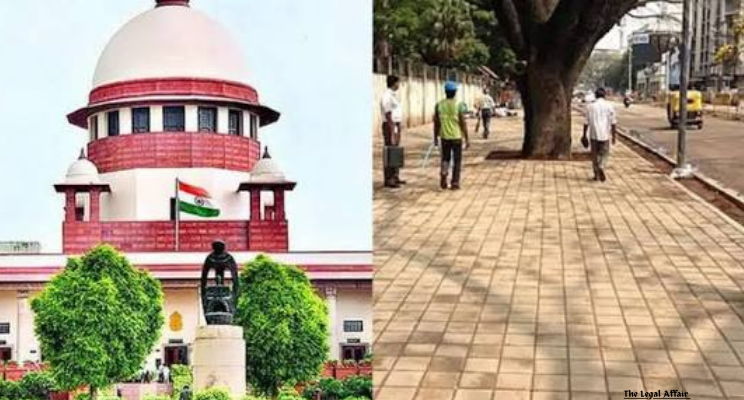
In a landmark judgment with far-reaching implications for urban governance, road safety, and constitutional rights, the Supreme Court of India has unequivocally recognized the right of pedestrians to walk on demarcated footpaths as a fundamental right protected under Articles 19(1)(d) and 21 of the Constitution of India. The Court further emphasized that the rights of pedestrians take precedence over the convenience of motorized vehicles and underscored the urgent necessity of creating a dedicated statutory framework to protect and enforce this right.
The judgment was delivered by a Bench comprising Justice P.S. Narasimha and Justice Atul S. Chandurkar in the case of Maniyar Iliyaz Shaik Riyaz v. P. Ayyappan (Civil Appeal Nos. 4665-4666 of 2025). Although the dispute initially arose from a claim for compensation under the Motor Vehicles Act following a tragic road accident, the Supreme Court expanded the scope of the proceedings to address larger constitutional concerns relating to pedestrian safety and the absence of adequate legal protections for individuals using footpaths.
The case concerned the death of a five-year-old child who lost his life after being struck by a tanker while walking to school with his father. The devastating incident raised critical questions regarding the safety of pedestrians, particularly children, and highlighted the broader issue of the State’s responsibility to provide secure and accessible walking infrastructure. The father of the deceased child sought compensation of ₹25,00,000 for the loss suffered by the family. However, the compensation awarded during the proceedings was substantially reduced to ₹4,70,000, prompting further legal challenge before the Supreme Court.
While considering the appeal concerning compensation, the Court examined the larger constitutional dimensions of pedestrian rights. The Bench observed that Indian cities and towns have increasingly become motor vehicle-centric, often disregarding the needs and rights of pedestrians. In many areas, footpaths are either absent, encroached upon, poorly maintained, or rendered inaccessible, forcing pedestrians to walk on roads alongside moving traffic. Such conditions significantly increase the risk of accidents and undermine the constitutional guarantee of safe movement.
The Court noted that although the Constitution guarantees freedom of movement and the right to life with dignity, there is currently no comprehensive legislation specifically recognizing and protecting the right to walk on footpaths. It therefore considered the matter not merely as a compensation dispute but as an opportunity to address a pressing constitutional and social issue affecting millions of citizens across the country.
Recognizing the broader public importance of the issue, the Supreme Court directed that the matter be renamed as “Re: Fundamental Right to Walk and Footpath” for the purpose of continued monitoring and policy consideration. The Court also directed that copies of the judgment be forwarded to various ministries and the Law Commission of India to facilitate the development of a statutory framework capable of protecting pedestrian rights in a meaningful and effective manner.
Arguments of the Parties:
The appellant, Maniyar Iliyaz Shaik Riyaz, approached the Court seeking enhanced compensation for the death of his young son. The appellant contended that the compensation awarded by the lower forums failed to adequately reflect the gravity of the loss suffered by the family. It was argued that the death of a child involves not only immediate emotional trauma but also the loss of future prospects and opportunities that the child would have contributed to the family and society.
The appellant emphasized that the accident occurred while the child was walking to school with his father, an ordinary and lawful activity that should not have exposed him to fatal danger. The circumstances surrounding the accident highlighted the vulnerability of pedestrians and demonstrated the serious consequences of inadequate pedestrian infrastructure and insufficient road safety measures.
It was further argued that public authorities have a responsibility to ensure that roads are designed and maintained in a manner that safeguards pedestrians. The appellant’s submissions effectively raised concerns regarding the broader systemic failures that contribute to pedestrian fatalities across the country. The case therefore transcended the issue of individual compensation and brought attention to the need for institutional reforms aimed at protecting vulnerable road users.
The respondent, including the vehicle owner and parties connected with the offending vehicle, opposed the claim for enhanced compensation. The respondents argued that the compensation already awarded was reasonable and consistent with the principles governing motor accident claims. They maintained that the assessment carried out by the lower forums was based on established legal standards and should not be disturbed.
The respondents further contended that motor accident compensation proceedings are governed by the provisions of the Motor Vehicles Act, 1988, and that the determination of compensation must remain within the framework prescribed by that legislation. According to them, broader policy considerations relating to pedestrian rights and infrastructure planning should not influence the assessment of compensation in a particular accident claim.
At the same time, the State authorities and public institutions involved in road management were drawn into the discussion due to the larger constitutional issues identified by the Court. The proceedings highlighted the absence of a dedicated legal framework governing pedestrian rights and the lack of clear accountability mechanisms for ensuring the safety and accessibility of footpaths.
The Court also examined the broader legislative context. It considered whether existing legal provisions adequately recognize the rights of pedestrians and whether the current statutory framework imposes sufficient obligations on governmental authorities responsible for urban planning, road construction, and transportation management.
These considerations transformed what began as a compensation dispute into an important constitutional inquiry regarding the relationship between infrastructure development, public safety, and fundamental rights.
Court’s Judgment:
The Supreme Court delivered a judgment that is likely to become a defining precedent in the field of pedestrian rights and urban mobility. While enhancing the compensation payable to the appellant, the Court also laid down significant constitutional principles concerning the status of footpaths and the rights of pedestrians.
At the outset, the Court observed that the right to walk is one of the most basic forms of human movement and is intrinsically connected to constitutional guarantees contained in Articles 19(1)(d) and 21 of the Constitution. Article 19(1)(d) guarantees every citizen the freedom to move freely throughout the territory of India, while Article 21 protects the right to life and personal liberty. According to the Court, these constitutional provisions necessarily include the right to move safely and with dignity.
The Bench emphasized that walking is not merely a mode of transportation but a fundamental human activity that enables access to education, employment, healthcare, recreation, and social participation. Without safe and accessible footpaths, the constitutional promise of free movement becomes illusory for a significant portion of the population.
The Court observed that pedestrians constitute one of the largest categories of road users in India. Despite this reality, public infrastructure planning often prioritizes motorized vehicles at the expense of pedestrians. Roads are frequently designed to maximize vehicular speed and traffic flow while neglecting the safety and convenience of those who walk.
Rejecting this approach, the Court categorically stated that the rights of motorists cannot override or negate the rights of pedestrians. It held that the right of individuals to walk safely on demarcated footpaths precedes the interests of motorized vehicles. The Bench stressed that public roads are not meant exclusively for vehicles and must accommodate the needs of all users, particularly the most vulnerable.
A significant aspect of the judgment was the Court’s finding that existing legislation does not adequately protect the right to walk. The Court noted that while the Motor Vehicles Act, 1988, contains provisions relating to road safety, licensing, vehicle regulation, and compensation for accidents, it is not a statute specifically designed to recognize or enforce pedestrian rights.
In fact, the Court observed that the current legal framework often approaches pedestrian safety indirectly and fails to establish a comprehensive rights-based regime. Consequently, there is no clear statutory recognition of the right to walk on footpaths, no effective mechanism for enforcing that right, and no dedicated institutional structure responsible for protecting pedestrians.
The Court therefore declared that there is a compelling necessity for Parliament and relevant authorities to enact legislation specifically dedicated to pedestrian rights. Such legislation, according to the Court, should not merely declare the existence of the right but should also identify the corresponding duties of governmental authorities and other stakeholders responsible for implementing and protecting it.
The proposed framework should establish accountability mechanisms, prescribe standards for pedestrian infrastructure, create remedies for violations, and ensure that individuals whose rights are infringed can obtain timely and effective relief. The Court emphasized that recognition of a right without corresponding remedies would be inadequate and ineffective.
Another important aspect of the judgment was the Court’s recognition of restitutionary remedies. The Bench observed that violations of pedestrian rights should entitle affected individuals to appropriate legal remedies. This approach reflects a broader constitutional principle that fundamental rights must be accompanied by mechanisms for enforcement and redress.
The Court also highlighted the need for a dedicated regulatory body tasked exclusively with planning, implementing, monitoring, and enforcing pedestrian infrastructure standards. Such a regulator would ensure continuous oversight and facilitate coordination among various governmental agencies responsible for urban development, transportation, and public works.
Recognizing the national importance of the issue, the Court directed the Registry to forward copies of the judgment to the Ministry of Housing and Urban Affairs, the Ministry of Rural Development, and the Ministry of Road Transport and Highways. These ministries were impleaded as parties for the purpose of considering the development of an appropriate legislative framework.
Additionally, the Court directed that a copy of the judgment be sent to the Law Commission of India. The Commission was requested to examine the feasibility of establishing a statutory framework that would clearly define pedestrian rights, identify duty bearers, and provide effective remedies for violations.
Turning to the specific facts of the case, the Court found that the compensation awarded to the appellant required enhancement. The Bench held that the amount of ₹4,70,000 was inadequate in light of the circumstances and the principles governing compensation in motor accident cases. Accordingly, the Court enhanced the compensation to ₹11,44,628 and directed that the amount be paid within two months.
Perhaps the most enduring legacy of the judgment lies in its broader constitutional vision. The Court recognized that urban development cannot be measured solely by the expansion of roads and accommodation of vehicles. A truly inclusive and constitutional approach to infrastructure development must prioritize human dignity, accessibility, and safety.
By declaring the right to walk on footpaths a fundamental right, the Supreme Court has elevated pedestrian safety from a matter of administrative convenience to a constitutional obligation. The judgment places responsibility upon lawmakers, planners, regulators, and public authorities to ensure that Indian cities and towns are designed for people rather than merely for vehicles.
The decision represents a transformative step in the evolution of constitutional jurisprudence relating to mobility, public spaces, and urban rights. It signals that the constitutional promise of life and liberty extends beyond abstract guarantees and includes the practical ability of citizens to walk safely on public roads. In doing so, the Court has laid the foundation for a more humane, inclusive, and rights-based approach to urban governance in India.