


Introduction:
In a significant judgment addressing the scope of compensation claims under the Motor Vehicles Act, 1988, the Supreme Court of India has clarified that an accident caused by the fall of a roadside tree branch on a stationary vehicle during heavy rain cannot automatically be regarded as an accident arising out of the “use of a motor vehicle” under Section 166 of the Act. At the same time, invoking its extraordinary constitutional powers under Article 142 of the Constitution, the Court enhanced the compensation payable to the victim from ₹17.10 lakh to ₹25 lakh in view of the catastrophic and life-altering injuries suffered by him.
The decision was delivered by a Bench comprising Justice Sanjay Karol and Justice Nongmeikapam Kotiswar Singh in The Commissioner, Bruhat Bangalore Mahanagara Palike v. K.K. Umesh Kumar & Ors., reported as 2026 LiveLaw (SC) 621. The case raised important questions regarding the interpretation of Sections 165 and 166 of the Motor Vehicles Act, particularly the meaning and extent of the expression “arising out of the use of a motor vehicle.”
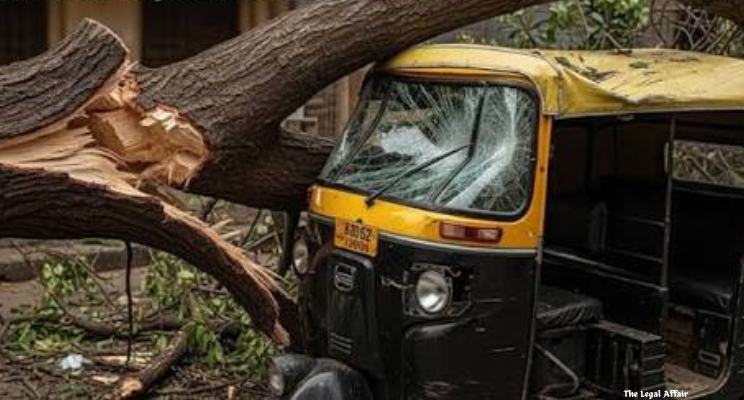
The litigation originated from a tragic incident that occurred in Bengaluru in June 2007. K.K. Umesh Kumar, the claimant, was travelling as a passenger in an autorickshaw from Queens Road towards the M. Chinnaswamy Stadium. During the journey, heavy rain began to pour, prompting the autorickshaw driver to stop the vehicle by the roadside. The vehicle came to a halt beneath an old roadside tree, apparently as a precautionary measure against the adverse weather conditions.
While the vehicle remained stationary, a large branch from the tree suddenly detached and fell onto the autorickshaw. The impact caused severe injuries to Umesh Kumar. The consequences proved devastating. Medical evidence later revealed that the victim suffered complete paraplegia affecting both lower limbs, accompanied by permanent bladder and bowel incontinence. The injuries dramatically altered the course of his life and left him with permanent disabilities requiring continuous care and support.
The injured claimant approached the Motor Accident Claims Tribunal seeking compensation. The dispute eventually travelled through various judicial forums, leading to a judgment of the Karnataka High Court. The High Court apportioned liability among the Bruhat Bengaluru Mahanagara Palike (BBMP), the insurer of the autorickshaw, and the State Horticulture Department. Dissatisfied with the imposition of liability, the municipal corporation challenged the High Court’s decision before the Supreme Court.
The case presented a complex legal issue. While the victim had undoubtedly suffered grievous injuries, the Court had to determine whether the accident could legally be classified as one arising from the use of a motor vehicle. The answer to this question would directly impact the maintainability of a claim under Section 166 of the Motor Vehicles Act.
Beyond the immediate dispute, the case carried broader implications for motor accident jurisprudence in India. Courts have traditionally adopted a liberal approach while interpreting beneficial legislation such as the Motor Vehicles Act. However, the present matter required the Supreme Court to define the limits of such liberal interpretation and determine whether every injury sustained by a person travelling in a vehicle necessarily falls within the ambit of motor accident compensation law.
Arguments of the Parties:
The appellant, Bruhat Bengaluru Mahanagara Palike (BBMP), challenged the findings of the Karnataka High Court and argued that the accident in question did not arise out of the use of a motor vehicle. The municipal corporation contended that the direct and immediate cause of the injuries was the unexpected fall of a tree branch during heavy rainfall and not any operation, movement, or use of the autorickshaw itself.
According to the appellant, the Motor Vehicles Act contemplates compensation in cases where a motor vehicle has a substantial causal connection with the accident. Merely because the injured person happened to be sitting inside a vehicle at the time of the incident would not automatically bring the matter within the scope of Sections 165 and 166 of the Act.
The appellant further argued that the incident was essentially a natural occurrence triggered by adverse weather conditions. It was submitted that the branch fell due to circumstances beyond human control and that neither the municipal authorities nor the driver of the autorickshaw could reasonably have anticipated the occurrence. Therefore, the incident bore the characteristics of an “Act of God,” a doctrine recognized in common law jurisprudence to describe natural events that cannot be prevented through ordinary care and diligence.
BBMP also emphasized the practical realities faced by municipal authorities in modern urban administration. It was argued that a city corporation is responsible for maintaining thousands of trees spread across vast geographical areas. While authorities have a duty to ensure public safety and undertake periodic maintenance, it would be impossible to maintain constant surveillance over every tree and branch at every moment.
The appellant contended that imposing liability in such circumstances would create an unreasonable standard of care. Municipal authorities cannot be expected to remove every old branch merely because it might fall at some uncertain point in the future. Such an approach, according to the appellant, would place an unrealistic and unsustainable burden upon civic bodies.
The insurer of the autorickshaw similarly questioned the applicability of the Motor Vehicles Act. It maintained that the vehicle itself played no active role in causing the accident. The autorickshaw was stationary and functioning merely as the location where the victim happened to be present. Consequently, there was no proximate connection between the use of the vehicle and the injuries sustained.
On the other hand, the respondent-claimant, K.K. Umesh Kumar, argued that he was a passenger lawfully travelling in an autorickshaw when the accident occurred. The fact that the vehicle was stationary at the time of the incident should not defeat his entitlement to compensation under the Motor Vehicles Act.
The claimant relied upon the broad and liberal interpretation consistently adopted by courts while construing the expression “arising out of the use of a motor vehicle.” Judicial precedents have often emphasized that beneficial legislation should be interpreted in a manner that advances the objective of providing relief to accident victims rather than restricting access to compensation through technical interpretations.
It was submitted that the claimant’s presence in the autorickshaw was directly connected to the sequence of events leading to the injury. The vehicle had stopped because of heavy rain, and the claimant was exposed to danger precisely because he was travelling in that vehicle. Therefore, a sufficient nexus existed between the use of the vehicle and the accident.
The claimant also emphasized the gravity of the injuries suffered. The accident had rendered him permanently disabled, destroying his earning capacity and drastically diminishing his quality of life. He argued that compensation awarded by the courts should reflect not merely economic losses but also the immense physical, emotional, and social consequences arising from permanent paraplegia.
The State Horticulture Department and other respondents were also implicated because of their role in maintaining roadside vegetation and ensuring public safety. The dispute thus involved overlapping questions regarding statutory liability, public authority responsibility, and compensation principles.
At its core, the case required the Supreme Court to reconcile two competing considerations. On one hand stood the need to interpret beneficial legislation liberally in favour of accident victims. On the other stood the requirement that compensation claims under the Motor Vehicles Act must retain a genuine and legally recognizable connection with the use of a motor vehicle.
Court’s Judgment:
The Supreme Court allowed the appeal in part and delivered a nuanced judgment that carefully distinguished between legal liability under the Motor Vehicles Act and the broader demands of justice in exceptional circumstances.
The Court commenced its analysis by examining the phrase “arising out of the use of a motor vehicle,” which forms the foundation of claims under Sections 165 and 166 of the Motor Vehicles Act. The Bench acknowledged that Indian courts have historically adopted an expansive interpretation of this expression. The objective has been to ensure that victims of accidents receive compensation without being denied relief on narrow technical grounds.
However, the Court clarified that even a liberal interpretation requires the existence of some causal relationship between the motor vehicle and the accident. The expression cannot be stretched to the point where the vehicle becomes entirely incidental to the occurrence.
The Bench observed that in the present case the autorickshaw was not moving, malfunctioning, or involved in any collision. The vehicle merely happened to be the place where the claimant was seated when the tree branch fell. The accident was caused by the falling branch and not by any activity associated with the operation or use of the autorickshaw.
To illustrate the point, the Court provided a hypothetical example. If the claimant had been standing beneath the same tree as a pedestrian seeking shelter from the rain, and the branch had fallen upon him, the nature of the accident would have remained unchanged. The presence or absence of the autorickshaw would not have materially altered the cause of the injury.
This reasoning led the Court to conclude that the motor vehicle did not constitute a proximate cause of the accident. Since the vehicle played no active role in bringing about the injury, a claim specifically under Section 166 of the Motor Vehicles Act was legally inappropriate.
The Court then considered the doctrine of “Act of God.” Drawing from English, American, and Indian jurisprudence, the Bench noted that certain accidents occur due to natural forces operating beyond human foresight and control. While municipal authorities owe a duty of care regarding maintenance of public infrastructure and roadside trees, liability cannot automatically arise whenever a tree branch falls during severe weather conditions.
The Court recognized that civic authorities must inspect and maintain trees to ensure public safety. Nevertheless, it cautioned against imposing unrealistic expectations. Urban local bodies administer rapidly expanding cities with extensive road networks and vegetation. Expecting authorities to maintain constant vigilance over every tree and every branch would be impractical and impossible.
The Bench observed that although it may be foreseeable in a general sense that old branches can fall, such foreseeability does not justify requiring authorities to remove all old branches as a preventive measure. The law demands reasonable care, not absolute prevention of every conceivable risk.
Significantly, the Court held that neither the claimant’s decision to seek shelter beneath the tree nor the exact timing of the branch’s fall could reasonably have been anticipated by the municipal authorities or the autorickshaw driver. Consequently, fastening liability solely on the basis of such unforeseeable circumstances would be unfair.
Despite these findings, the Court expressed deep concern regarding the claimant’s condition. Medical evidence demonstrated that the injuries had resulted in complete paraplegia of both lower limbs, accompanied by loss of bladder and bowel control. The Bench described these injuries as life-altering and acknowledged the profound impact they would have on every aspect of the claimant’s future existence.
The Court noted that although the legal question regarding maintainability had been answered against the claimant, compelling him to initiate fresh proceedings in another forum would result in further hardship and injustice. Nearly two decades had already elapsed since the accident, and additional litigation would only prolong his suffering.
Invoking its extraordinary powers under Article 142 of the Constitution, the Supreme Court sought to achieve complete justice. Article 142 empowers the Court to pass such orders as may be necessary for doing complete justice in any cause or matter pending before it.
Exercising this constitutional authority, the Bench enhanced the compensation awarded to the claimant from ₹17.10 lakh to ₹25 lakh. The enhanced amount was directed to carry interest from the date of filing of the original claim petition.
Importantly, while increasing the compensation, the Court chose not to disturb the apportionment of liability previously fixed by the Karnataka High Court among BBMP, the insurer, and the Horticulture Department. This pragmatic approach ensured that the claimant would receive meaningful compensation without reopening complex questions regarding contribution and inter se liability.
The Court directed all concerned parties to deposit the requisite amounts within four weeks.
The judgment is significant for two distinct reasons. First, it clarifies that a claim under Section 166 of the Motor Vehicles Act requires a genuine causal connection between the accident and the use of a motor vehicle. Mere presence inside a vehicle at the time of injury is not sufficient. Second, it demonstrates the Supreme Court’s willingness to employ its extraordinary constitutional powers to prevent injustice where rigid application of legal principles may produce harsh consequences.
Ultimately, the decision strikes a careful balance between doctrinal consistency and equitable justice. While reinforcing the limits of motor accident liability, the Court ensured that a victim who suffered catastrophic and permanent injuries was not left without adequate relief. The ruling therefore stands as an important contribution to both motor vehicle jurisprudence and the evolving scope of Article 142 as an instrument for achieving complete justice.