


Introduction:
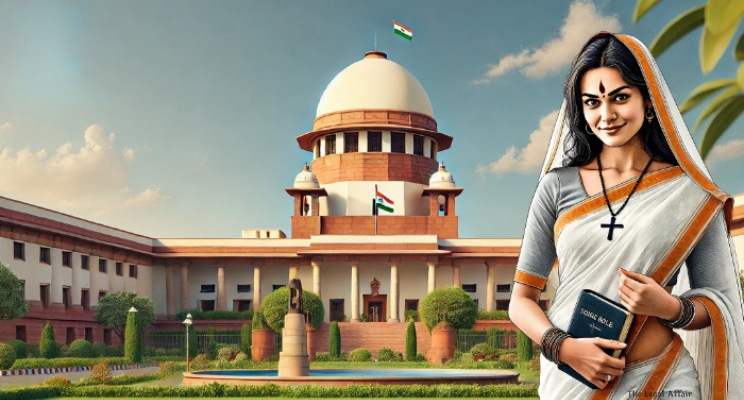
The Supreme Court of India recently addressed the applicability of the doctrine of caste eclipse in the context of an appeal challenging the denial of a Scheduled Caste (SC) certificate. The appellant, a Christian by birth, claimed to have embraced Hinduism and sought caste-based benefits for a government position. The bench, comprising Justice Pankaj Mithal and Justice R. Mahadevan, ruled that the doctrine of caste eclipse does not extend to individuals born into Christianity, as Christianity inherently rejects the caste system. This ruling is significant in delineating the boundaries of caste restoration upon religious reconversion and its implications for affirmative action policies.
Arguments Presented by the Appellant:
The appellant argued that her caste status, associated with her father’s Hindu heritage, remained eclipsed following her baptism into Christianity. She contended that upon her claimed reconversion to Hinduism, her caste identity as a Scheduled Caste should have been revived. Drawing on precedents like Kailash Sonkar v. Maya Devi (1984), she asserted that caste is determined by birth and does not vanish upon conversion. She further claimed that her parents had converted back to Hinduism, which should entitle her to the benefits associated with her original caste under Hinduism. Additionally, the appellant emphasized that her caste identity should not be permanently erased by her Christian upbringing, invoking the constitutional principles of equality and justice.
Arguments from the Respondents:
The respondents challenged the appellant’s claim, arguing that no credible evidence supported her assertion of reconversion to Hinduism. They noted the lack of a formal reconversion ceremony, public declaration, or community acceptance to substantiate her claims. The respondents further highlighted that the appellant continued to practice Christianity, as evidenced by factual findings. They also argued that Christianity fundamentally rejects caste distinctions, making the doctrine of caste eclipse inapplicable to individuals born as Christians. The absence of documented proof of her conversion and the ongoing practice of Christianity were presented as key reasons for denying her the SC certificate.
Supreme Court’s Judgment:
The Supreme Court, while upholding the Madras High Court’s decision, dismissed the appeal and clarified the doctrine of caste eclipse. The bench explained that the principle applies when individuals born into caste-based religions such as Hinduism convert to caste-less religions like Christianity. In such cases, their caste identity remains temporarily eclipsed and can be restored upon reconversion to their original religion, subject to acceptance by their caste or community. However, the Court distinguished the appellant’s case, noting that she was born into Christianity—a faith that does not recognize or propagate caste distinctions. Therefore, the doctrine of caste eclipse was deemed inapplicable to her situation.
The Court also emphasized the lack of credible evidence to support the appellant’s claim of reconversion to Hinduism. It pointed out the absence of any formal ceremony, declaration, or community acceptance necessary for establishing a legitimate reconversion. The Court rejected the appellant’s reliance on precedents like Kailash Sonkar v. Maya Devi, stating that those cases dealt with individuals born into Hinduism, making the circumstances factually distinguishable.
Additionally, the judgment referenced S. Rajagopal v. C.M. Armugam (1968), which reaffirmed that Christianity does not recognize caste divisions, treating all adherents equally. The Court noted that while caste status can theoretically revive upon reconversion to Hinduism, such restoration is contingent on the individual being born into a caste-based religion. Born Christians cannot invoke this principle because they are not associated with caste by birth.
The bench underscored the importance of genuine belief and community acceptance in cases of religious conversion. It highlighted that conversions motivated purely by a desire to claim reservation benefits, without sincere faith or practice, constitute a fraud on the Constitution. The Court concluded that the appellant failed to meet the evidentiary requirements to establish her claims and affirmed the denial of the SC certificate.