


Introduction:
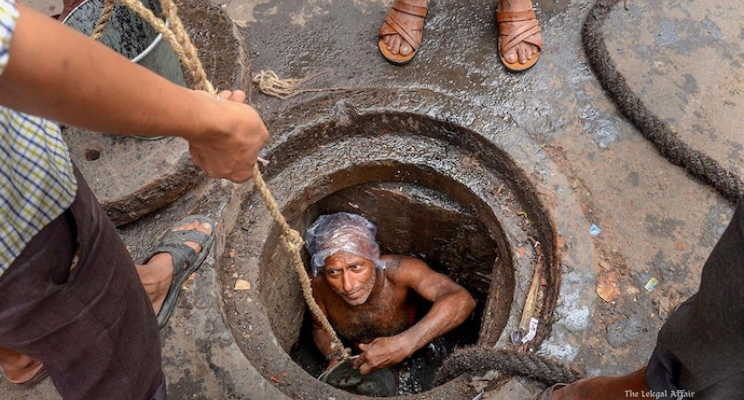
In a crucial clarification strengthening the rights of families of sanitation workers who die in hazardous manual scavenging and sewer cleaning operations, the Supreme Court of India, while dealing with a writ petition arising from the death of a sewer worker who lost his life on July 1, 2022 after inhaling poisonous gases inside a septic tank, clarified that its landmark October 2023 ruling enhancing compensation from ₹10 lakhs to ₹30 lakhs will apply even to deaths that occurred prior to the judgment, provided compensation has not yet been determined or paid, and the clarification was issued by a Bench comprising Justice Aravind Kumar and Justice P.B. Varale while considering an application filed by the National Legal Services Authority seeking clarity due to conflicting interpretations adopted by different High Courts, and the original writ petition was filed by Asha, widow of the deceased sewer cleaner, who contended that despite an order passed by the National Commission for Safai Karamcharis in August 2023, no compensation had been paid to her, and she sought application of the enhanced compensation directed by the Supreme Court in its October 2023 judgment in the public interest litigation concerning eradication of manual scavenging, wherein the Court had categorically directed that compensation for sewer deaths must be ₹30 lakhs, being the present-day equivalent of the ₹10 lakhs fixed decades ago, and that such amount shall be paid to dependents who had not been compensated, and further shall be the standard amount payable in future cases, thereby placing the present clarification within the broader constitutional framework of dignity, equality, and the State’s duty to protect vulnerable workers engaged in hazardous occupations.
Arguments:
The National Legal Services Authority submitted that divergent judicial approaches had emerged across High Courts regarding whether the enhanced compensation would apply retrospectively, citing that while the Madras High Court in one case directed payment of ₹10 lakhs for deaths occurring before October 2023, the Delhi High Court awarded ₹30 lakhs relying on the Supreme Court’s ruling, and therefore two conflicting interpretations were possible, first that families who had already received ₹10 lakhs before October 20, 2023 would be entitled to additional ₹20 lakhs, and second that only deaths occurring after the judgment would attract ₹30 lakhs while earlier cases would remain governed by the old amount, and NALSA sought authoritative clarification to ensure uniform application of law and to avoid inconsistent treatment of similarly placed victims, while in the present writ petition, the widow of the deceased sewer worker argued that although her husband died before the October 2023 judgment, compensation had neither been determined nor paid and therefore denying her the enhanced amount would perpetuate injustice and defeat the very purpose of the Supreme Court’s earlier directions aimed at restoring dignity and providing meaningful relief to families devastated by systemic neglect and illegal engagement in hazardous cleaning, and she further relied upon the categorical language of the October 2023 judgment which stated that in cases where dependents of any victim have not been paid such amount, ₹30 lakhs shall be payable, thereby showing clear legislative intent of the Court to cover pending and unpaid cases, while on the administrative front, the Court also took note of submissions regarding the failure of the Union Government to fill vacant posts in the National Safai Karamcharis Commission, despite earlier assurances given by the Solicitor General and the Additional Solicitor General that appointments would be made before March 2025, and the Court expressed serious concern that no progress had been made, reflecting continuing institutional apathy toward a community that is constitutionally entitled to protection from inhuman working conditions.
Judgment:
After considering the application and the background of the October 2023 ruling, the Supreme Court clarified the legal position in unequivocal terms and held that cases where compensation has already been determined and paid would not be reopened, thereby ensuring certainty and avoiding administrative chaos, but in all cases where death occurred prior to the October 2023 judgment and compensation has not yet been determined or paid, authorities are mandatorily required to pay ₹30 lakhs as compensation, thus extending the benefit of enhanced compensation to all pending and unresolved claims irrespective of the date of death, and the Court reasoned that the purpose of the earlier judgment was to correct an outdated and grossly inadequate compensation framework that had remained unchanged since 1993, and therefore limiting its application only to future deaths would undermine the remedial and humanitarian objective of the Court’s directions, and the Bench further directed that claims seeking ₹30 lakhs compensation in cases where deaths occurred prior to October 2023 should be placed before the Chief Justice of India for appropriate orders, indicating the seriousness with which the Court views enforcement of its directions, and additionally the Court recorded its displeasure over the Union Government’s failure to fill vacancies in the National Safai Karamcharis Commission despite assurances, and allowed time for the Union to file an affidavit specifying the timeline for making appointments, thereby linking compensation with broader institutional accountability, and through this clarification, the Supreme Court reaffirmed that compensation for sewer deaths is not merely an ex gratia payment but a constitutional obligation flowing from Articles 14, 17, 21 and the statutory prohibition on manual scavenging, and that families of victims cannot be denied meaningful relief on technical or temporal grounds when the State has failed to eradicate the very practice that caused such deaths.