


Introduction:
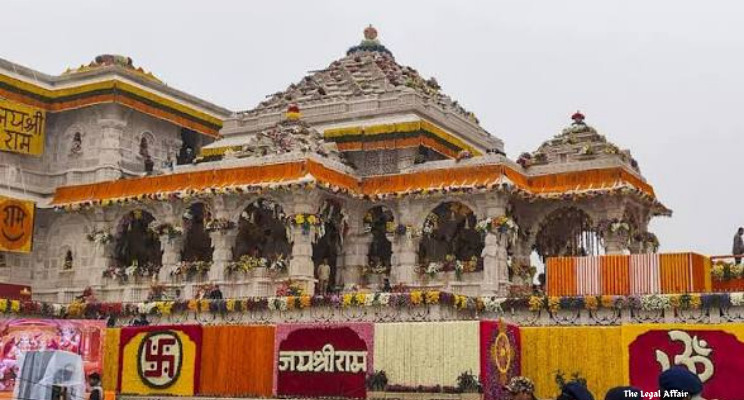
The Supreme Court of India, while hearing a batch of petitions concerning alleged embezzlement of donations made to the Shri Ram Janmabhoomi Teerth Kshetra Trust, observed that the issue must not be converted into a political controversy and should instead be addressed strictly as a matter involving allegations of criminal misconduct. The proceedings arose from four separate petitions, namely Narendra Kumar Goswami v. Union of India and Others (W.P. (C) No. 790/2026), Ajay Kumar Rai and Another v. Shri Ram Janmabhoomi Teerth Kshetra Trust (W.P. (Crl.) No. 241/2026), Sudhakar Singh v. Union of India and Others (W.P. (Crl.) No. 256/2026), and Hindu Dharma Parishad v. Union of India and Others (W.P. (C) No. 827/2026). These petitions sought a Central Bureau of Investigation (CBI) probe, forensic audit, and greater financial transparency concerning donations received for the construction and management of the Ayodhya Ram Mandir.
The matter was heard by a Bench comprising Chief Justice of India Surya Kant, Justice Joymalya Bagchi, and Justice V. Mohana. During the hearing, the Court repeatedly emphasised that allegations relating to theft or misappropriation of donations should be treated as an ordinary criminal investigation rather than as a matter capable of generating political controversy. Chief Justice Surya Kant remarked that the Court was dealing with “a simple case of commission of offence” and cautioned all parties against attempting to politicise the proceedings.
The controversy emerged after allegations surfaced regarding theft and embezzlement of donations made by devotees towards the construction of the Ram Mandir. The allegations extended beyond cash donations and included claims relating to disappearance of gold and silver offerings, irregular accounting practices, and concerns regarding the financial management of the Trust. Given the enormous public participation in funding the temple, the allegations attracted widespread public attention and led several individuals and organisations to approach the Supreme Court seeking judicial intervention.
Prior to the Supreme Court proceedings, the Uttar Pradesh Government had constituted a Special Investigation Team (SIT) to examine the allegations. Acting on the SIT’s preliminary findings, the State Police registered a First Information Report and commenced investigation. Earlier hearings before the Supreme Court resulted in directions requiring the State Government to submit a status report detailing the progress of the investigation.
At the present hearing, the Court considered the status report submitted by the State while also examining broader concerns raised by the petitioners regarding financial accountability, transparency in handling donations, preservation of evidence, and possible restructuring of the Temple Trust. The proceedings therefore involved balancing the need for effective criminal investigation with broader questions concerning governance of charitable religious institutions.
The petitions also reflected larger public concerns regarding the accountability of trusts administering religious institutions that receive substantial public contributions. While the petitioners emphasised transparency and independent oversight, the respondents maintained that a criminal investigation was already underway and judicial intervention beyond monitoring fairness of the investigation was presently unnecessary.
Arguments of the Parties:
The petitioners argued that the allegations concerning the disappearance and alleged misappropriation of donations made by millions of devotees required investigation by an independent central agency rather than the State Police. According to them, the magnitude of public donations, the national significance of the Ram Mandir, and the seriousness of the allegations justified transferring the investigation to the Central Bureau of Investigation. They contended that only an independent agency could inspire confidence among the public and ensure that no influential individuals escaped scrutiny.
Narendra Kumar Goswami, appearing in person, sought not only a CBI investigation but also an audit of the Trust’s finances by the Comptroller and Auditor General of India. He argued that the Trust had received enormous public donations and that an independent constitutional authority should verify whether such funds had been properly accounted for and utilised in accordance with law.
Ajay Kumar Rai and Dinesh Kumar Yadav similarly sought directions for a CBI investigation. Their petition emphasised that irrespective of whether the allegations ultimately proved true or false, reports regarding missing donations had shaken public confidence. Since countless devotees had voluntarily contributed to the construction of the temple, the petitioners argued that transparency in financial management was essential to preserve public faith.
Senior Advocate Devadatt Kamat, appearing for certain petitioners, highlighted a broader issue extending beyond the registered criminal case. He submitted that allegations had also emerged regarding disappearance of gold and silver offerings and improper accounting of donations. To strengthen transparency, he suggested that receipts issued to donors at the time of collection should be published on an official website so that contributors could verify whether their donations had been properly credited to the Trust. According to him, such disclosure would reassure devotees and reduce suspicion regarding handling of public funds.
Another important petition was filed by Member of Parliament Sudhakar Singh. Besides seeking a Court-monitored CBI investigation, he requested a comprehensive forensic audit of all financial transactions undertaken by the Trust. His petition sought preservation of physical records, digital ledgers, UPI transaction histories, bank statements, CCTV footage, and every other form of electronic evidence that could assist investigators. He further requested that pending completion of investigation, the Trust should be restrained from undertaking major financial transactions, investments, contracts, or administrative decisions without prior approval of a Court-monitored oversight committee.
Sudhakar Singh’s petition also sought directions requiring publication of audited financial statements, donation records, utilisation of funds, and complete financial disclosures on the Trust’s official website, while ensuring protection of confidential donor information wherever necessary. Additionally, he requested that the Trust submit before the Supreme Court a complete statement of all donations received since its constitution, including cash contributions, digital transfers, foreign donations, donations in kind, gold, silver, and other valuable articles, together with complete details regarding their accounting and utilisation.
The Hindu Dharma Parishad also approached the Supreme Court seeking a Court-monitored investigation into the alleged irregularities surrounding temple donations. Its petition similarly emphasised the need for maintaining public confidence in the administration of one of India’s most significant religious institutions.
Meanwhile, the Nirmohi Akhara separately sought restructuring of the Shri Ram Janmabhoomi Teerth Kshetra Trust into a public trust. According to the Akhara, the existing structure lacked sufficient public accountability and did not adequately reflect the spirit underlying the Supreme Court’s 2019 Ayodhya judgment.
The petitioners also raised concerns regarding preservation of digital evidence such as CCTV footage. They urged the Court to ensure that electronic records remained intact so that no material evidence could be destroyed or tampered with during investigation. Some counsel additionally requested that the FIR registered by the State Police and the status report submitted before the Supreme Court should be made available to the petitioners and uploaded publicly to ensure transparency.
On behalf of the respondents, Solicitor General Tushar Mehta submitted that the allegations were already being thoroughly investigated by the Uttar Pradesh Police. Referring to the status report filed pursuant to the Supreme Court’s earlier directions, he informed the Bench that eight persons had already been arrested during the investigation. He submitted that the police had found sufficient material disclosing commission of cognizable offences and that investigation was progressing in accordance with law.
The Solicitor General emphasised that because the investigation remained ongoing, detailed disclosure regarding evidence or investigative steps would not be appropriate at that stage. He assured the Court that the State Police was conducting the investigation fairly and professionally. In response to concerns regarding preservation of electronic evidence, he specifically informed the Court that CCTV footage and other digital records were being preserved.
The State further maintained that the criminal investigation should be allowed to proceed without unnecessary interference. Although the Court indicated that it would examine whether the SIT required reconstitution, the Solicitor General stated that he would obtain instructions regarding that aspect from the State Government.
Court’s Judgment:
While the Supreme Court did not finally decide the petitions, it made several important observations that are likely to shape the future course of the proceedings. The Court’s foremost concern was ensuring that the investigation remained independent, transparent, and focused exclusively on the criminal allegations without becoming influenced by political narratives.
Chief Justice Surya Kant firmly observed that the matter essentially concerned allegations regarding commission of a criminal offence. He cautioned all stakeholders against transforming the proceedings into a political debate. The Court’s observation reflects an important constitutional principle that criminal investigations should proceed on the basis of evidence, statutory procedure, and rule of law rather than political considerations or public sentiment.
The Bench indicated that before issuing further directions it intended to carefully examine the status report submitted by the Uttar Pradesh Government. Recognising that the investigation was still underway, the Court adjourned the matter for further consideration after studying the material placed before it.
At the same time, the Court stressed that the investigation must be fair, transparent, and carried through to its logical conclusion. This observation underscores the judiciary’s constitutional responsibility to ensure that investigations involving matters of significant public importance inspire public confidence while respecting investigative autonomy.
The Court also requested the Solicitor General to obtain instructions regarding possible reconstitution of the Special Investigation Team. Although no immediate order was passed, the observation suggests that the Bench remains open to considering structural changes if necessary to strengthen public confidence in the investigation.
An important aspect of the hearing related to transparency in maintaining records of donations. While Senior Advocate Devadatt Kamat proposed that donation receipts should be uploaded on an official website, the Court declined to accept that suggestion in its existing form. Chief Justice Surya Kant observed that requiring publication of all donation details could create practical difficulties because false claims regarding donations might subsequently be made. Consequently, the Court found such a proposal impractical.
However, the Court simultaneously recognised the importance of proper financial record-keeping. It emphasised that wherever receipts are issued to donors, corresponding records must necessarily be maintained. This observation reflects a balanced approach that seeks accountability without imposing impractical disclosure obligations capable of generating further disputes.
Regarding preservation of evidence, the Court recorded the Solicitor General’s assurance that CCTV footage and other digital evidence were already being preserved. Preservation of electronic evidence assumes considerable significance in modern criminal investigations because digital records frequently constitute primary evidence capable of establishing timelines, movements, transactions, and identities of persons involved in alleged offences.
The Bench also expressed reluctance to permit numerous interventions by different parties, questioning the necessity for multiple persons seeking to participate in the proceedings when the principal issues were already before the Court through the pending petitions. This approach reflects the Court’s consistent practice of preventing unnecessary expansion of litigation while ensuring that essential issues remain effectively adjudicated.
Similarly, the Court declined to direct immediate publication of the FIR or sharing of the State’s status report with the petitioners. Since the investigation remains at a preliminary stage, the Court appears to have balanced the principles of transparency with the equally important requirement of protecting the integrity of an ongoing criminal investigation.
The Supreme Court’s observations also demonstrate judicial restraint. Rather than immediately transferring the investigation to the CBI or ordering a forensic audit, the Court chose to first assess the effectiveness of the ongoing State investigation through the status report. This approach aligns with established jurisprudence recognising that transfer of investigation to the CBI constitutes an extraordinary measure ordinarily exercised only when circumstances demonstrate that investigation by the existing agency is incapable of inspiring confidence or ensuring justice.
The Court has therefore adopted a measured course by closely supervising developments while avoiding premature conclusions regarding the competence or fairness of the State Police investigation. Such an approach preserves institutional balance between judicial oversight and investigative independence.
Ultimately, the matter remains pending before the Supreme Court. The Court is expected to examine the status report in greater detail before determining whether additional safeguards, reconstitution of the SIT, transfer of investigation, forensic audit, or other directions become necessary. Until then, the Uttar Pradesh Police investigation continues, with eight arrests already having been made according to the State’s status report.
The proceedings represent an important reminder that allegations involving public trusts, religious institutions, or matters attracting widespread public attention remain subject to the same constitutional principles governing every criminal investigation. Accountability, transparency, preservation of evidence, procedural fairness, and adherence to the rule of law remain central to the judicial process. Equally significant is the Court’s insistence that legal proceedings concerning alleged criminal conduct must not become vehicles for political contestation. By emphasising fairness over rhetoric and evidence over speculation, the Supreme Court has reinforced the principle that justice must be administered impartially, irrespective of the institution or individuals involved.