


Introduction:
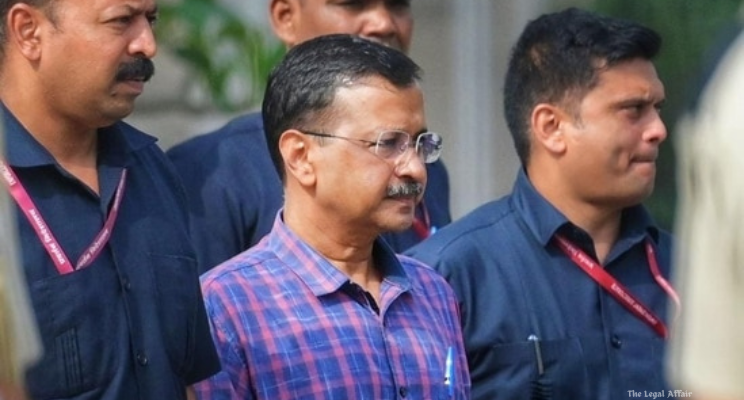
In a landmark judgment on the need for uniformity in arrest policies under the Prevention of Money Laundering Act (PMLA), the Supreme Court granted interim bail to Delhi Chief Minister Arvind Kejriwal. The case, Arvind Kejriwal v. Directorate of Enforcement, involved a petition challenging Kejriwal’s arrest by the Enforcement Directorate (ED) in connection with the Delhi liquor policy case. The bench, comprising Justices Sanjiv Khanna and Dipankar Datta, emphasized the necessity for the ED to adopt a consistent approach in deciding when to arrest individuals under the PMLA.
Arguments of Both Sides:
Arvind Kejriwal, represented by senior advocate Abhishek Manu Singhvi, contended that his arrest was arbitrary and lacked the necessary grounds. Singhvi argued that the ED’s actions were politically motivated and aimed at tarnishing Kejriwal’s reputation. He pointed out discrepancies in the ED’s handling of cases, emphasizing that the agency had not followed a uniform policy for arrests. Singhvi referred to the official data from the ED’s website, highlighting that out of 5,906 Enforcement Case Information Reports (ECIRs) registered, only 531 had involved searches, and merely 513 arrests had been made. He questioned the criteria used by the ED to decide on arrests, arguing that the lack of a standardized policy led to selective targeting.
Singhvi further argued that Kejriwal had cooperated with the investigation and there was no risk of him fleeing or tampering with evidence. He stressed the importance of the principle of parity, stating that the ED’s inconsistent approach violated Article 14 of the Constitution, which guarantees equality before the law. Singhvi urged the court to recognize the need for a clear policy on arrests under the PMLA to prevent misuse of power and ensure fairness in enforcement.
The Directorate of Enforcement, represented by Solicitor General Tushar Mehta, defended the arrest, stating that it was conducted following due process and based on substantial evidence of Kejriwal’s involvement in money laundering related to the liquor policy. Mehta argued that the ED had sufficient grounds to believe that Kejriwal was part of a larger conspiracy involving financial irregularities and corruption. He contended that the agency’s actions were justified under Section 19 of the PMLA, which grants ED officers the power to arrest individuals suspected of money laundering.
Mehta dismissed the allegations of political motivation, asserting that the ED’s investigations were independent and based solely on evidence. He argued that the principle of parity did not apply in this case, as each investigation had its own unique facts and circumstances. Mehta maintained that the ED’s discretion in deciding arrests was essential for effective enforcement of the PMLA, and a uniform policy might hinder the agency’s ability to respond to different situations appropriately.
Court’s Judgment:
The Supreme Court, in its judgment authored by Justice Sanjiv Khanna, granted interim bail to Arvind Kejriwal, highlighting the need for a uniform policy by the ED regarding arrests under the PMLA. The bench noted the discrepancies in the ED’s data, pointing out that out of 5,906 ECIRs, searches were conducted in only 531 cases, and 513 arrests were made, with a disproportionate number of search warrants issued. The court questioned whether the ED had a formulated policy on when to arrest individuals, emphasizing the importance of consistency in enforcement actions.
Justice Khanna acknowledged that while the principle of parity could not be used to justify repeated irregularities, it was crucial for the ED to act uniformly and consistently. He stated that the necessity of arrest should be considered as a condition under Section 19 of the PMLA, which gives ED officers the power to arrest. The bench referred to the Constitutional doctrine of proportionality, suggesting that the necessity of arrest must align with the principles of fairness and justice.
Given the constitutional validity of Section 19 PMLA upheld by the Supreme Court in Vijay Madanlal Choudhary v. Union of India, the bench chose to refer the issue regarding the necessity of arrest to a larger bench. The court framed specific questions for reference, seeking clarity on whether the necessity to arrest is a separate ground for challenging arrest orders under Section 19(1) of the PMLA, and what parameters should be considered in determining the necessity of arrest.
The judgment underscored the importance of a uniform and transparent policy by the ED to ensure fair and just enforcement of the PMLA. The court’s decision to grant interim bail to Kejriwal was based on the need to address these broader concerns and ensure that the principles of equality and fairness are upheld in the enforcement of anti-money laundering laws.