


Introduction:
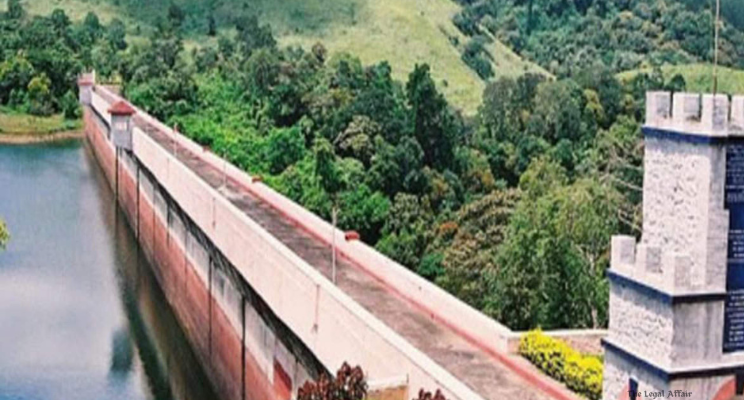
The Supreme Court of India recently deliberated on the pressing issue of the Mullaperiyar Dam, situated in Kerala but operated by Tamil Nadu, amidst concerns over the structural safety of the dam and the delay in implementing the provisions of the Dam Safety Act, 2021. The case, titled Mathews J. Nedumpara and Ors. v. Union of India and Ors., Diary No. 37275/2024, was filed by Advocate Mathews J. Nedumpara, raising critical concerns about the Union of India’s inaction in constituting the National Committee on Dam Safety as mandated by the Act. A bench comprising Justices Surya Kant, Dipankar Datta, and Ujjal Bhuyan presided over the matter, seeking clarity on the safety measures for the dam, the role of the Supervisory Committee, and compliance with previous judicial directions.
Arguments of Both Sides:
During the hearing, Advocate Mathews J. Nedumpara argued that the Union of India’s failure to constitute the National Committee on Dam Safety under the Dam Safety Act, 2021, posed a significant threat to the structural and operational safety of dams across the country, particularly the Mullaperiyar Dam. He emphasized that Section 4, read with Section 5 of the Act, explicitly required the formation of the Committee within 60 days of the Act’s commencement, yet no such body had been established even after two years. He also highlighted the absence of rules or regulations regarding the Committee’s constitution, composition, and functions, rendering the Act ineffective. Advocate Nedumpara contended that this inaction jeopardized compliance with crucial safety norms and undermined the legislative intent of ensuring dam safety.
On behalf of Tamil Nadu, senior counsel Krishnamurthy defended the state’s position, referring to an Office Memorandum (OM) dated November 21, 2024, issued by the Ministry of Jal Shakti. This OM superseded the previous Supervisory Committee and constituted a new Supervisory Committee chaired by the Chairman of the National Dam Safety Authority. Tamil Nadu argued that this step was sufficient to address immediate concerns about the Mullaperiyar Dam’s safety, particularly since the Dam Safety Act did not explicitly mandate the creation of a Supervisory Committee. The state asserted that the Supervisory Committee had been formed in line with previous Supreme Court judgments and was competent to oversee the dam’s safety measures. Tamil Nadu also urged the Court to consider the dam’s history of judicial scrutiny and compliance with earlier directives, including the 2014 judgment that upheld the dam’s safety and permitted water levels up to 142 feet.
The Union of India, represented by its counsel, acknowledged the delay in constituting the National Committee on Dam Safety and attributed it to administrative challenges. It informed the Court that steps were being taken to operationalize the Dam Safety Act and sought additional time to address the procedural gaps. The Union assured the Court of its commitment to complying with the Act and safeguarding the Mullaperiyar Dam.
Court’s Judgment:
After hearing the arguments, the Supreme Court expressed serious concern over the Union of India’s delay in implementing the provisions of the Dam Safety Act, 2021. The bench pointed out that the Act unequivocally required the establishment of a National Committee on Dam Safety within 60 days of its commencement and that such a committee was to be reconstituted every three years. The Court noted that the absence of this committee and the lack of associated rules or regulations undermined the Act’s purpose. The bench also observed that a Supervisory Committee, though established under the OM, was not a substitute for the National Committee envisaged under the Act, as no provision in the Act permitted such an alternative arrangement.
The Court referred to its earlier judgment in Dr. Joe Joseph and Ors. v. State of Tamil Nadu and Ors. (April 8, 2022), which directed the continuation of the Supervisory Committee until the National Dam Safety Authority under the Act became operational. It expressed concern that the directives in paragraphs 17 and 18 of that judgment, which called for ensuring dam safety through proper oversight mechanisms, were yet to be fully implemented. The bench sought the assistance of the Attorney General of India to address these lapses and ensure compliance with the Act’s provisions. It also directed the Attorney General to clarify the role and responsibilities of the National Dam Safety Authority in the context of the Mullaperiyar Dam and provide updates on the steps being taken to operationalize the Authority and the National Committee.
The Court acknowledged the complexities surrounding the Mullaperiyar Dam, which has been a subject of prolonged litigation and judicial intervention. It recalled its 2006 judgment in Mullaperiyar Environmental Protection Forum v. Union of India & Ors., which permitted Tamil Nadu to raise the dam’s water level to 142 feet following structural strengthening. It also cited the 2014 Constitution Bench judgment, which reaffirmed the dam’s safety and allowed Tamil Nadu to carry out repair works. The Court underscored the need for continued oversight and adherence to safety norms, particularly given the dam’s age and its location in a seismically sensitive area.
In conclusion, the bench issued notice to the Union of India, directing it to file a detailed response by the next hearing on January 22, 2025. It reiterated the importance of constituting the National Committee on Dam Safety and ensuring compliance with the Dam Safety Act to address safety concerns comprehensively. The Court also directed the Union to provide updates on the implementation of its April 2022 judgment and ensure that the National Dam Safety Authority fulfills its statutory responsibilities.