


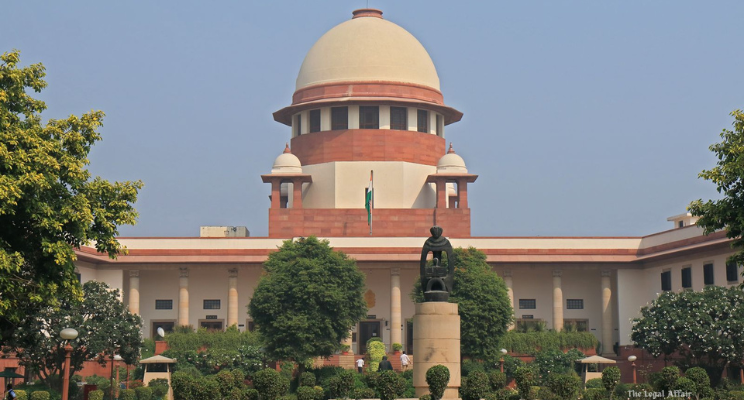
Introduction:
In a significant ruling that underscores the foundational importance of prompt and accurate reporting in criminal investigations, the Supreme Court of India set aside the conviction of Govind Mandavi, the appellant-accused, in a murder case arising from the State of Chhattisgarh. The case was heard by a Bench comprising Justice Vikram Nath and Justice Sandeep Mehta, who meticulously examined the prosecution’s narrative, the credibility of eyewitness testimony, and the critical omissions in the First Information Report (FIR) lodged by the deceased’s father, Heeralal Hidko (PW-1). The prosecution had relied heavily on the belated identification of the accused by the deceased’s wife, Sukmai Hidko (PW-2), who was the sole eyewitness. However, the failure to mention the accused’s name in the FIR—even though PW-2 allegedly knew and communicated it to PW-1 on the same night—proved to be a decisive flaw. The Court held that such an omission strikes at the heart of the prosecution’s case, raising serious doubts about credibility, consistency and the authenticity of the subsequent statements recorded under Section 161 CrPC. Ultimately, the Supreme Court allowed the appeal, ruling that once the belated claim of identification was excluded, no credible evidence linked the accused to the crime.
Arguments of the Appellant:
The appellant contended that the prosecution’s entire case rested on a highly belated, unnatural, and unreliable identification by PW-2, the deceased’s wife, who initially described the assailants as masked and unknown. The appellant argued that if PW-2 had genuinely identified him at the time of the incident—whether by voice or due to the mask allegedly slipping—there was no conceivable reason for her to omit this crucial fact when PW-1, her father-in-law, lodged the FIR on the same night. The defence stressed that PW-2 had narrated every minute detail of the incident, including the attackers’ physical features, weapons, and sequence of events, which made it untenable to believe that she would fail to disclose the accused’s identity if she had truly recognized him. The appellant further submitted that the prosecution’s explanation that PW-2 was “ill” or in “shock” was a fabricated afterthought, concocted to overcome the glaring omission in the FIR. Relying on precedents including Ram Kumar Pandey v. State of M.P., the appellant asserted that such omissions are material contradictions amounting to substantive infirmities in the prosecution’s case, creating reasonable doubt that must benefit the accused. It was also argued that no corroborative evidence—neither forensic, circumstantial, motive-based nor recovery-linked—supported the prosecution’s story, and thus the conviction rested purely on an unreliable, belated and legally unsustainable identification.
Arguments of the State:
The State of Chhattisgarh argued that PW-2, being the sole eyewitness and a close family member of the deceased, had no motive to falsely implicate the appellant, and her belated identification should be accepted in light of the traumatic circumstances surrounding the murder. The prosecution contended that PW-2 had initially refrained from mentioning the appellant’s name due to shock, emotional distress and subsequent illness, and that such human reactions should not be interpreted as deliberate omissions undermining her credibility. It was argued that in rural settings, where people may react differently to extreme events, some delay in recalling or articulating specific details, especially in cases involving masked assailants, is not uncommon. The State also submitted that the appellant, being the deceased’s brother-in-law, was already known to PW-2, making voice recognition plausible when combined with the claim that one attacker’s mask slipped during the incident. The prosecution urged the Court to consider the totality of circumstances, stressing that minor discrepancies should not overshadow the core testimony of an eyewitness. They further argued that courts have, in past cases, upheld convictions based on delayed but credible identification, asserting that the present case falls within that principle. Therefore, the State urged the Court to sustain the conviction, asserting that the trial court and the High Court had rightly appreciated the evidence.
Court’s Judgment:
The Supreme Court, after thoroughly examining the factual matrix and legal principles, held that the prosecution’s case suffered from a fundamental, irreparable defect due to the crucial omission in the FIR. The Bench emphasized that the deceased’s wife, PW-2, who claimed to have identified the appellant, had described every detail of the incident with precision—from the attackers’ arrival to their weapons, physical attributes, and actions—yet inexplicably failed to disclose the accused’s name when PW-1 lodged the FIR. The Court found it implausible that PW-2 could narrate so many minute details but omit the most critical fact of all: the identity of the accused. The Court held that the delayed claim of identification, introduced days later in the Section 161 statement, appeared to be a “cooked-up story” devised to repair the prosecution’s weakened position. Citing Ram Kumar Pandey v. State of M.P., the Court reiterated that such omissions constitute material contradictions affecting the very probability of the prosecution’s case and become relevant under Section 11 of the Evidence Act. The Bench concluded that once the belated identification was excluded from consideration, no credible evidence remained to link the appellant to the crime. Accordingly, the conviction was set aside and the appeal was allowed, reaffirming the principle that the prosecution must prove guilt beyond reasonable doubt and that omissions striking at the root of credibility cannot be ignored.