


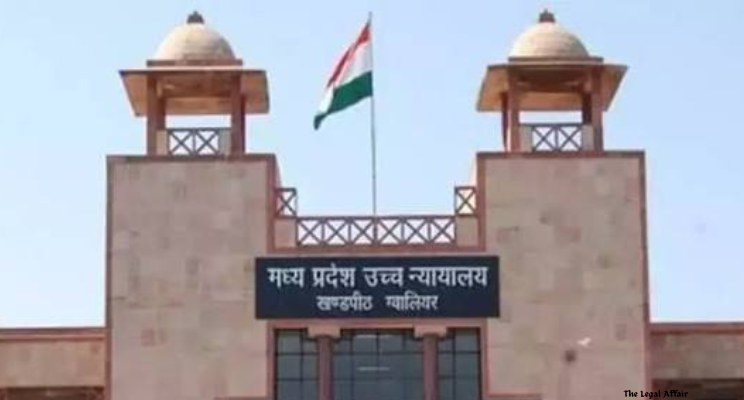
Introduction:
The Madhya Pradesh High Court has dismissed a writ petition challenging a demolition notice issued by the Indore Municipal Corporation for a proposed road-widening project, holding that the petitioner had failed to disclose material facts concerning a joint inspection and the alleged encroachment upon government land. The Court concluded that the suppression of relevant information disentitled the petitioner from seeking discretionary relief under Article 226 of the Constitution and imposed a cost of ₹20,000 for abuse of the process of law.
Justice Sandeep N. Bhatt delivered the decision in Anand Kumar Kedia v. State of Madhya Pradesh, Writ Petition No. 33717 of 2026, reported as 2026 LiveLaw (MP) 349. The petition was filed by Anand Kumar Kedia, a member of the promoter group managing Associated Alcohols and Breweries, against the State of Madhya Pradesh and the Indore Municipal Corporation.
The dispute arose from a demolition notice dated August 11, 2026, issued by the Building Officer of the Indore Municipal Corporation. The notice was connected with the proposed widening of a road passing near the petitioner’s residential property in Indore. Kedia sought quashing of the notice and a direction restraining the authorities from disturbing his property or undertaking road-widening work without following the statutory procedure contemplated under the Madhya Pradesh Nagar Tatha Gram Nivesh Adhiniyam, 1973.
The petitioner claimed lawful ownership and possession of the residential property. According to him, the property had been purchased through a registered sale deed dated April 4, 2017, after which the revenue authorities had carried out formal demarcation. He further relied upon permissions granted by the Town and Country Planning Department in 2019 and building permission granted by the Municipal Corporation in 2020 for construction of residential premises.
The petitioner alleged that despite these permissions and his claimed lawful ownership, the Municipal Corporation subsequently sought to demolish part of his premises for implementing a road-widening project contemplated under the Indore Development Plan of 2021.
His challenge was not limited to the demolition notice itself. He alleged that the authorities had altered the alignment of the road and were effectively attempting to take possession of his property without following the acquisition procedure prescribed by law. According to him, the Municipal Corporation could not use Section 305 of the Madhya Pradesh Municipal Corporation Act, 1956 as a means of bypassing the acquisition mechanism contemplated under the applicable town-planning legislation.
The petitioner also invoked constitutional protections, alleging violation of Articles 14 and 300A of the Constitution. Article 14 was relied upon to contend that the action of the authorities was arbitrary and discriminatory, while Article 300A was invoked to protect his alleged right to property against deprivation except by authority of law.
The Municipal Corporation contested these assertions. Its case was that the petitioner had himself encroached upon government land and had constructed a wall by including part of the government land within his claimed property. The respondents relied upon a joint inspection conducted pursuant to earlier directions of the High Court and maintained that the inspection established the encroachment.
The respondents also defended the road-widening project by relying upon the Development Plan of 2021. They submitted that the development plan had been prepared after inviting objections and suggestions and had subsequently been finalised. Once finalised, the plan was binding upon the Municipal Corporation and was required to be implemented.
The High Court therefore had to consider two connected questions. First, whether the authorities had acted illegally or arbitrarily in issuing the demolition notice and pursuing the road-widening project. Second, and crucially, whether the petitioner had approached the Court with complete disclosure of the material facts surrounding the earlier proceedings and the joint inspection report.
The Court ultimately found that the petitioner had not placed the complete factual picture before it. In particular, the Court found significance in the petitioner’s failure to properly disclose the earlier proceedings in W.P. No. 27726 of 2026, in which directions had been issued for a joint inspection and for the report to be supplied to the petitioner.
The Court also found that the petitioner’s pleadings created an impression that he had not been given access to the relevant inspection material, whereas the respondents’ case demonstrated that the joint inspection report had in fact been provided to him. This suppression, in the Court’s view, went to the root of the petition and justified denial of relief.
Arguments of the Parties:
Appearing for the petitioner, Senior Advocate Kishore Shrivastava, assisted by Advocate Amit Dubey, challenged the demolition notice dated August 11, 2026 and sought protection against the proposed road-widening activity.
The petitioner asserted that he was the lawful owner and was in physical possession of the residential property in question. He relied upon the sale deed executed on April 4, 2017 as the source of his title and submitted that the revenue authorities had subsequently carried out formal demarcation of the property.
The petitioner further relied upon the permissions obtained from the planning and municipal authorities. He pointed out that the Town and Country Planning Department had granted permission in 2019 and that the Municipal Corporation had subsequently granted building permission in 2020 for residential construction.
According to the petitioner, these permissions demonstrated that the construction had not been undertaken clandestinely or without governmental knowledge. The subsequent attempt to demolish a portion of the premises for road widening was therefore challenged as arbitrary and legally unsustainable.
The petitioner alleged that the authorities had altered the road alignment and were attempting to take over his property under the guise of implementing the development plan. His argument was that the Government could not deprive a person of property merely by issuing a demolition notice where the real effect of the action would be to acquire or take possession of privately owned land.
He therefore contended that the authorities were required to follow the statutory acquisition procedure under the Madhya Pradesh Nagar Tatha Gram Nivesh Adhiniyam, 1973. In his submission, Section 305 of the Madhya Pradesh Municipal Corporation Act, 1956 could not be employed to circumvent the safeguards associated with acquisition of private property.
The petitioner also alleged violations of Articles 14 and 300A of the Constitution. He argued that arbitrary interference with his property rights would offend the constitutional guarantee against arbitrary State action and the protection against deprivation of property except by authority of law.
Another aspect of the petitioner’s case concerned the joint inspection. The petitioner sought to present the dispute as one in which the authorities were attempting to remove him from his legitimately owned property despite the presence of alleged encroachments by others on the southern side. His case was that the authorities were selectively proceeding against his property while failing to address other alleged encroachments.
The petitioner also relied upon earlier proceedings before the High Court. He referred to W.P. No. 27726 of 2026, in which the Court had directed the authorities to conduct a joint inspection and furnish the report to him. According to the petitioner, the relevant documents had not been supplied to him.
On the other side, Advocate Rishi Tiwari represented the State, while Advocate Tanishq Pate appeared for the Indore Municipal Corporation. The respondents opposed the petition and defended the demolition notice as part of a lawful exercise undertaken to implement the applicable development plan.
The Municipal Corporation submitted that a joint inspection had revealed that the petitioner had encroached upon government land. According to the respondents, the construction of the wall was not confined to the petitioner’s legitimate property but extended into government land.
The respondents therefore disputed the fundamental premise of the petitioner’s challenge. Rather than being a case of the Government seeking to unlawfully dispossess a lawful owner, the respondents maintained that the petitioner had himself occupied government land and incorporated it into his premises.
The respondents further relied upon the Development Plan of 2021. They explained that the road-widening project formed part of a larger planned development and that the development plan had been finalised after following the procedure of inviting objections and suggestions.
The respondents contended that once the development plan had been duly finalised, it was binding upon the Municipal Corporation. The Corporation could not simply disregard the plan or abandon the road-widening requirement because a portion of the proposed alignment affected a particular private property.
Reliance was placed upon the Supreme Court judgment in Ravindra Ramchandra Waghmare v. Indore Municipal Corporation, (2017) 1 SCC 667. The respondents relied upon the principle that a development plan, once duly finalised, is binding and has to be implemented by the Corporation.
The respondents also disputed the petitioner’s allegation that Section 305 of the Municipal Corporation Act was being invoked to circumvent acquisition laws. Their position was that the petitioner had misunderstood the legal basis of the action and that the proceedings were connected with implementation of the development plan and removal of encroachment rather than an unlawful acquisition of private property.
The respondents further informed the Court that the petitioner had been given an opportunity of hearing and that the authorities had followed the necessary procedure before taking the impugned decision. Thus, according to the respondents, the action could not be characterised as arbitrary or violative of natural justice.
A particularly significant submission concerned the petitioner’s disclosure of facts. The respondents pointed out that the petitioner had not properly disclosed the earlier proceedings and the joint inspection conducted pursuant to the High Court’s directions. They maintained that the inspection had established encroachment upon government land and that the report had been supplied to the petitioner.
The respondents therefore urged the Court to decline discretionary relief on the ground that the petitioner had not approached the Court with clean hands. In their submission, the writ jurisdiction under Article 226 could not be used by a litigant who suppressed material documents or presented an incomplete factual narrative in an attempt to obtain an order of protection.
The competing submissions thus required the Court to examine not only the legality of the demolition notice and development plan but also the conduct of the petitioner in invoking the extraordinary writ jurisdiction.
Court’s Judgment:
Justice Sandeep N. Bhatt dismissed the writ petition after considering the rival submissions and the material placed before the Court. The Court found that the petitioner’s case, although appearing attractive on the surface, did not withstand scrutiny once the complete factual background was examined.
A central consideration for the Court was the allegation that the petitioner had suppressed material facts. The High Court noted that the petitioner had previously approached the Court in W.P. No. 27726 of 2026. In those proceedings, directions had been issued requiring the authorities to conduct a joint inspection and supply the inspection report to the petitioner.
The earlier proceedings were therefore directly relevant to the controversy raised in the subsequent writ petition. The result of the joint inspection had a bearing upon the petitioner’s claim that he was being threatened with demolition despite being the lawful owner of the entire property.
The Court found that the petitioner had not properly disclosed these circumstances. More importantly, the petitioner’s pleadings did not accurately reflect the status of the inspection report and its supply to him.
The Bench noted that the petitioner had contended that the relevant documents had never been supplied. However, the material placed by the respondents demonstrated that the report of the joint inspection had in fact been provided to him.
This discrepancy assumed considerable importance because the petitioner was asking the Court to exercise its extraordinary and discretionary jurisdiction under Article 226. Such jurisdiction is not available as a matter of absolute right. A litigant seeking discretionary relief must place the relevant facts fairly and completely before the Court.
The Court therefore concluded that the petitioner had not properly disclosed all facts material to the adjudication of the writ petition. The suppression was considered sufficiently serious to amount to an abuse of the process of law.
The Court observed that the petitioner’s averments, though appearing attractive, lacked merit when examined against the complete factual record. The allegation that the authorities were seeking to dispossess him from legitimately owned property while ignoring government-land encroachments was found to be misconceived.
The respondents’ reply, according to the Court, clearly demonstrated that the petitioner had constructed the wall by including government land within his own property. Thus, the factual foundation upon which the petitioner sought protection was substantially undermined by the material arising from the joint inspection.
The Court’s reasoning illustrates an important principle of writ jurisdiction: a petitioner cannot select only those facts that support his case while withholding circumstances that may materially affect the Court’s assessment. Suppression becomes particularly serious where the undisclosed material arises from previous judicial proceedings involving the same dispute.
The Court accordingly applied the general principle that a litigant who suppresses material facts may be denied relief. It expressly held that, in view of the petitioner’s failure to properly disclose relevant facts, the general rule of denial of relief was attracted.
The Court also referred to the Latin maxim falsus in uno, falsus in omnibus, meaning “false in one thing, false in everything.” In the context of the case, the Court used the principle to underscore the seriousness of the petitioner’s conduct in suppressing material documents and facts.
The maxim is not ordinarily treated as an inflexible rule of evidence requiring every part of a person’s case to be rejected whenever one statement is found false. However, the Court’s reference to the maxim here underscored the loss of credibility arising from suppression of material information when a litigant seeks discretionary relief.
The Court found that the petitioner’s failure to disclose the inspection report and the earlier directions disentitled him from obtaining relief. The issue was therefore not simply whether every allegation in the writ petition was factually incorrect, but whether the petitioner had presented the Court with the complete circumstances necessary for deciding the dispute fairly.
The High Court also examined the substantive challenge to the development plan and road-widening action. On this aspect, the respondents relied upon the 2021 Development Plan, which had been prepared after inviting objections and suggestions and subsequently finalised.
The Court accepted the respondents’ submission that a duly finalised development plan is binding upon the Municipal Corporation and must be implemented in accordance with law. The principle was supported by the Supreme Court’s decision in Ravindra Ramchandra Waghmare v. Indore Municipal Corporation, (2017) 1 SCC 667.
The significance of this principle is that urban development cannot ordinarily be undertaken on an ad hoc basis. Once a statutory planning process has been completed, the authorities responsible for implementing the plan are required to give effect to it. Individual claims of inconvenience or opposition to a proposed alignment cannot automatically invalidate a development plan that has been prepared and finalised in accordance with the prescribed procedure.
At the same time, implementation of a development plan remains subject to law. A development plan cannot, by itself, authorise arbitrary deprivation of private property. The Court’s decision in the present case, however, turned significantly on its finding that the petitioner had not established the factual foundation for alleging such arbitrary deprivation.
The petitioner had sought to characterise the action as an attempt to acquire his property without following the applicable acquisition procedure. The Court found that this contention did not merit acceptance in light of the respondents’ material concerning the encroachment upon government land.
The Court also found no arbitrariness or illegality in the actions of the Municipal Corporation. The authorities had conducted a joint inspection, the petitioner had been afforded an opportunity of hearing, and the development plan had been prepared and finalised after inviting objections and suggestions.
Consequently, the constitutional challenge under Article 14 could not succeed. The petitioner had failed to demonstrate that the respondents had acted in a discriminatory, irrational or arbitrary manner.
The Court also did not find a sustainable violation of Article 300A. Article 300A protects the right to property by providing that no person shall be deprived of property save by authority of law. However, the protection does not mean that every interference with a structure situated on or extending into government land necessarily amounts to unconstitutional deprivation of private property.
The factual finding concerning the alleged inclusion of government land in the petitioner’s construction was therefore important to the Court’s assessment. Once the petitioner’s claim to exclusive lawful possession was undermined by the joint inspection findings, his argument that the authorities were simply taking over his private property became considerably weaker.
The Court further rejected the petitioner’s attempt to rely upon Section 305 of the Madhya Pradesh Municipal Corporation Act as evidence of an attempt to bypass acquisition laws. The Bench found no material demonstrating that the Corporation had acted arbitrarily or used the statutory provision as a device to unlawfully acquire the petitioner’s property.
Ultimately, however, the most consequential aspect of the decision was the petitioner’s conduct in approaching the Court.
The High Court emphasised that suppression of material facts can itself justify dismissal of a writ petition. A litigant who invokes the extraordinary jurisdiction of the High Court is expected to make a full and fair disclosure. The Court cannot be expected to determine a dispute accurately when a party deliberately or materially withholds facts connected with previous proceedings and relevant documents.
The Bench therefore held that the petitioner had not properly disclosed all relevant facts material to the decision of the petition. Such suppression was treated as an abuse of the process of law, and the general rule requiring denial of relief in such circumstances was applied.
The Court did, however take note of the petitioner’s explanation that he was not awar