


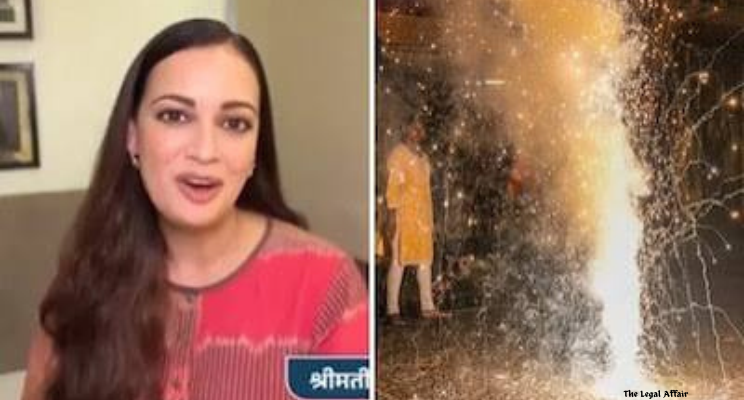
Introduction:
The Bombay High Court has reaffirmed the constitutional importance of secularism, religious inclusiveness and collective responsibility towards environmental protection while addressing the controversy surrounding an awareness video featuring actor Dia Mirza, who appealed to citizens not to burst firecrackers on public streets during Diwali. The Court expressed concern over objections raised by certain political leaders against her participation in the Brihanmumbai Municipal Corporation’s (BMC) environmental awareness campaign and emphasised that participation in a festival cannot be restricted or questioned merely on the basis of an individual’s religious identity.
A Division Bench comprising Justice Girish Kulkarni and Justice Dr Neela Gokhale made these observations while considering the controversy arising from the removal of the awareness video from the civic body’s social media platforms. The Bench observed that India is a secular country and that festivals are occasions for everyone to celebrate, irrespective of their religious backgrounds. It questioned the basis on which an individual could be criticised for participating in a public awareness initiative simply because she belonged to a different religious community.
The controversy originated when the BMC approached Dia Mirza to participate in an awareness initiative concerning the environmental consequences of bursting firecrackers on public streets. The video was created in the context of the Court’s directions aimed at preventing firecracker-related pollution and encouraging responsible celebrations during Diwali. Through the video, Mirza conveyed a message urging citizens to avoid bursting firecrackers on public roads, thereby contributing to the civic body’s efforts to promote environmental awareness.
However, the initiative soon became controversial after certain political leaders objected to the BMC featuring the actor in its Diwali campaign. Mumbai BJP President and MLA Ameet Satam criticised the civic body’s decision, while Mumbai Mayor Ritu Tawde accused Mirza of consistently adopting an allegedly anti-Hindu and anti-Hindutva position. Maharashtra Minister Nitesh Rane also questioned why she advocated an environmentally responsible Diwali without making similar appeals during festivals such as Eid, Muharram and Bakri Eid. Shiv Sena spokesperson Shaina NC also questioned the need for the actor to participate in the campaign.
Following these objections, the BMC removed the video from its social media accounts. The removal raised concerns about whether an environmental awareness initiative, undertaken in the context of judicial directions, could be withdrawn because of objections based on the religious identity or perceived views of the individual delivering the message.
The controversy consequently brought into focus broader constitutional principles concerning secularism, equality, freedom of expression and the relationship between religious celebrations and environmental protection. Although the dispute arose in the context of Diwali, the underlying issue extended beyond any particular festival. It concerned whether public authorities could allow environmental concerns to become entangled with religious divisions and whether citizens should be discouraged from participating in public-interest initiatives because of their religious affiliations.
The constitutional framework of India recognises the equal status of all religions and prohibits the State from discriminating against individuals on religious grounds. Article 14 guarantees equality before the law and equal protection of the laws, while Article 15 prohibits discrimination on specified grounds, including religion. Article 25 protects freedom of conscience and the right freely to profess, practise and propagate religion, subject to public order, morality, health and the other provisions of Part III of the Constitution.
At the same time, environmental protection is an important constitutional responsibility. Article 48A directs the State to protect and improve the environment and safeguard forests and wildlife, while Article 51A(g) places a fundamental duty upon every citizen to protect and improve the natural environment, including forests, lakes, rivers and wildlife, and to have compassion for living creatures. These constitutional provisions establish that environmental protection is not opposed to religious freedom. Rather, both can operate together through responsible and considerate conduct.
It was against this constitutional background that the Bombay High Court questioned the objections raised against Mirza’s participation and directed the BMC to restore the awareness video. The Court made it clear that an initiative intended to protect public health and reduce pollution should not be transformed into an issue of religious or political division.
Arguments of the Parties:
The proceedings arose in the context of a suo motu public interest litigation before the Bombay High Court concerning noise and air pollution caused by firecrackers during festivals. The dispute surrounding Mirza’s video came before the Court during the hearing of the broader environmental proceedings. It is therefore important to understand that the central issue was not an independent challenge to the actor’s religious views or the validity of Diwali celebrations. Rather, the Court was examining the implementation of its environmental directions and the circumstances in which the BMC had withdrawn an awareness message created pursuant to those directions.
Bar and Bench – Indian Legal news+2
The position underlying the environmental awareness campaign
The BMC’s initiative was intended to communicate the harmful consequences of bursting firecrackers in public spaces, particularly on public roads, lanes and footpaths. The campaign was part of a broader effort to make citizens aware of the need to celebrate festivals without causing unnecessary air and noise pollution.
The civic body’s engagement with public personalities was consistent with the Court’s earlier suggestion that well-known individuals could be involved in spreading awareness about environmental protection. On October 26, the High Court had encouraged the authorities to involve celebrities in the campaign so that the message could reach a wider section of society. Following this suggestion, the BMC approached several prominent personalities, including Dia Mirza, Madhuri Dixit and cricketer Ajinkya Rahane, to record messages supporting responsible celebrations. The participants reportedly extended their support without charging the civic body.
Bar and Bench – Indian Legal news+1
Mirza’s participation was therefore connected with an existing judicially encouraged public awareness initiative. Her message did not introduce a separate religious or political issue. It was directed towards compliance with the Court’s environmental directions and encouraged citizens to avoid bursting firecrackers on public streets.
From the perspective of the environmental campaign, the participation of individuals from different religious and social backgrounds was consistent with the objective of communicating a public health message to the entire population. Environmental pollution does not affect citizens according to their religion, caste or political beliefs. The campaign was intended to benefit the community collectively.
Objections raised against the video
The controversy began after Mumbai BJP President and MLA Ameet Satam objected to the BMC featuring Mirza in its Diwali awareness campaign. His objection was followed by criticism from other political representatives.
Mumbai Mayor Ritu Tawde questioned Mirza’s participation and accused the actor of consistently adopting an allegedly anti-Hindu and anti-Hindutva position. She maintained that Hindus did not require the actor to teach them how to celebrate Diwali. She also questioned the civic body’s decision to feature her in an official campaign.
Maharashtra Minister Nitesh Rane raised a separate objection, questioning why Mirza advocated an environmentally responsible Diwali without making comparable appeals during Eid, Muharram or Bakri Eid. He suggested that environmental awareness should extend to other religious occasions as well and alleged that individuals such as Mirza were opposed to the Sanatan Hindu religion.
Shiv Sena spokesperson Shaina NC also questioned the actor’s participation, expressing the view that Mumbai did not need lessons from Mirza on how to celebrate Diwali.
These objections brought the actor’s religious identity and perceived political position into a campaign that had originally been designed to address pollution. Following the criticism, the BMC removed her video from its social media platforms, while other awareness videos featuring public personalities continued to remain available.
The objections effectively shifted public attention away from the environmental message and towards the identity of the person delivering it. The Court subsequently expressed concern that the controversy had developed without proper consideration of the purpose of its earlier directions.
NDTV+2
The Court’s concern regarding the withdrawal
During the hearing, the Division Bench questioned the rationale behind the criticism and the subsequent removal of the video. Justice Girish Kulkarni observed that the politicians making such remarks appeared to have overlooked the Court’s earlier order, which had allowed everyone to participate in the awareness campaign.
The Bench emphasised that the Court’s directions did not impose any religious qualification on the individuals who could contribute to the initiative. If a person voluntarily came forward to spread awareness about environmental protection, there was no justification for questioning that person’s participation merely because of religious identity.
The Court also noted that Mirza had delivered a meaningful message concerning air pollution in accordance with the judicial directions. It described the objections and the resulting controversy as unfortunate, particularly because the campaign was intended to serve a public cause.
The judges were concerned that a message promoting environmental responsibility had been given an entirely different interpretation. They questioned why participation in a festival-related awareness campaign should become controversial simply because the individual involved belonged to a different religious community.
The Bench also referred to the Supreme Court’s observations concerning the inclusive character of Diwali, noting that the festival is celebrated by people irrespective of caste, community or religion. It questioned the contradiction between that understanding and the objections raised against an individual participating in a campaign connected with the festival.
The Court’s approach was thus directed towards preserving the original purpose of the environmental initiative and ensuring that public-interest activities were not undermined by unnecessary divisions.
Court’s Judgment:
The Bombay High Court expressed strong displeasure over the controversy and made it clear that environmental protection should not be given a religious or political colour. The Division Bench of Justice Girish Kulkarni and Justice Dr Neela Gokhale observed that the comments made by certain politicians were particularly disturbing because they failed to appreciate the purpose of the campaign and the Court’s earlier directions.
1. Secularism is a constitutional commitment
One of the most significant aspects of the Court’s observations was its emphasis on India’s secular character. The Bench reminded public representatives that India is a secular country and that no individual should be prevented from participating in a festival-related activity merely because of their religious background.
The judges questioned the reasoning behind objecting to Mirza’s participation in the awareness campaign simply because she belonged to a different religious community. The Court orally observed:
“A festival is for everyone to celebrate… No individual can be isolated from celebrating any festival in this country…how can you object to someone’s participation just because that person is from some other religion? Aren’t we a secular country?”
These observations reflect the constitutional understanding that secularism is not merely a matter of allowing different religious communities to coexist. It also requires mutual respect, equal participation and the rejection of unnecessary religious divisions in public life.
The constitutional scheme reinforces this principle through several provisions. Article 14 guarantees equality before the law and equal protection of the laws, while Article 15 prohibits discrimination on grounds including religion. Article 25 protects freedom of conscience and the right freely to profess, practise and propagate religion, subject to constitutional limitations.
The Court’s observations were consistent with these constitutional values. Although the proceedings did not involve a formal adjudication of an Article 14 or Article 15 claim, the Bench highlighted the importance of maintaining a secular spirit in public activities.
The judges also reminded public representatives that the Constitution expects citizens to foster respect for one another. Religious differences should not become a reason to question someone’s participation in an activity intended to benefit society.
2. Environmental protection cannot be converted into a religious controversy
Another important aspect of the judgment was the Court’s insistence that the controversy must be viewed in its proper context: environmental protection.
Justice Neela Gokhale observed that the issue was purely environmental and should not be given any other interpretation. She emphasised that everyone breathes the same air, irrespective of their religion, caste or community.
“Everyone is breathing the same air, be it anyone,” the judge observed.
This statement highlighted an essential characteristic of environmental rights: their universal nature. Air pollution, noise pollution and the resulting public health concerns do not distinguish between religious communities. Their consequences are experienced collectively, making environmental protection a shared responsibility.
The constitutional framework also recognises the importance of protecting the environment. Article 48A directs the State to protect and improve the environment, while Article 51A(g) imposes a corresponding fundamental duty upon citizens to safeguard the natural environment.
Although these provisions do not independently prohibit the celebration of festivals or the exercise of religious practices, they establish that environmental responsibility is an important constitutional consideration.
The Court’s reasoning reflected the need to maintain a balance between religious celebrations and public health. It clarified that preventing the bursting of firecrackers on public streets does not amount to taking away anyone’s right to celebrate Diwali.
Justice Gokhale specifically observed:
“It’s not that barring firecrackers is taking away your right to celebrate the festival.”
The observation is significant because it distinguishes the freedom to celebrate a festival from the manner in which certain activities are undertaken during its celebration. Religious freedom does not automatically mean that every activity associated with a festival must remain unrestricted, particularly where public health, safety and environmental concerns are involved.
The Court did not suggest that citizens should abandon their religious traditions. Instead, it emphasised that celebrations and environmental responsibility can coexist. The objective should be to ensure that the enjoyment of a festival by one section of society does not adversely affect the health and well-being of others.
3. Participation in a court-supported awareness campaign cannot be questioned on religious grounds
The Bench also took note of the fact that Mirza had participated in the campaign in accordance with the Court’s earlier directions.
Justice Kulkarni observed that the politicians who criticised the actor had apparently failed to consider the earlier judicial order permitting everyone to participate in the initiative.
The judges made it clear that the campaign was not designed around any particular religious community. Its objective was to spread awareness about the harmful effects of firecrackers and encourage responsible public behaviour.
The Court observed that Mirza had delivered a good message concerning air pollution and had acted in accordance with the directions of the Court. Consequently, the objections raised against her participation were described as unfortunate.
The Bench also questioned why public figures who voluntarily contributed to a social cause should face criticism for doing so. It indicated that the selection of celebrities by the civic authorities was an effective way of communicating important public messages.
This aspect of the proceedings highlights the importance of public participation in environmental governance. Government authorities cannot undertake every awareness initiative independently. Cooperation from public personalities, community organisations and citizens can help communicate environmental concerns more effectively.
When such participation is voluntary and directed towards a legitimate public purpose, attempts to discourage it on unrelated grounds can undermine the effectiveness of the campaign.
The Court therefore stressed that the initiative should be assessed according to its actual purpose rather than the religious identity or perceived political opinions of the person delivering the message.
4. Public representatives must exercise responsibility in their statements
The Bench also expressed concern about the nature of the comments made by certain politicians and corporators.
The Court observed that individuals holding public positions should be mindful of the influence their statements can have on society. Political representatives have an important role in maintaining social harmony, particularly in a diverse city such as Mumbai.
The judges cautioned against introducing unnecessary divisions into an issue concerning public health and environmental protection.
They observed that the objections reflected the views of only a few individuals and should not be allowed to disturb the broader objective of the campaign.
The Bench further remarked that when the subject concerns health, pollution and environmental protection, there is no room for factionalism.
Importantly, the Court did not use the proceedings to determine whether any particular political leader had committed an independent legal wrong. Its observations were directed towards the broader responsibility of public representatives to avoid statements that could create unnecessary divisions in matters concerning the common good.
The Court’s emphasis was on the need for public discourse to remain consistent with constitutional values, particularly secularism, equality and social harmony.
5. Reference to the Supreme Court’s observations on Diwali
The Bombay High Court also referred to the Supreme Court’s observations concerning the inclusive nature of Diwali.
The Bench recalled the Supreme Court’s recognition that Diwali is celebrated by people irrespective of their caste, community or religion. The judges questioned why this understanding was being overlooked while criticising Mirza’s participation in the campaign.
The reference reinforced the idea that festivals can serve as occasions for collective participation rather than becoming markers of religious separation.
The Cout’s observations were particularly relevant because the campaign was connected