


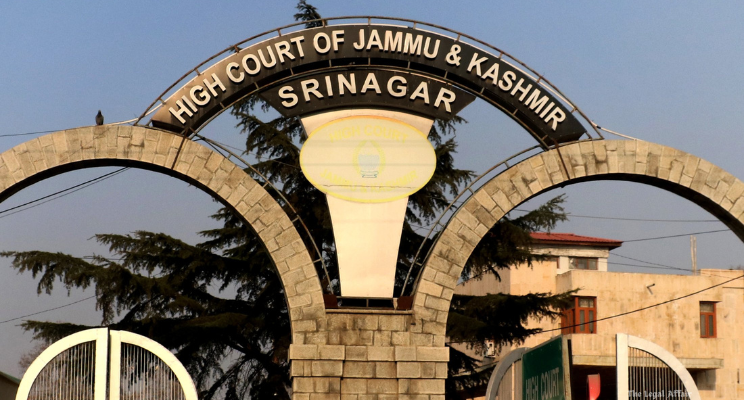
Introduction:
In Younis Ali Vs Union Of India & Ors., reported as 2026 LiveLaw (JKL), the High Court of Jammu and Kashmir and Ladakh examined the extent to which constitutional courts can interfere with medical fitness determinations made during recruitment to the Central Armed Police Forces. The matter was decided by Justice Sanjay Dhar, who was called upon to determine whether a candidate declared medically unfit by a Review Medical Board could seek constitution of a fresh and independent medical board merely on the basis of a contrary opinion obtained from a government hospital. The petitioner had applied pursuant to an advertisement notification issued by the Staff Selection Commission for recruitment to the posts of Constable General Duty in the CAPFs, Special Security Force and Rifleman General Duty in the Assam Rifles. He successfully cleared the Physical Standard Test, Physical Efficiency Test and document verification and thereafter underwent the Detailed Medical Examination. During the Detailed Medical Examination he was declared medically unfit on account of Myopia, Squint and Knock Knee. Availing the statutory remedy, he appeared before the Review Medical Board. While the Review Medical Board cleared him of Myopia and Knock Knee, it reaffirmed the finding of Squint in his right eye and declared him unfit. Aggrieved by this determination, the petitioner relied upon an outpatient card issued by the Ophthalmology Department of Government Medical College Hospital Jammu which recorded that there was no evidence of squint. On the strength of this document, he approached the High Court seeking direction for a fresh medical examination by an independent board. The core question before the Court was whether the medical opinion rendered by the Review Medical Board constituted under recruitment rules could be reopened on the basis of a subsequent individual medical report.
Arguments of the Petitioner:
Appearing for the petitioner, Mr P N Bhat, Advocate, contended that the findings of the CAPFs medical authorities were erroneous and casual. He argued that the petitioner had successfully cleared all physical and efficiency parameters and that his disqualification rested solely on the alleged presence of squint. According to counsel, the outpatient record from the Government Medical College Hospital Jammu clearly indicated absence of squint, thereby casting serious doubt on the correctness of the Review Medical Board’s conclusion. It was submitted that the medical examination conducted by the CAPFs authorities lacked due care and that an incorrect diagnosis had unjustly deprived the petitioner of public employment. Counsel emphasized that public recruitment must be fair and transparent and that an erroneous medical opinion cannot be permitted to defeat the legitimate aspirations of a meritorious candidate. He argued that the High Court, exercising jurisdiction under Article 226 of the Constitution, possesses ample power to direct constitution of a fresh medical board where credible material suggests error in the assessment. It was further submitted that denial of such an opportunity would amount to arbitrariness and violation of Articles 14 and 16 of the Constitution. The petitioner did not allege malafides in express terms but urged that the conflicting medical opinion from a reputed government institution warranted re examination in the interests of justice. According to him, when two expert opinions differ, the benefit should go to the candidate, particularly in recruitment to disciplined forces where medical fitness standards are strictly applied. On these grounds, he sought judicial intervention to order a fresh medical evaluation.
Arguments of the Respondents:
Opposing the writ petition, Mr Vishal Sharma, learned Deputy Solicitor General of India, assisted by Mr Sumant Sudan, Advocate, submitted that the recruitment process was conducted strictly in accordance with statutory rules and medical policy framed by the Ministry of Home Affairs. It was contended that the applicable memorandum dated 24 August 2005 clearly stipulates that no appeal lies against the decision of the Review Medical Board. The respondents emphasized that the recruitment framework provides for two stages of medical examination namely the Detailed Medical Examination and the Review Medical Examination and that the latter is intended to be final. Counsel argued that permitting a third medical examination would be contrary to the recruitment policy and would open the floodgates for endless litigation by dissatisfied candidates. It was further submitted that medical fitness assessment in CAPFs recruitment is a specialized function entrusted to expert boards comprising qualified doctors who examine candidates in accordance with prescribed standards. Courts, it was urged, lack the technical expertise to re evaluate such determinations. Reliance was placed on judicial precedents including decisions of the Allahabad High Court in Vivek Kumar v State of U P and Diwakar Paswan v State of U P which caution against judicial interference in medical assessments merely on the basis of private or subsequent medical opinions. The respondents contended that a solitary outpatient entry cannot override the collective opinion of a duly constituted Review Medical Board consisting of three specialists. It was submitted that the petitioner had neither pleaded nor proved any procedural irregularity, bias or malafide in the conduct of the medical examination. Therefore, the writ petition deserved dismissal.
Court’s Judgment:
After hearing the parties and examining the record, Justice Sanjay Dhar framed the principal issue as whether the opinion recorded in an outpatient card issued by a government hospital could discredit or override the findings of a Review Medical Board constituted under the recruitment rules. The Court began by emphasizing the limited scope of judicial review in matters relating to assessment of medical fitness by expert bodies. It observed that recruitment to the Central Armed Police Forces involves rigorous standards and that the medical examination process is governed by a clearly defined legal framework. The Court noted that under the applicable rules, a candidate declared unfit in the Detailed Medical Examination is entitled to a Review Medical Examination. However, once the Review Medical Board renders its decision in accordance with prescribed procedure, that decision attains finality. The Court underscored that the Ministry of Home Affairs memorandum dated 24 August 2005 categorically reiterates that no appeal lies against the decision of the Review Medical Board. In unambiguous terms, the Court stated that the legal framework for medical examination in CAPFs recruitment clearly provides that the medical board’s assessment is final and no appeal can be entertained against the finding of the second medical examination. Referring to consistent judicial precedent, the Court observed that interference with expert medical determinations would be justified only in exceptional circumstances such as proven procedural violations, arbitrariness or malafides. Medical fitness, the Court remarked, is a subject best left to experts and not amenable to comparative evaluation by courts. Permitting reopening of medical examinations solely on the basis of individual medical reports obtained subsequently would set a dangerous precedent and disrupt recruitment processes conducted strictly in accordance with statutory rules. Applying these principles to the facts of the case, the Court found that the petitioner relied merely on a solitary entry made by the Registrar of the Ophthalmology Department in an outpatient card. This document, the Court held, could not outweigh the collective opinion of a Review Medical Board comprising three specialist doctors who examined the petitioner in accordance with recruitment standards. The petitioner had not alleged any procedural irregularity in the conduct of the Review Medical Examination nor had he produced cogent material casting doubt on its integrity. In the absence of such material, there was hardly any scope for judicial review of the findings. The Court thus concluded that the petitioner failed to make out any exceptional circumstance warranting interference. Upholding the finality accorded to the Review Medical Board’s decision, the High Court dismissed the writ petition.