


Introduction:
In a significant exercise of its constitutional jurisdiction, the Rajasthan High Court has taken suo motu cognizance of the widespread and persistent violation of liquor vending regulations in Jodhpur city, particularly the illegal sale of alcohol beyond the statutorily prescribed closing hours. The matter, registered as In Re: Systemic Violations of Liquor Closing Hours and Excise Regulations in Jodhpur City, came before a Division Bench comprising Dr. Justice Pushpendra Singh Bhati and Dr. Justice Nupur Bhati.
The Court’s intervention was triggered by a report published in a local newspaper highlighting a sting operation that exposed rampant after-hours liquor sales across various parts of Jodhpur. The report revealed that several liquor vendors were allegedly continuing their business well beyond the legally permitted hours through concealed and innovative methods, including restricted-access windows, partially shuttered shops, and covert delivery mechanisms. The revelations also pointed towards a possible failure of regulatory authorities to effectively enforce the provisions of the Excise laws and licensing conditions governing liquor trade.
Recognizing the seriousness of the issue, the High Court initiated proceedings on its own motion, observing that illegal liquor sales after designated hours are not merely violations of licensing conditions but have far-reaching implications for public health, public safety, women’s security, road safety, and maintenance of law and order. The Court noted that the issue touches upon constitutional values embodied in Articles 21 and 47 of the Constitution of India.
Article 21 guarantees every individual the right to life and personal liberty, which has been expansively interpreted by constitutional courts to include the right to live with dignity, safety, and a healthy environment. Article 47, which forms part of the Directive Principles of State Policy, casts a duty upon the State to improve public health and to endeavor to prohibit the consumption of intoxicating substances harmful to health.
Against this constitutional backdrop, the Court examined the apparent failure of authorities to prevent systematic violations of liquor vending regulations. The proceedings have consequently evolved into a broader inquiry concerning the State’s obligation to regulate liquor trade effectively and protect public welfare.
The matter assumes particular importance because liquor trade occupies a unique position in Indian constitutional law. Unlike ordinary commercial activities, trade in liquor is treated as a privilege granted by the State and remains subject to strict regulatory control. The case therefore raises significant questions concerning governance, administrative accountability, public health obligations, and judicial oversight of regulatory enforcement.
Arguments of the Parties:
Since the proceedings originated through suo motu cognizance by the High Court, there was no conventional petitioner presenting a structured challenge. Instead, the Court proceeded on the basis of information available in the public domain, particularly the investigative newspaper report that exposed alleged large-scale violations of liquor licensing regulations in Jodhpur.
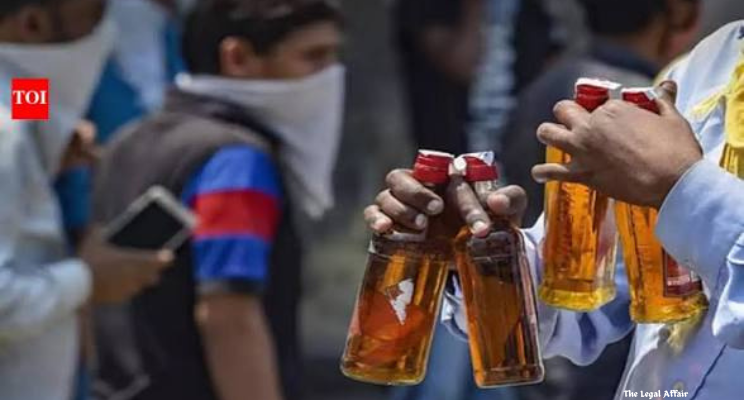
The material placed before the Court suggested that several liquor vendors were continuing sales even after the expiry of permissible business hours. According to the report, vendors had devised methods to evade regulatory scrutiny by conducting transactions through partially closed shutters, concealed openings, side entrances, and restricted-access windows. These practices allegedly enabled customers to purchase liquor late into the night despite statutory restrictions.
The information further indicated that such violations were neither isolated nor sporadic. Rather, they appeared to reflect a systemic pattern of non-compliance that had become normalized in certain areas. The report also raised concerns regarding the effectiveness of enforcement mechanisms and questioned whether adequate monitoring was being undertaken by the Excise Department and local police authorities.
From the perspective of public interest, concerns emerged regarding the consequences of unrestricted liquor availability during late-night hours. The continuation of liquor sales beyond permitted timings was viewed as contributing to drunken driving, public disturbances, crime, violence, accidents, and threats to public safety.
The Court took note of the broader societal impact of such violations, particularly on women, children, senior citizens, and residents of affected neighborhoods. Late-night liquor availability often correlates with increased incidents of disorderly conduct, public nuisance, and threats to personal security.
The State authorities, who were issued notices by the Court, are expected to place their responses regarding the enforcement measures already in place, action taken against erring licensees, and future strategies for ensuring compliance with statutory regulations.
The Court specifically sought explanations concerning action already initiated against liquor vendors found violating prescribed closing hours. It also required information regarding existing monitoring systems, inspection protocols, and enforcement mechanisms employed by the Excise Department and police authorities.
Additionally, the authorities were called upon to explain what immediate and long-term measures were being contemplated to eliminate unauthorized methods used for after-hours liquor sales.
The Court’s queries indicate an expectation that the State must justify not only the adequacy of its current enforcement framework but also its commitment to preventing future violations through improved regulatory oversight.
Thus, while the proceedings remain at an interim stage, the broad contours of the dispute reveal a tension between regulatory obligations imposed upon liquor licensees and the State’s responsibility to ensure meaningful enforcement of those obligations in the interest of public welfare.
Court’s Judgment:
The Rajasthan High Court’s order reflects a strong constitutional approach to the regulation of liquor trade and the protection of public welfare. While issuing notices and seeking detailed responses from the authorities, the Court made several important observations regarding the nature of liquor trade, the obligations of the State, and the role of constitutional courts in addressing systemic governance failures.
At the outset, the Court reiterated a well-established constitutional principle that trade in liquor is not an ordinary commercial activity carrying unrestricted rights. Instead, it is a privilege granted by the State and remains subject to stringent regulation in the interest of public health and public order.
The Court emphasized that because liquor trade is heavily regulated, compliance with licensing conditions becomes an essential requirement. Among these conditions, prescribed operating hours constitute a critical regulatory safeguard intended to balance commercial interests with broader societal concerns.
According to the Court, permitting systematic violations of closing-hour restrictions undermines the very framework of regulation upon which liquor licensing is based. When authorities fail to enforce these conditions effectively, public confidence in the rule of law is weakened.
A central feature of the judgment is its reliance upon constitutional values embodied in Articles 21 and 47 of the Constitution. The Court observed that the consequences of unregulated after-hours liquor sales extend beyond technical breaches of licensing requirements and directly affect constitutional rights and public welfare.
The Court noted that Article 21 guarantees the right to live with dignity and in a safe environment. Excessive and unregulated liquor availability has the potential to negatively impact public safety, increase criminal activity, contribute to road accidents, and endanger vulnerable sections of society.
The Bench also invoked Article 47, which directs the State to improve public health and reduce the harmful effects of intoxicating substances. Although Directive Principles are not directly enforceable, courts have consistently recognized them as guiding principles for governance and policy implementation.
Significantly, the Court observed that persistent violations of liquor vending regulations undermine the State’s constitutional obligation to protect public health and maintain public order. The failure to enforce closing-hour restrictions therefore raises concerns that transcend ordinary administrative lapses.
Another important aspect of the judgment is its invocation of the doctrine of parens patriae. This doctrine recognizes the State—and in appropriate cases, constitutional courts—as protectors of public welfare and guardians of vulnerable interests.
The Court observed that where executive inaction, negligence, or regulatory failure threatens constitutional rights and public interests, judicial intervention becomes necessary. Referring to the doctrine, the Bench remarked that courts are obligated to act when executive apathy or complicity undermines the rule of law and affects citizens’ fundamental rights.
The Court found sufficient material in the newspaper report and sting operation to warrant a deeper examination of the issue. The allegations disclosed not merely isolated violations but a potentially systemic failure in enforcement that required urgent attention.
Consequently, the Court directed the concerned authorities to submit detailed reports addressing several critical issues. These included action taken against liquor licensees found violating closing-hour restrictions, mechanisms currently in place for monitoring compliance, and measures proposed for preventing recurring violations.
The Court further required authorities to identify and address unauthorized methods through which liquor sales were allegedly continuing after permitted hours.
Recognizing the need for immediate corrective action, the Court issued a series of interim directions designed to strengthen enforcement and improve accountability.
One of the most significant directions concerned the constitution of special enforcement teams. The Court directed the Police Commissioner and the District Excise Officer to establish dedicated teams tasked with conducting surprise inspections of liquor establishments.
Importantly, the Court mandated that such inspections be geo-tagged and videographed. This requirement serves multiple objectives. It enhances transparency, creates reliable evidence of enforcement activity, discourages collusion, and enables judicial review of compliance efforts if necessary.
The Court also demonstrated an awareness of the role of technology in modern regulatory enforcement. It directed the State Government to examine the feasibility of introducing technological safeguards aimed at improving monitoring and compliance.
Among the measures suggested by the Court were installation of night-vision CCTV cameras, implementation of digital billing systems, integration of electronic point-of-sale mechanisms, and development of photographic and timestamp-based closure verification protocols.
These directions reflect a broader judicial trend toward encouraging technology-driven governance solutions capable of reducing discretion, enhancing transparency, and strengthening regulatory oversight.
The Court further sought information regarding liquor shops situated near sensitive public locations such as schools, hospitals, places of worship, and residential colonies. This aspect of the order underscores the Court’s concern regarding the broader social impact of liquor availability in areas frequented by vulnerable populations.
By requiring a detailed assessment of such establishments, the Court signaled its intention to evaluate whether existing licensing and zoning practices adequately safeguard public interests.
Although the proceedings remain pending and no final adjudication has yet been rendered, the interim order represents a significant judicial intervention in matters of public administration and regulatory enforcement.
The Court has effectively transformed a newspaper report into a constitutional inquiry concerning public health, administrative accountability, and the State’s duty to enforce the law. The observations made by the Bench indicate that mere existence of regulatory provisions is insufficient if enforcement mechanisms fail in practice.
The matter, which is scheduled for further consideration on July 6, 2026, is likely to have broader implications for liquor regulation across Rajasthan and potentially beyond. Depending upon the reports submitted by the authorities, the Court may consider additional measures aimed at strengthening compliance and ensuring that liquor licensing regulations are implemented in both letter and spirit.
Ultimately, the order serves as a reminder that regulatory governance cannot remain confined to paper compliance. Where systemic violations threaten public health, public safety, and constitutional values, courts may step in to ensure that statutory obligations are effectively enforced and that administrative authorities discharge their duties with diligence and accountability.