


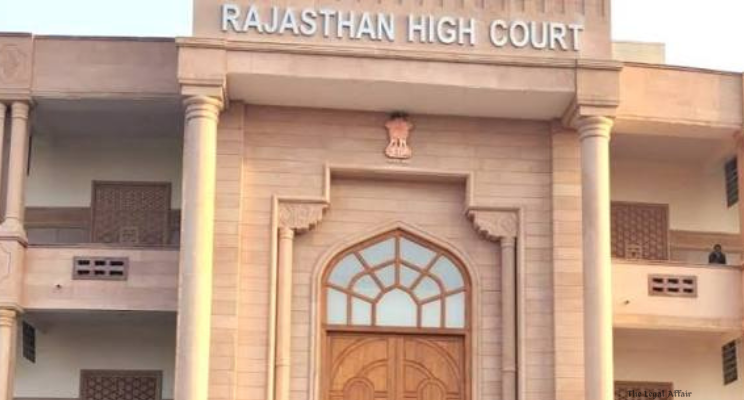
Introduction:
The Rajasthan High Court, in Smt. Guddi Bai v. Raghuveer (2026 LiveLaw (Raj) 163), delivered a thought-provoking judgment addressing the limitations of maintenance law under Section 125 of the Code of Criminal Procedure, 1973. The case raised a critical question concerning the entitlement of a woman to maintenance when her marriage is rendered void due to the subsistence of a prior marriage of both parties.
The petitioner, Smt. Guddi Bai, approached the Family Court seeking maintenance from the respondent, Raghuveer, under Section 125 CrPC. However, her application was rejected on the ground that at the time of their alleged marriage, both the petitioner and the respondent had living spouses. Consequently, the marriage between them was considered void in the eyes of law. Aggrieved by this decision, the petitioner challenged the Family Court’s order before the High Court.
The matter came before a single bench presided over by Justice Anoop Kumar Dhand. While dealing with the issue, the Court was confronted with a delicate balance between strict legal interpretation and the broader objective of social justice embedded in Section 125 CrPC. The case also brought to light a recurring social reality where economically vulnerable women are left without legal protection due to technical limitations in statutory provisions.
The Court acknowledged the unfortunate circumstances faced by the petitioner, noting that many women, particularly from weaker sections of society, are often subjected to exploitation in relationships that lack legal recognition. Despite the remedial intent of Section 125 CrPC, the Court observed that certain legal loopholes continue to hinder its effectiveness in addressing such exploitation.
Arguments of the Parties:
The petitioner contended that she was entitled to maintenance under Section 125 CrPC as she had lived with the respondent as his wife and was dependent on him for her livelihood. It was argued that the provision is a measure of social justice designed to prevent destitution and vagrancy among women and children. Therefore, its interpretation should be liberal and purposive rather than strictly technical.
The petitioner further emphasized that she had entered into the relationship in good faith and had cohabited with the respondent, thereby establishing a domestic arrangement akin to marriage. She argued that denying her maintenance on the ground of a technical invalidity of marriage would defeat the very purpose of the provision, which is to protect vulnerable women from abandonment and financial hardship.
It was also submitted that the inclusive definition of “wife” under Section 125 CrPC extends beyond strictly valid marriages and includes women who may not technically qualify as legally wedded wives but are nevertheless in relationships that resemble marriage. On this basis, the petitioner sought to bring her case within the protective ambit of the provision.
On the other hand, the respondent strongly opposed the claim, asserting that the petitioner was not his legally wedded wife. He argued that both parties had subsisting marriages at the time they entered into their relationship, rendering their subsequent union void ab initio. As such, the petitioner could not claim any legal status as a wife under Section 125 CrPC.
The respondent relied on settled legal principles which hold that maintenance under Section 125 is available only to a legally wedded wife, including a divorced woman who has not remarried. However, a second wife whose marriage is void due to the existence of a prior valid marriage does not fall within the scope of the provision.
The respondent further contended that extending maintenance rights to such relationships would effectively legitimize void marriages, which is contrary to established matrimonial law. He maintained that the statutory framework does not recognize such unions and therefore cannot confer benefits arising from a legally valid marriage.
Court’s Judgment:
The High Court, after carefully considering the submissions and the legal framework, upheld the decision of the Family Court and rejected the petitioner’s claim for maintenance under Section 125 CrPC. The Court began by reiterating the fundamental objective of the provision, describing it as a measure of social justice intended to protect women and children from destitution and neglect.
At the same time, the Court emphasized that the application of Section 125 CrPC is subject to certain legal conditions, one of which is the requirement that the claimant must fall within the definition of “wife.” While acknowledging that the term “wife” has been interpreted expansively in certain contexts to include divorced women, the Court clarified that this inclusivity does not extend to women in void marriages arising out of subsisting prior marriages.
The Court observed that the law draws a clear distinction between irregular or voidable marriages and marriages that are void ab initio. In the present case, since both the petitioner and the respondent had living spouses at the time of their union, their relationship did not constitute a valid marriage under the law. Consequently, the petitioner could not be recognized as a legally wedded wife.
In a significant observation, the Court stated that the definition of “wife” under Section 125 CrPC does not envisage a situation where both parties to the relationship have existing spouses. Therefore, such a relationship cannot attract the protections available under the provision.
However, the Court did not overlook the harsh realities faced by the petitioner. In a sympathetic tone, it described the situation as “unfortunate” and acknowledged that many women in similar circumstances are left without effective legal remedies due to gaps in the law. The Court noted that despite the social justice objective of Section 125 CrPC, its limited scope often fails to address the exploitation of women in void marriages.
The judgment candidly highlighted the existence of legal loopholes that allow individuals to evade responsibility while leaving vulnerable women without support. The Court expressed concern that such situations undermine the very purpose of maintenance laws and called attention to the need for legislative intervention to address these gaps.
Despite these observations, the Court maintained that it could not extend the scope of Section 125 CrPC beyond its statutory limits. It held that judicial interpretation must remain within the framework of the law and cannot override clear legal provisions.
Importantly, the Court pointed out that the petitioner was not entirely without remedy. It referred to the provisions of the Protection of Women from Domestic Violence Act, 2005, particularly Section 22, which allows a woman to seek compensation and other reliefs in cases of domestic violence. The Court suggested that this avenue could provide some measure of relief to the petitioner.
By directing attention to alternative remedies, the Court sought to balance the strict application of law with the need to ensure justice for the petitioner. Nevertheless, it ultimately concluded that the petitioner was not entitled to maintenance under Section 125 CrPC.
Accordingly, the petition was disposed of, and the order of the Family Court was upheld.