


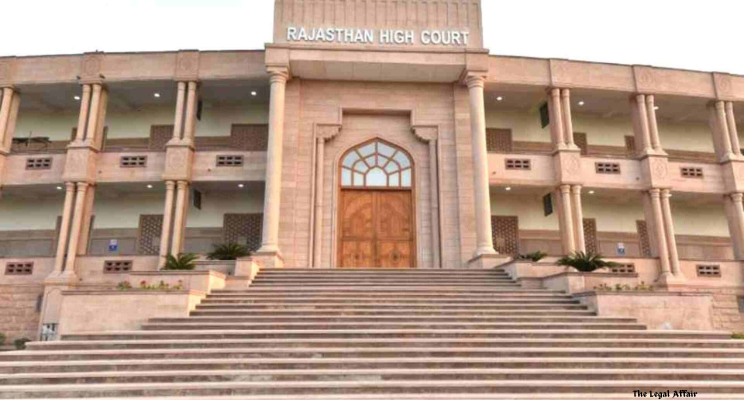
Introduction:
In the significant judgment delivered by the Rajasthan High Court in Smt. Rajani Bhardwaj v Director, Secondary Education, reported as 2025 LiveLaw (Raj) 168, the Court expressed deep anguish over the systemic gender discrimination that persists in government services and took a decisive stand by issuing a writ of mandamus against the State of Rajasthan. The petitioner, Smt. Rajani Bhardwa was a meritorious female Lecturer selected by the Rajasthan Public Service Commission (RPSC), securing 4th position in the merit list. She was subsequently appointed and served in boys’ institutions throughout her career. Despite her qualifications and consistent service, when the seniority list for promotion to the post of Principal was prepared, her name was excluded solely because she was a woman categorised under Schedule-II (meant for girls’ institutions) in Rule 4(4) of the Rajasthan Educational Service Rules, 1970. Meanwhile, less meritorious male candidates—Neeraj Kumar Sharma (Rank 8) and Ashok Kumar Joshi (Rank 31)—were granted promotion. Her appeal to the Rajasthan Civil Services Appellate Tribunal was rejected, prompting her to approach the High Court under Article 226 of the Constitution. The State justified the exclusion by relying on the classification under Rule 4(4), which distinguishes between male and female Lecturers based on their postings in boys’ or girls’ institutions.
Arguments:
However, the petitioner contended that this classification was arbitrary and discriminatory, particularly because she had been serving in boys’ institutions and fulfilled all necessary criteria for promotion. She argued that the denial of promotion solely based on her gender violated Articles 14 (equality before law), 15 (prohibition of discrimination), 16 (equality in public employment), and 21 (right to life and dignity) of the Constitution.
Judgement:
The Court, presided over by Justice Anoop Kumar Dhand, delivered a strongly worded verdict condemning gender bias, stating that even in modern times, societal norms and official policies still perpetuate discrimination against women. Justice Dhand noted the persistent existence of such bias in governmental decision-making, calling it a “gross discrimination” and expressing “pain” at the unfair treatment of deserving women candidates. The Court pointed out that Rule 4(4) of the 1970 Rules merely classifies institutions for administrative convenience and does not impose any bar on promotions across these schedules. Therefore, differentiating based on gender or the nature of the institution (boys or girls) lacks any legal basis. Moreover, the Court found no justification in Rule 28(3) for preparing separate seniority lists based on gender, highlighting that such action was legally untenable and violative of constitutional provisions. The judgment stressed that when a female Lecturer performs the same duties and holds the same qualifications as her male counterparts, she cannot be denied equal treatment merely due to a stereotypical understanding of gender roles. Citing the Supreme Court’s decision in Ajay Kumar Shukla v Arvind Rai & Ors, the Court reaffirmed that while promotion itself may not be a fundamental right, the right to be considered for promotion is a fundamental right, which was denied in this case. The Court went on to emphasise that equal opportunity in public employment is a constitutional guarantee, and administrative convenience cannot override fundamental rights. Justice Dhand further elaborated that perpetuating such discrimination through rules or practices undermines the principles of justice and equality enshrined in the Constitution. He remarked that creating artificial barriers based on gender not only impacts individual careers but also entrenches harmful stereotypes. The Court therefore issued a writ of mandamus to the State of Rajasthan directing it to take immediate policy action to rectify all discriminatory practices embedded in existing rules and policies. This included ensuring that women performing equal work receive equal benefits and are not denied promotion or other advantages available to their male colleagues. The Court also quashed the Rajasthan Civil Services Appellate Tribunal’s decision and directed the respondents to consider the petitioner’s case for promotion to the post of Principal as per her seniority. It ordered that this promotion be granted with retrospective effect from the date when her junior male counterparts were promoted, along with all consequential benefits, including arrears and seniority. The judgment stands as a clarion call for eradicating gender-based inequality in public employment, reaffirming that administrative rules cannot be used as a tool for perpetuating injustice. Justice Dhand’s observations underscore the constitutional mandate to build an inclusive and equitable society where rights are not determined by one’s gender. He stressed that all individuals, regardless of being male, female, or third gender, are entitled to equal treatment and dignity. The decision sends a powerful message to all state authorities and administrative bodies that excuses rooted in outdated norms or institutional rigidity will no longer be entertained when fundamental rights are at stake. It is a reminder that India’s constitutional values must be reflected in its governance structures and that equality must not remain a theoretical ideal but a lived reality.