


Introduction:
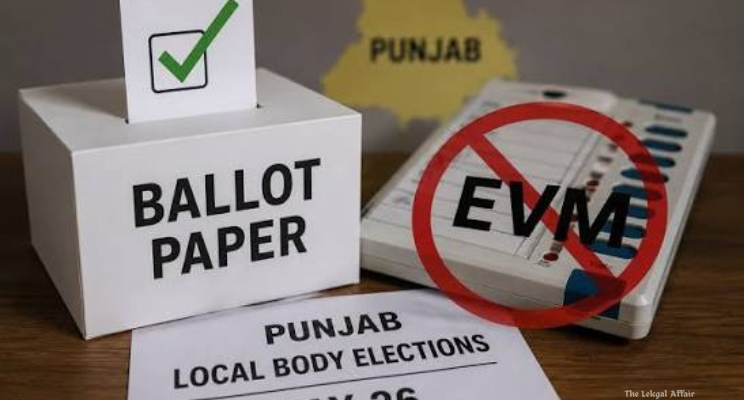
In a significant ruling concerning the conduct of municipal elections and the scope of powers vested in State Election Commissions under the Constitution, the Punjab & Haryana High Court dismissed a Public Interest Litigation challenging the decision of the Punjab State Election Commission to conduct the upcoming local body elections through ballot papers instead of Electronic Voting Machines (EVMs) with Voter Verifiable Paper Audit Trail (VVPAT) systems.
The judgment was delivered by a Division Bench comprising Chief Justice Sheel Nagu and Justice Sanjiv Berry in the matter titled Ruchita Garg v. State of Punjab. The petition came before the Court shortly before the Municipal General Elections, 2026, which are scheduled to be conducted in Punjab on May 26, with counting of votes fixed for May 29.
The controversy arose after the Punjab State Election Commission decided to revert to the use of ballot papers for the conduct of local body elections, departing from the earlier practice of using EVMs equipped with VVPAT technology. The petitioner questioned the legality and constitutional validity of this decision, arguing that the sudden shift from electronic voting to paper ballots was made through an administrative communication without legislative backing, statutory amendment, or meaningful public consultation.
The plea alleged that the decision compromised the constitutional principles of free and fair elections and weakened electoral transparency and credibility. The petitioner contended that the use of EVMs with VVPAT had been repeatedly endorsed by the Supreme Court as a safeguard against electoral malpractice, including booth capturing, ballot stuffing, tampering, and manipulation.
The matter assumed significance because it involved the intersection of constitutional election law, electoral technology, and the autonomy of State Election Commissions under Article 243ZA of the Constitution of India. The case also raised broader questions regarding whether courts can interfere with procedural decisions taken by State Election Commissions concerning the manner in which local body elections are conducted.
The petitioner heavily relied upon several landmark Supreme Court decisions, including Dr. Subramanian Swamy v. Election Commission of India, Chandrababu Naidu v. Union of India, and Association for Democratic Reforms v. Union of India, to argue that EVM-VVPAT systems had emerged as essential safeguards ensuring transparency and voter confidence in the democratic process.
On the other hand, the State defended the decision by asserting that the constitutional authority to conduct municipal elections vests exclusively in the State Election Commission under Article 243ZA. The Advocate General for Punjab argued that the Election Commission of India has no direct role in municipal elections and that the State Election Commission possesses independent authority to determine the method and manner of conducting such polls.
After hearing the parties, the High Court dismissed the PIL, thereby permitting the Punjab local body elections to proceed through ballot papers. Although a detailed judgment is awaited, the Court’s decision is significant because it appears to reaffirm the constitutional autonomy of State Election Commissions in matters concerning local self-government elections.
The ruling also reflects judicial restraint in election-related matters, especially where constitutional bodies exercise discretionary powers within their statutory and constitutional domain. It underscores the distinction between parliamentary and assembly elections conducted under the supervision of the Election Commission of India and municipal elections governed by State Election Commissions under Part IXA of the Constitution.
The decision is likely to have wider implications for future debates surrounding electoral technology, decentralised election administration, and the balance between electoral transparency and institutional autonomy in India’s democratic framework.
Arguments of the Parties:
The petitioner challenged the Punjab State Election Commission’s decision to conduct the Municipal General Elections, 2026 through ballot papers instead of EVMs with VVPAT systems.
According to the petitioner, the decision to revert to ballot paper voting had been taken abruptly through an administrative communication without any legislative amendment, statutory sanction, or public consultation process. It was argued that such an important shift in electoral procedure affecting the integrity of elections could not be implemented merely through executive or administrative directions.
The petitioner contended that the use of EVMs with VVPAT had evolved into a critical safeguard ensuring electoral transparency, accountability, and public confidence in the democratic process. It was argued that abandoning this mechanism without proper justification undermined the constitutional mandate of free and fair elections.
The plea specifically alleged violation of Articles 14, 19(1)(a), 21, and 243ZA of the Constitution of India. According to the petitioner, arbitrary replacement of EVM-VVPAT systems with ballot papers infringed constitutional guarantees of equality, fairness, informed participation, and democratic integrity.
The petitioner strongly relied upon judicial precedents delivered by the Supreme Court concerning the use of EVMs and VVPAT technology. Particular reliance was placed upon Dr. Subramanian Swamy v. Election Commission of India, where the Supreme Court had recognized VVPAT as an indispensable requirement for ensuring transparency and verifiability in elections.
The petitioner also cited Chandrababu Naidu v. Union of India and Association for Democratic Reforms v. Union of India to contend that judicial decisions had consistently emphasized the importance of electoral transparency and institutional safeguards against manipulation.
According to the petitioner, EVMs with VVPAT were introduced precisely to address concerns relating to booth capturing, ballot stuffing, tampering, and electoral fraud that historically plagued paper ballot systems. Therefore, reverting to ballot papers without any demonstrated defect in EVM functioning was irrational and contrary to public interest.
The plea further alleged that the State Election Commission’s decision appeared to stem from arbitrary administrative considerations rather than any objective assessment of electoral integrity or technological failure. It was argued that no material had been placed before the public demonstrating malfunction, unreliability, or insecurity in EVM-VVPAT systems.
The petitioner also expressed concern regarding the possibility of increased electoral malpractice in ballot-based elections, especially considering previous experiences in the State. According to the petitioner, paper ballots inherently carry greater risks of booth capturing, ballot tampering, invalid vote manipulation, and counting disputes.
In this background, the petitioner sought directions from the High Court requiring the authorities to conduct the Municipal Elections, 2026 exclusively through EVMs equipped with VVPAT systems. The petition also prayed for quashing any official communication or administrative order permitting conduct of elections through ballot papers.
On the other hand, the State of Punjab opposed the PIL and defended the constitutional authority of the State Election Commission to independently determine the manner in which municipal elections are conducted.
Advocate General for Punjab, Maninderjit Singh Bedi, argued that Article 243ZA of the Constitution confers exclusive authority upon the State Election Commission in matters relating to municipal elections and local body polls.
The State emphasized that the Election Commission of India, which conducts parliamentary and assembly elections under Article 324, has no direct constitutional role in the conduct of municipal corporation elections. Therefore, decisions relating to the procedure and mechanism of local body elections fall entirely within the domain of the State Election Commission.
The State’s submissions effectively highlighted the constitutional distinction between national and state-level elections on one hand and local self-government elections on the other. According to the State, once the Constitution itself vests election-related authority in the State Election Commission, judicial interference with procedural decisions should remain extremely limited.
The respondents also opposed the petitioner’s attempt to constitutionalize the use of EVMs. According to the State, neither the Constitution nor statutory law mandates compulsory use of EVM-VVPAT systems for local body elections.
It was argued that the choice between ballot papers and electronic voting machines falls within the policy and administrative discretion of the competent election authority, particularly where no statutory prohibition exists against either method.
The State therefore urged the Court to refrain from interfering with election-related administrative decisions taken by a constitutionally empowered authority in the absence of clear illegality or constitutional violation.
Court’s Judgment:
The Punjab & Haryana High Court dismissed the Public Interest Litigation challenging the decision of the Punjab State Election Commission to conduct the upcoming local body elections through ballot papers instead of EVMs with VVPAT systems.
Although the detailed judgment is awaited, the dismissal of the petition indicates that the Division Bench comprising Chief Justice Sheel Nagu and Justice Sanjiv Berry was not persuaded that the State Election Commission’s decision warranted judicial interference.
The Court’s ruling appears to reaffirm the constitutional autonomy and authority of State Election Commissions under Article 243ZA of the Constitution of India. This provision vests in State Election Commissions the power of superintendence, direction, and control over the preparation of electoral rolls and conduct of elections to municipalities.
The High Court seemingly accepted the State’s contention that municipal elections stand on a distinct constitutional footing from parliamentary and assembly elections conducted by the Election Commission of India under Article 324.
By refusing to interfere, the Court effectively recognized that procedural decisions concerning the conduct of local body elections fall primarily within the discretionary domain of the State Election Commission, unless the decision is shown to be manifestly arbitrary, unconstitutional, or contrary to statutory provisions.
The dismissal of the PIL also reflects the well-established principle of judicial restraint in election-related matters. Courts traditionally exercise caution before interfering with electoral processes, especially when elections are imminent and when decisions are taken by constitutionally recognized election authorities.
The petitioner had attempted to argue that use of EVM-VVPAT systems had become an essential constitutional requirement for ensuring free and fair elections. However, the Court’s refusal to grant relief suggests that it did not accept the proposition that EVMs constitute the only constitutionally permissible mode of conducting elections.
The ruling implicitly acknowledges that both ballot paper systems and EVM-based voting remain legally recognized methods of conducting elections in India, subject to statutory and constitutional authorization.
Another important aspect emerging from the case is the Court’s apparent distinction between judicial endorsement of EVM-VVPAT systems and mandatory constitutional compulsion to use them in every category of election.
The Supreme Court judgments relied upon by the petitioner, including Dr. Subramanian Swamy v. Election Commission of India, recognized VVPAT as an important transparency safeguard. However, those decisions did not declare ballot paper elections unconstitutional or prohibit competent authorities from choosing alternative lawful electoral mechanisms.
The High Court therefore appears to have treated the issue as one involving electoral policy and administrative discretion rather than constitutional invalidity.
The Court’s decision also indirectly reinforces the principle that constitutional bodies entrusted with specialized functions should ordinarily be permitted to exercise their expertise and discretion without excessive judicial substitution of administrative judgment.
Importantly, the High Court dismissed the petition shortly before the scheduled elections. Judicial interference at such a late stage could potentially have disrupted the election process, delayed polling, or created administrative uncertainty. Courts have consistently emphasized that electoral processes should not be interrupted except in cases involving grave illegality or constitutional breakdown.
The ruling therefore aligns with broader judicial principles discouraging last-minute intervention in election administration.
At the same time, the controversy surrounding the case highlights continuing public debate regarding electoral technology, transparency, and voter confidence. Supporters of EVM-VVPAT systems often argue that electronic voting improves efficiency, reduces invalid votes, and minimizes opportunities for physical tampering associated with ballot papers.
Conversely, constitutional authorities may sometimes consider logistical, administrative, or operational concerns while selecting voting mechanisms for local elections. The High Court’s ruling suggests that such decisions fall within the competence of election authorities rather than judicial determination.
The case also highlights the decentralized structure of India’s electoral framework. While the Election Commission of India oversees national and state legislative elections, local body elections are constitutionally entrusted to State Election Commissions, thereby reflecting the federal and decentralized character of Indian democracy.
Ultimately, the Punjab & Haryana High Court’s decision reinforces the autonomy of State Election Commissions while underscoring judicial reluctance to interfere in election administration absent compelling constitutional grounds.
The ruling affirms that courts will ordinarily defer to the judgment of constitutionally empowered election authorities regarding procedural aspects of local body elections, provided such decisions remain within the framework of law and constitutional governance.