


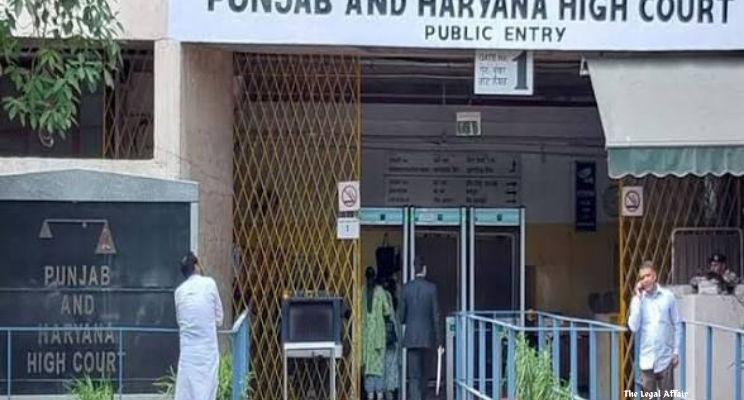
Introduction:
The Punjab and Haryana High Court has ruled that a police officer below the rank of Deputy Inspector General of Police (DIG) cannot issue an intimation to an online intermediary for restricting access to social media content under the Information Technology (Intermediary Guidelines and Digital Media Ethics Code) Rules, 2021, unless the statutory requirements governing the exercise of that power are satisfied. The Court further held that a user whose content is targeted by such an intimation must receive a copy of it when it is sent to the intermediary, thereby enabling the user to challenge the restriction through the prescribed grievance redressal mechanism.
Justice Tribhuvan Dahiya delivered the ruling while hearing a petition filed by Haryana 24 News Network Pvt. Ltd., a news organisation whose verified Facebook page had been blocked in India following an intimation issued by the Superintendent of Police, Yamuna Nagar. The Court found that the officer had exercised a power that the relevant statutory rules did not confer upon an officer of his rank. It consequently set aside the intimation dated August 21, 2026, and directed the authorities to initiate the process for restoring the page.
The dispute arose after the news organisation discovered that its verified Facebook page had become inaccessible in India from August 21, 2026. The only explanation available to the company was a notice displayed by Meta, stating that access had been restricted in response to a request from the Government or a law enforcement agency under Section 79(3)(b) of the Information Technology Act, 2000. The company maintained that it had not received any prior communication or a copy of the underlying intimation and was therefore unable to understand the legal basis for the restriction or challenge it effectively.
The controversy brought into focus the statutory safeguards governing government directions to online intermediaries. Section 79 of the Information Technology Act provides a conditional safe-harbour framework for intermediaries in respect of third-party information, subject to compliance with the statutory requirements. Section 79(3)(b), read with the applicable rules, concerns the circumstances in which intermediary protection may be affected by knowledge of unlawful information or non-compliance with a lawful direction. Rule 3(1)(d) of the 2021 Rules prescribes the mechanism through which an intermediary obtains the relevant actual knowledge by way of a court order or a qualifying written intimation from an authorised government or law enforcement officer.
The Rules impose specific conditions concerning the rank and authorisation of officers empowered to issue such intimations. In police matters, the intimation must be issued by an officer not below the rank of DIG who has been specially authorised for that purpose. The framework also contains requirements concerning the reasons for the intimation, identification of the relevant content and periodic review of the action taken.
The High Court was therefore required to consider whether the Superintendent of Police, Yamuna Nagar, could issue the intimation in question, whether the State Government could validate the exercise of that power by delegating it to an officer below the prescribed rank, and whether the affected user was entitled to receive a copy of the intimation when it was communicated to the intermediary.
Another important issue concerned the availability of an effective remedy after content has been blocked. Rule 3(2) provides a grievance redressal mechanism through the intermediary’s Grievance Officer. However, the usefulness of that mechanism depends on the affected user knowing why the content was restricted and having access to the material necessary to challenge the decision. The petition thus raised questions concerning statutory compliance, administrative accountability and the application of natural justice to government-directed restrictions on digital content.
The Court’s ruling addresses these issues by insisting that restrictions imposed through the statutory framework must comply with the prescribed authority requirements and procedural safeguards. It also recognises that a grievance mechanism cannot provide a meaningful opportunity to challenge a restriction if the affected user is kept unaware of the intimation on which the intermediary acted.
Arguments of the Parties:
The petitioner, Haryana 24 News Network Pvt. Ltd., challenged the intimation issued by the Superintendent of Police, Yamuna Nagar, which had resulted in the restriction of access to its verified Facebook page in India. The company’s principal grievance was that the action had been taken without providing it with the intimation sent to Meta or any meaningful explanation of the legal grounds for the restriction.
The petitioner submitted that the Facebook page had become inaccessible from August 21, 2026, and that the notice displayed by Meta merely referred to a request from the Government or a law enforcement agency under Section 79(3)(b) of the Information Technology Act, 2000. According to the company, it had been kept entirely unaware of the underlying communication, its contents and the material relied upon by the authorities.
The petitioner argued that the procedure followed by the State was contrary to Rule 3(1)(d) of the Information Technology (Intermediary Guidelines and Digital Media Ethics Code) Rules, 2021. The provision prescribes the rank and authorisation requirements applicable to officers who issue written intimations to intermediaries concerning unlawful information. Where the intimation originates from a police authority, the petitioner contended, it must be issued by an officer not below the rank of Deputy Inspector General of Police who has been specially authorised for that purpose.
The company maintained that the Superintendent of Police did not satisfy this statutory requirement. It argued that the prescribed rank was not a mere administrative formality but a mandatory safeguard governing the exercise of power that could result in restricting access to online content. An intimation issued by an officer who lacked the requisite statutory authority, according to the petitioner’s case, could not lawfully serve as the basis for blocking its Facebook page.
The petitioner also challenged the failure to provide it with a copy of the intimation. Without knowing the reasons for the restriction, the precise content identified by the authorities or the legal provisions invoked, the company argued that it could not effectively contest the action. The absence of disclosure prevented it from making an informed representation and undermined its ability to use the grievance redressal mechanism under Rule 3(2).
The company therefore sought judicial intervention to set aside the impugned intimation and restore access to its Facebook page. Its challenge was directed at the legality of the State’s action and the procedure adopted to secure the restriction, rather than merely at the fact that Meta had implemented the notice.
The State of Haryana, on the other hand, defended the action by relying on the circumstances that had prompted the police to approach Meta. It informed the Court that one of the petitioner’s directors was an accused in a First Information Report registered on August 6, 2026, under Section 308(2) of the Bharatiya Nyaya Sanhita, 2023. According to the State, the director had allegedly been posting videos and sending messages through the Facebook page with the intention of intimidating the victim and witnesses connected with the criminal case.
The State maintained that the police had acted in response to conduct that allegedly threatened the victim and witnesses. It argued that the Superintendent of Police, Yamuna Nagar, had issued the intimation to Meta on August 21, 2026, in view of these circumstances. The State’s position was therefore that the restriction had arisen from law enforcement concerns rather than an arbitrary decision to interfere with the news organisation’s online presence.
On the question of statutory authority, the State argued that the Superintendent of Police had been authorised by the State Government as a delegatee. It sought to justify the officer’s action on the basis of this delegation, contending that the intimation had been issued under governmental authority.
The State also questioned the petitioner’s decision to approach the High Court without first exhausting the grievance redressal mechanism available under Rule 3(2) of the 2021 Rules. It submitted that the company could have raised its objections before Meta’s Grievance Officer, who was responsible for examining complaints relating to content restrictions and resolving them within the prescribed period.
The State’s submissions thus raised two principal objections: first, that the Superintendent of Police was authorised to issue the intimation through governmental delegation; and second, that the petitioner should have pursued the remedy available under the intermediary’s internal grievance mechanism before invoking the constitutional jurisdiction of the High Court.
The State did not dispute the material facts concerning the blocking of the Facebook page or the issuance of the intimation by the Superintendent of Police. The dispute before the Court consequently centred on the legality of the officer’s authority, the permissibility of delegation under the 2021 Rules and the procedural safeguards available to the affected user.
The High Court was required to determine whether the alleged intimidation of a victim and witnesses could justify bypassing the statutory requirements governing the issuance of an intimation. It also had to examine whether the existence of a grievance redressal mechanism could be treated as an effective alternative remedy when the petitioner had not received the very document necessary to understand and challenge the restriction.
Court’s Judgment:
The Punjab and Haryana High Court allowed the petition and set aside the intimation dated August 21, 2026, issued by the Superintendent of Police, Yamuna Nagar. Justice Tribhuvan Dahiya held that the officer had exercised a statutory power that was not available to him under the applicable provisions of the Information Technology (Intermediary Guidelines and Digital Media Ethics Code) Rules, 2021. The Court further held that a copy of an intimation affecting a user’s online content must be furnished to that user when the intimation is sent to the intermediary, as a requirement flowing from the principles of natural justice.
The judgment rests on two central conclusions. First, the statutory requirements governing the authority to issue blocking-related intimations cannot be bypassed through administrative delegation to an officer of a lower rank. Second, a person whose content is restricted must be given sufficient information to understand and challenge the action. These requirements ensure that the exercise of governmental power over online content remains within the limits prescribed by law and is accompanied by a meaningful opportunity to seek redress.
Statutory Authority Under Rule 3(1)(d) Of The IT Rules, 2021
The Court examined Rule 3(1)(d) of the 2021 Rules, which governs the circumstances in which an intermediary obtains actual knowledge of unlawful information through a court order or a reasoned written intimation issued by an authorised government or law enforcement officer.
The provision prescribes specific requirements regarding the authority competent to issue such an intimation. Where the intimation is issued by a government officer, the Rules identify the relevant level of authorisation. In the case of a police intimation, the officer must not be below the rank of Deputy Inspector General of Police and must be specially authorised for the purpose.
The prescribed rank is significant because an intimation under the statutory framework may lead to an intermediary restricting access to content. Such action can have serious consequences for the person or organisation responsible for publishing the material, particularly when an entire social media page becomes inaccessible rather than an individual item of content.
The Court found that the Superintendent of Police, Yamuna Nagar, was admittedly below the rank of DIG. The officer’s intimation therefore failed to satisfy the express requirement of Rule 3(1)(d).
The Bench did not treat the statutory rank requirement as a procedural detail that could be overlooked merely because the police considered the underlying content objectionable. Instead, it treated the requirement as a limitation on the authority empowered to initiate the process. Where the Rules specify which officer may exercise a particular power, the action must be taken by an officer meeting those conditions.
The Court consequently held that the intimation had been issued without jurisdiction and was not required to be acted upon by Meta. Its conclusion was based on the absence of the prescribed statutory authority, rather than a determination that the material posted on the Facebook page was necessarily lawful.
This distinction is important. The Court did not hold that law enforcement authorities are powerless to seek the restriction of unlawful online content. Rather, it held that such action must be initiated by the officer authorised under the governing legal framework. The seriousness of an allegation cannot substitute for compliance with the statutory conditions regulating the exercise of power.
State Government Cannot Delegate The Power To An Officer Below The Prescribed Rank
The State attempted to justify the Superintendent of Police’s action by contending that the officer had been authorised by the State Government as a delegatee. The Court rejected this submission, holding that a statutory requirement prescribing a minimum rank cannot be circumvented through delegation to an officer below that rank.
The Bench reasoned that once the Rules expressly identify the minimum rank of the officer empowered to issue an intimation, the authority cannot transfer that power to a lower-ranking officer unless the statutory framework permits such delegation. The State was unable to identify any provision in the Rules that authorised the delegation it relied upon. The impugned intimation itself also did not refer to a delegation order capable of supporting the exercise of the power.
The Court’s reasoning reflects a fundamental principle of administrative law: public authorities must exercise statutory powers within the limits established by the legislation or rules conferring those powers. An administrative arrangement cannot override an express statutory condition or expand the class of officers authorised to exercise a particular power.
The requirement of a minimum rank is intended to ensure that decisions capable of restricting online content are made at the level specified by the Rules. If an authority could bypass that requirement simply by delegating its powers to a subordinate officer, the safeguard would lose much of its practical significance.
The Court accordingly rejected the State’s attempt to validate the intimation through delegation. The Superintendent of Police could not acquire jurisdiction merely because the State Government claimed to have authorised him to act on its behalf.
The Bench strongly criticised the manner in which the power had been exercised. It observed that the Superintendent of Police had assumed authority that had not been vested in him, describing the action as a flagrant violation of the statutory provisions and an arbitrary exercise of power.
This observation underscores the Court’s insistence that statutory safeguards are binding on government authorities. Even where the State believes that urgent action is necessary to protect a victim or witnesses, it must act through the procedure and officers prescribed by law.
Mandatory Monthly Review Of Intimations
The Court also examined the requirement under the 2021 Rules that an intimation be reviewed every month by an officer not below the rank of Secretary. The review mechanism is intended to ensure that the intimation remains necessary and proportionate and is consistent with Section 79(3)(b) of the Information Technology Act, 2000.
Periodic review is an important safeguard because restrictions on online content may continue to affect users long after the initial decision has been taken. A review mechanism allows the competent authority to reconsider whether the restriction remains justified and whether the action continues to satisfy the statutory requirements.
The Court noted that more than a month had passed since the impugned intimation was issued, yet the State had not demonstrated that the mandatory monthly review had taken place.
This failure provided an additional reason for concern regarding compliance with the statutory framework. The review requirement is not merely an administrative exercise. It forms part of the system of accountability intended to prevent restrictions from continuing without proper examination.
The judgment therefore highlights the need for authorities to comply not only with the conditions governing the initial issuance of an intimation but also with the continuing safeguards applicable to it. A lawful restriction must satisfy the prescribed procedural requirements throughout the relevant process.
Intimations Must Identify The Legal Basis And The Content In Question
The Court also discussed the substantive requirements governing an intimation under Rule 3(1)(d). The prescribed framework requires an intimation to specify the legal provision invoked, the nature of the unlawful act alleged and the precise URL or other identifier of the content sought to be restricted.
These requirements serve an important purpose. An intermediary must be able to identify the material concerned and understand the legal basis for the requested action. Equally, the affected user must be able to understand which content is being challenged and why the authorities consider it unlawful.
A vague or inadequately reasoned communication can make it difficult to assess whether the restriction is properly confined to the material in question. Identification of the relevant content and the applicable legal provision helps ensure that the action is capable of being examined against the requirements of the law.
In the present case, the High Court’s central finding was that the intimation had been issued by an officer who did not possess the rank required by the Rules. The Court held that this defect deprived the communication of legal authority. The decision therefore does not amount to a separate finding that every other requirement concerning the content of the intimation had necessarily been breached. Its significance lies in the Court’s insistence that the statutory framework must be followed by the authorities responsible for initiating restrictions.
A Copy Of The Intimation Must Be Furnished To The Affected User
The second major issue concerned the failure to provide Haryana 24 News Network Pvt. Ltd. with a copy of the intimation sent to Meta. The petitioner had learned about the restriction only through Meta’s notice, which referred generally to a government or law enforcement request under Section 79(3)(b) of the Information Technology Act.
The Court examined Rule 3(2), which provides a grievance redressal mechanism through the intermediary’s Grievance Officer. Under this mechanism, a user may submit a complaint concerning the relevant action, and the Grievance Officer is required to resolve the complaint within 15 days.