


Introduction:
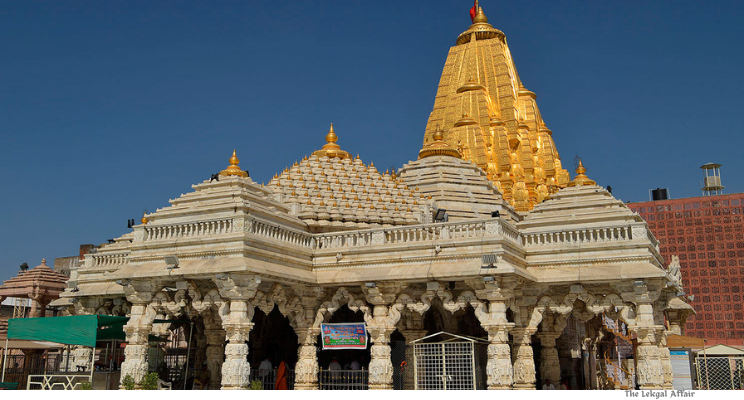
In Maharanshri Mahipendrasinhji Parmar (Heir of Pruthvirajsinh) & Ors. v. Administrator, Shree Ambaji Mata Devsthan Trust, Ambaji & Ors., decided by the Gujarat High Court in First Appeal No. 2293 of 2009 along with Cross Objection No. 177 of 2011 and reported as 2025 LiveLaw (Guj) 242, the Court was confronted with a long-standing and emotionally charged dispute concerning claims of “special privileges” asserted by the heirs of the erstwhile Danta royal family over ritualistic practices at the revered Arasuri Ambaji Temple, particularly on the eighth day of Navratri. The appellant–heir of the former Maharana of Danta State–sought recognition of exclusive hereditary rights to perform specific rituals such as puja, havan, and waving of the chamar before the deity, coupled with the asserted authority to exclude pilgrims from the temple premises during the performance of such rituals. The controversy was rooted in historical claims predating the merger of the princely Danta State with the Union of India in 1948 and was intertwined with earlier rounds of litigation, including proceedings before the Bombay High Court and a landmark constitutional judgment of the Supreme Court in 1957. Justice Hemant M. Prachchhak, while deciding the appeal and cross-objection, was required to balance historical assertions of royal privilege against constitutional values, statutory public trust law, and the rights of lakhs of devotees who visit the Ambaji Temple, one of the most prominent Shakti Peethas in the country.
Arguments on Behalf of the Appellant (Heir of the Erstwhile Royal Family):
The appellant argued that the family of the former Maharana of Danta possessed longstanding hereditary and customary rights connected with the Ambaji Temple, flowing from their historical role as rulers and patrons of the region. It was contended that these rights survived even after the merger of the princely state and were recognized in practice over generations, particularly the right to perform puja on the eighth day of Navratri, to conduct havan, and to wave the chamar before the deity in a specified traditional manner. The appellant relied upon certain findings of the Deputy Charity Commissioner, the Charity Commissioner, and the District Court, which had acknowledged such ritual privileges, even while registering the temple as a public trust. It was further argued that these ritualistic rights were not claims of ownership over the temple property but were limited ceremonial privileges that did not undermine the public character of the temple. According to the appellant, exclusion of pilgrims for a limited duration during the performance of these rituals was an essential and integral part of the traditional practice and was necessary to preserve the sanctity and continuity of age-old customs. The appellant also attempted to distinguish earlier Supreme Court judgments by submitting that those decisions dealt primarily with questions of ownership and political rights post-merger, and not with ritual privileges rooted in religious custom and practice.
Arguments on Behalf of the Respondents (Temple Trust and Authorities):
The respondents, including the Administrator of the Ambaji Mata Devsthan Trust, firmly opposed the appellant’s claims, contending that the Arasuri Ambaji Temple is undeniably a public religious institution, held in trust for the benefit of the general public, and not a private or family temple. It was argued that once the property was dedicated to the deity, the deity became a juristic person and the endowed property assumed the character of public religious property, over which no individual or lineage could claim exclusive or hereditary rights. The respondents relied heavily on the constitutional judgment of the Supreme Court dated 03.12.1957, which had categorically held that after the merger of the Danta State, no proprietary or sovereign rights survived in favour of the erstwhile ruler with respect to the temple or its properties, and that any challenge to the merger agreement lay exclusively within the framework of Article 363 of the Constitution. The respondents further placed reliance on later Supreme Court precedents, including Sri Marthanda Varma (D) Thr. Lrs. v. State of Kerala (2021), to emphasize that where a temple is dedicated to the public and worship is open as of right, claims of private ownership or exclusive hereditary privileges are legally untenable. It was specifically contended that granting the appellant the right to exclude pilgrims, particularly on the eighth day of Navratri when lakhs of devotees throng the temple, would amount to an unconstitutional curtailment of the fundamental right of worship of the public and would run contrary to the very nature of a public religious trust governed by the Gujarat (Bombay) Public Trusts Act.
Court’s Judgment and Reasoning:
After an exhaustive consideration of the historical background, statutory framework, and binding judicial precedents, the Gujarat High Court unequivocally rejected the appellant’s claim for special ritual privileges. Justice Hemant M. Prachchhak noted that the issue of ownership and rights over the Ambaji Temple had already been conclusively settled by the Supreme Court as far back as 1957, wherein it was held that once the property was dedicated to the deity, it ceased to be private property and became public religious property, and no rights survived in favour of the erstwhile ruler after the merger. The Court observed that the appellant’s attempt to resurrect claims under the guise of “ritual privileges” was legally impermissible, particularly when such privileges had the effect of excluding the general public from worship. Drawing strength from the Supreme Court’s judgment in Sri Marthanda Varma, the High Court reiterated that where worship is open to the public as of right and the endowment is for a public religious purpose, the temple must be treated as a public religious institution, and the deity, as a juristic person, is the true owner of the endowed property. The Court emphasized that the Ambaji Temple is one of the most significant Shakti Peethas in the country, attracting crores of devotees for centuries, and that during Navratri—especially on the eighth day of the Asho Maas—the influx of pilgrims is enormous. In such circumstances, granting exclusive ritual rights to one individual or family, coupled with the power to shut out devotees, would be wholly unjust, impractical, and contrary to public interest. The Court categorically held that no privilege could be recognized if it resulted in curtailing or obstructing the right of pilgrims to offer prayers in a public temple. It further held that the earlier orders of the Deputy Charity Commissioner, Charity Commissioner, and District Court, insofar as they granted special privileges to the appellant, were not just and proper and deserved to be quashed. Upholding the registration of the temple as a public religious trust under the Gujarat (Bombay) Public Trusts Act, the High Court dismissed the heir’s appeal and allowed the cross-objection filed by the temple trust, concluding that it was “crystal clear” that the Arasuri Ambaji Temple is a public temple and that no exclusive hereditary or ritual privileges could be claimed by the descendants of the erstwhile ruler.