


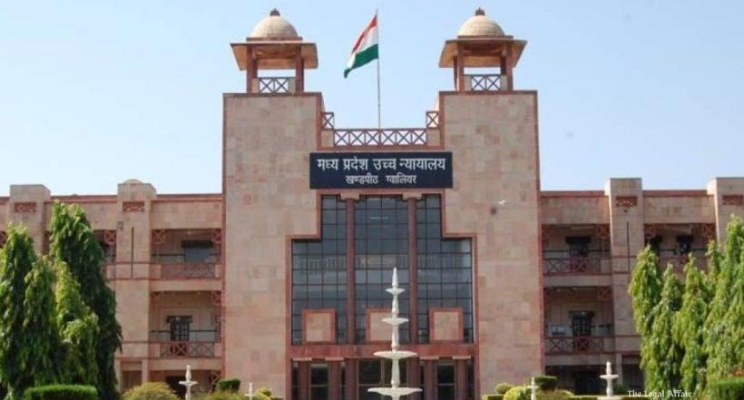
Introduction:
In the case titled Ashok Kumar Tripathi v. State of Madhya Pradesh (Writ Appeal 1140 of 2025; 2025 LiveLaw (MP) 199), the Madhya Pradesh High Court comprising Justice Anand Pathak and Justice Pushpendra Yadav dealt with an important plea filed by a police constable who was compulsorily retired for being found intoxicated and asleep while on guard duty. The appellant, Ashok Kumar Tripathi, a police employee, was deputed as a guard at the residence of a protectee in Gwalior, where he was allegedly discovered under the influence of alcohol, neglecting his critical responsibility. Following a departmental inquiry, the punishment of compulsory retirement was imposed on him. His subsequent appeals before the Deputy Inspector General of SAF, the Director General of Police, and even before the writ court were dismissed, leading him to approach the High Court. Interestingly, while dismissing the plea, the Court not only upheld the disciplinary penalty but also raised an issue of growing concern—the widespread use of mobile phones and social media among police personnel while on duty, which the bench described as another form of “intoxication” that undermines discipline and professionalism in uniformed departments.
Arguments Presented by the Appellant:
The counsel for the appellant, Advocate Prashant Sharma, strongly contended that the departmental proceedings were flawed and violative of principles of natural justice. He argued that the entire finding of intoxication was based merely on a “smell test” and on the doctor’s casual opinion without any proper scientific examination such as a breathalyzer test, blood alcohol content (BAC) test, or any medical analysis that could conclusively establish drunkenness. The appellant’s counsel emphasized that while the doctor mentioned a smell of alcohol, the same doctor also opined that the petitioner was medically fit, which meant that his capacity to discharge duties was not demonstrably impaired. This contradiction, according to the appellant, showed that the disciplinary authorities arbitrarily interpreted the evidence. It was further argued that the reliance solely on a smell test could not meet the threshold of proof required in disciplinary matters where livelihood and career are at stake. The appellant also submitted that the punishment of compulsory retirement was disproportionate, harsh, and shocking to the conscience, considering that no accident or incident actually occurred due to his alleged condition. The counsel invoked the principle of proportionality and urged the Court to intervene under its writ jurisdiction by reducing the penalty. Additionally, the appellant pointed out that his previous penalties for indiscipline were minor and ought not to have been used cumulatively to justify a severe punishment like compulsory retirement. The appellant placed reliance on the doctrine of judicial review as enunciated in Union of India v. K.G. Soni (2006) 6 SCC 794, submitting that interference is permissible where punishment is based on inadequate evidence or where it is disproportionate to the misconduct proved.
Arguments Presented by the Respondent:
On the other side, the respondents, represented by Additional Advocate General and Senior Advocate Vivek Khedkar assisted by Advocate Sohit Mishra, defended the disciplinary action as justified and proportionate. They argued that the petitioner was a member of the disciplined force where higher standards of vigilance, integrity, and responsibility are expected, particularly when posted on sensitive duties such as guarding a protectee’s residence. The respondents maintained that being intoxicated while on duty, and particularly while deployed for guard responsibilities, posed a grave risk not only to the protectee but also to public order and the credibility of the police force. The State’s counsel emphasized that even if a scientific test was not conducted, the testimony of the doctor, who categorically noted the smell of liquor in the petitioner’s breath, along with his behavior of being asleep, constituted sufficient evidence in departmental proceedings, which do not require proof beyond reasonable doubt as in criminal trials. They further argued that disciplinary inquiries operate on the test of preponderance of probabilities, and in this case, the available material was adequate to conclude guilt. It was highlighted that the petitioner had a history of dereliction of duty and absenteeism, for which penalties had been previously imposed. His conduct reflected a habitual pattern of negligence and indiscipline, which cumulatively justified the punishment. The respondents contended that the writ court rightly dismissed the plea as there was no procedural irregularity, illegality, or perversity in the inquiry or the punishment order. The proportionality of the penalty, according to them, had to be seen in the context of the role of police officers in maintaining law and order and protecting lives, where even a small lapse could result in catastrophic consequences.
Court’s Observations and Judgement:
After carefully considering the submissions, the Division Bench of the Madhya Pradesh High Court upheld the compulsory retirement of the petitioner. The Court noted that the evidence available in the departmental inquiry, including the testimony of the doctor who confirmed that the petitioner’s breath had the smell of liquor, sufficiently established intoxication. The bench clarified that in disciplinary proceedings, the standard of proof is not as stringent as criminal trials; rather, the test is whether the conclusion is reasonable on a balance of probabilities. On this basis, the Court found no perversity in the disciplinary authority’s finding of guilt. The Court categorically observed that a police employee, especially when on guard duty at the residence of a protectee, carries immense responsibility to remain alert and vigilant at all times. Performing such duties while under the influence of alcohol amounts to grave misconduct. The bench remarked, “An employee that too in police department if performs duties while in influence of liquor or in inebriated condition, is a recipe for law and order problem or dereliction of duty where many things are at stake. Therefore, conduct of police officer/employee is to be seen in that way. If police constable/employee is guilty of such misconduct then it is to be construed seriously.” The Court further noted that the petitioner’s prior record of indiscipline, including absenteeism, painted a picture of habitual negligence, which strengthened the justification for compulsory retirement. Referring to the Supreme Court precedent in Union of India v. K.G. Soni, the bench reiterated that courts could interfere in disciplinary penalties only if they were illogical, procedurally flawed, or shockingly disproportionate. In this case, the punishment was found to be appropriate and proportionate.
Concern on Mobile and Social Media ‘Intoxication’ in Police:
What makes this judgment particularly significant is the Court’s obiter dicta highlighting a modern-day challenge—mobile phone and social media “intoxication” among police personnel. The bench observed that in many situations such as bungalow guard duties, court duties, or law-and-order postings where the job might appear sedentary, police personnel were increasingly distracted by mobile phones and social media platforms. The Court flagged this as an emerging form of indiscipline, remarking that such distractions created casualness in discharge of duties and, at times, led to circulation of incriminating clips, thereby polluting the mind and affecting the disposition of police personnel. The Court expressed concern that this trend endangered both professionalism and public trust in uniformed services. In its observations, the Court urged senior police officers to design sensitization programs in police training centers for constables, sub-inspectors, and other officers. The bench also suggested that a mechanism of constant supervision be developed to check and verify the presence of police personnel on social media while on duty. The Court stated that this issue deserved urgent attention and required framing of rules, regulations, and guidelines as remedial measures. The observation is noteworthy as it expands the concept of intoxication from mere substance abuse to behavioral addiction like social media dependency, thereby recognizing evolving challenges in maintaining discipline in law enforcement.
Final Judgment:
The High Court ultimately dismissed the writ appeal, upholding the compulsory retirement of the petitioner. The bench concluded that considering the seriousness of the misconduct, the petitioner’s prior disciplinary record, and the sensitive nature of his duty, no interference was warranted. It underscored that a guard deployed for protecting a person cannot afford to be intoxicated, as it risks not only the protectee’s safety but also public confidence in the police force. At the same time, by highlighting the emerging menace of mobile and social media intoxication, the Court added an important dimension to the discourse on discipline in uniformed forces, calling upon senior leadership to proactively address this modern challenge.