


Introduction:
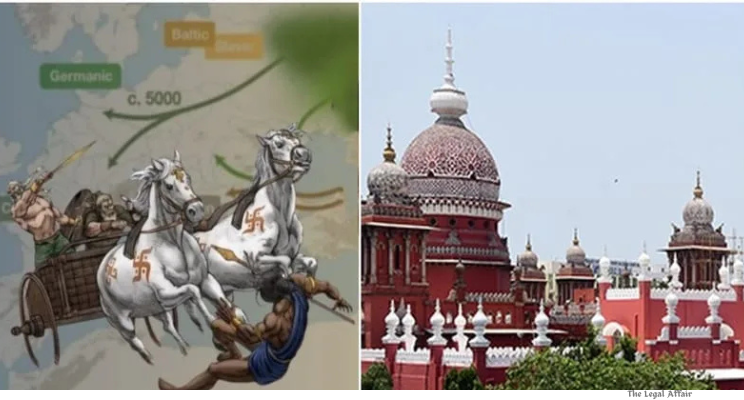
In an intriguing case before the Madras High Court, a petitioner challenged the teaching of the Aryan-Dravidian race theory in educational institutions, arguing that it perpetuated divisiveness and was historically inaccurate. The case, heard by a bench comprising Chief Justice KR Shriram and Justice Senthilkumar Ramamoorthy, touched on issues of history, education, and the potential societal impacts of controversial theories on race. Mahalingam Balaji, who filed the petition, argued that this two-race theory is false and harmful to young, impressionable minds. However, the court refrained from passing any definitive ruling on the subject, emphasizing the need for expert evaluation. Instead, the court directed educational authorities to consider Balaji’s concerns, thus placing the question of academic accuracy in the hands of historians and educators rather than the judiciary.
Case Background:
The petitioner, Mahalingam Balaji, represented himself in this public interest litigation (PIL), contending that the Aryan-Dravidian race theory, commonly referenced in history and social studies, was both factually flawed and socially divisive. He claimed that teaching the theory propagated a false narrative that could instil harmful ideologies in students. The petition specifically targeted the curriculum’s focus on a supposed distinction between two races, Aryan and Dravidian, which, he argued, lacked robust historical support and risked promoting bias and division in society.
In response, the Department of School Education in Tamil Nadu, represented by the Deputy Solicitor General Mr Rajesh Vivekananthan and Additional Advocate General Mr J. Ravindran, argued that the educational curriculum was developed based on the recommendations of experts in relevant fields. The Ministry of Education and the National Council of Educational Research and Training (NCERT) also submitted that if the petitioner had concerns, he should present them to the NCERT or the State Council of Education Research and Training (SCERT) for further review.
Arguments:
Petitioner’s Argument:
Mahalingam Balaji argued that the Aryan-Dravidian theory, as currently taught, is misleading and potentially harmful. According to Balaji, the distinction between the Aryan and Dravidian races was unfounded, and such divisions could deepen societal divides. He expressed concern that students exposed to such theories might develop biased perspectives or misunderstandings regarding their heritage, possibly leading to prejudice and a fragmented society. Balaji argued that the curriculum should be revised to reflect an accurate and unified historical narrative, free from what he described as colonial-era myths about race.
Additionally, Balaji emphasized that presenting such controversial theories as fact could do lasting harm to young minds, as students often accept educational content without question. He contended that it was the responsibility of educational authorities to avoid promoting contentious theories that lacked definitive support and could be socially harmful.
Respondent’s Argument:
The respondents, including representatives from the Department of School Education and the Ministry of Education, defended the current curriculum, stating that it was designed based on expert recommendations. They argued that historical and anthropological theories are often subject to debate and interpretation, and the curriculum aimed to present a broad perspective rather than advocate any divisive stance.
The respondents also highlighted the procedural channels available to Balaji for addressing his concerns. They suggested that Balaji submit his grievances to the SCERT or NCERT, which were better equipped to examine such contentions given their access to academic expertise. The respondents pointed out that curriculum development is an intricate process involving academic research, and changing content solely based on individual objections could undermine the curriculum’s integrity and the credibility of subject matter experts.
Court’s Judgement and Reasoning:
After hearing both sides, the Madras High Court refrained from passing any substantive order on Balaji’s plea, stating that it was not within the judiciary’s domain to determine the validity of historical theories. Chief Justice KR Shriram and Justice Senthilkumar Ramamoorthy observed that the court lacked the specialized expertise required to rule on the legitimacy of the Aryan-Dravidian race theory and thus could not grant Balaji the relief he sought. The bench noted, “The court is not an expert in history or the origin of races. The relief requested by the petitioner cannot be granted by this court without examining and deciding whether the two-race theory, which the petitioner claims to be false, is valid or invalid. It is appropriate that this determination be made by experts in the field, and not by the court.”
Instead of issuing a definitive ruling, the court recommended that Balaji submit his concerns to the NCERT and SCERT, both of which could assess the validity of his arguments through their committees of academic experts. The bench directed that Balaji’s representation be reviewed and that he be provided with a personal hearing within 12 weeks. In this way, the court shifted the matter from the judicial to the academic arena, allowing historians and educators to evaluate the contested theory within an academic framework.
In doing so, the court underscored a key principle regarding the judiciary’s role in education and history-related cases: while courts can enforce constitutional principles, they typically refrain from issuing determinations on complex matters outside their expertise, such as historical debates or academic theories. This ruling reflects judicial prudence and acknowledges that some issues are best resolved by specialists.