


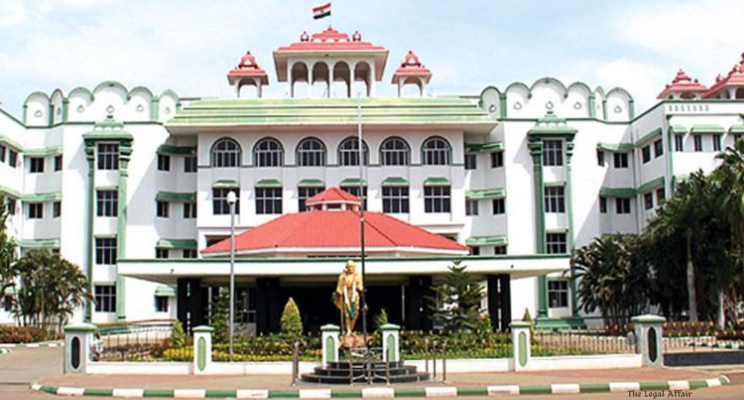
Introduction:
The Madras High Court recently delivered a landmark judgment in a series of writ petitions filed by Rama Ravikumar against the State of Tamil Nadu, challenging Government Orders that permitted the construction of marriage halls by using temple funds belonging to five temples located at different places across the state. The petitions raised significant concerns about the manner in which temple funds—accumulated through donations from devotees and offerings to deities—were being diverted by the government for purposes that were allegedly non-religious and commercial in nature. The bench of Justice S.M. Subramaniam and Justice G. Arul Murugan carefully examined the provisions of the Tamil Nadu Hindu Religious and Charitable Endowment Act, 1959, alongside its Rules, and held that the State’s decision to construct marriage halls with temple funds violated the very framework of the Act. The Court emphasized that temple funds, being exclusively collected from devotees for religious or charitable purposes, could not be diverted for commercial purposes such as the renting out of marriage halls. Highlighting that Hindu marriages, though considered sacrament, are also bound by contractual obligations, the Court ruled that marriage ceremonies cannot per se be categorized as “religious purposes” within the meaning of the Act. Consequently, the Government Orders were quashed as being ultra vires and violative of the rights of Hindu devotees.
Arguments of the Petitioner:
The petitioner, represented by Senior Advocate R.M. Arun Swaminathan, argued that the Government’s decision permitting construction of marriage halls from temple funds was fundamentally flawed and violative of law. It was submitted that temple funds are not public funds that the State can freely divert for any welfare or developmental activity. Instead, such funds are exclusively tied to religious and charitable purposes as contemplated under the Hindu Religious and Charitable Endowment Act, 1959. The petitioner highlighted that Sections 35, 36, and 66 of the Act impose restrictions on how surplus temple funds may be used. While the Act permits utilization of such funds for maintenance, renovation, festival celebrations, or development of temples and their religious activities, it does not authorize diversion for purely commercial ventures like marriage halls.
Further, the petitioner stressed that no building plans or permits were obtained for these constructions. Despite the lack of compliance with mandatory legal requirements, funds were already released, suggesting arbitrary exercise of power and potential misuse of temple wealth. The petitioner further argued that marriages cannot be deemed a religious purpose within the scope of the Act. Although Hindu marriages are treated as sacraments, they also possess contractual elements under the Hindu Marriage Act, 1955. This dual character, according to the petitioner, means that conducting marriages is not purely religious in nature and cannot justify the diversion of temple funds.
The petitioner also cautioned that permitting such an expansion of scope under the guise of “religious purposes” would set a dangerous precedent, leading to large-scale misuse and commercial exploitation of temple resources. Devotees donate ornaments, jewels, properties, and cash offerings with the expectation that these will be utilized for temple-related activities and not for revenue-generating ventures of the State. Therefore, the Government Order, in the petitioner’s view, amounted to a breach of trust reposed by devotees in temple administration.
Arguments of the Respondents:
On the other hand, the respondents, represented by Additional Advocate General Veera Kathiravan, supported by Special Government Pleader P. Subbaraj and Senior Counsel A.K. Sriram, defended the Government’s decision. They argued that the construction of marriage halls was directly linked to assisting Hindu families in conducting marriages with reduced financial burdens. According to the State, since marriage is regarded as a sacred religious activity within Hindu culture, the provision of affordable marriage halls could be considered a legitimate extension of temple-related services. The Additional Advocate General emphasized that Hindu marriages, though partly contractual, are deeply embedded within religious customs, rituals, and practices. Therefore, creating infrastructure to facilitate these marriages falls within the broader purpose of supporting Hindu religious life.
The respondents further submitted that construction of halls would not only help poor and middle-class Hindus perform marriages at reasonable costs but would also serve as an enduring asset for the temples. The rental income generated could be reinvested into the maintenance and development of the temples, thereby ultimately benefitting the deity and the religious community. The State contended that this approach was not a commercial exploitation but a pragmatic strategy for resource utilization, balancing social needs with temple welfare.
The Government also highlighted that the Hindu Religious and Charitable Endowment Department was empowered under the Act to make such administrative decisions for the benefit of Hindu devotees. They maintained that the GOs were issued in good faith, aiming to address societal needs, and could not be struck down merely because they involved an element of revenue generation.
Court’s Judgment:
The Court, after carefully analyzing the contentions, unequivocally rejected the State’s reasoning. It observed that the HR&CE Act of 1959, particularly Section 66, lays down the conditions for utilization of surplus temple funds, strictly limiting them to religious or charitable purposes. The Court underscored that temples are not public institutions of the government but sacred entities maintained from donations by devotees for specific religious use. Temple funds cannot be equated with public funds or treated as a government revenue source.
The Court emphasized that Hindu marriages, while regarded as sacraments, also carry contractual features under the Hindu Marriage Act, 1955. This duality meant that marriage, in itself, could not be treated as a purely religious purpose under the HR&CE Act. Therefore, construction of marriage halls for renting purposes could not be considered a religious activity.
A key observation of the Court was that the marriage halls in question were not free of cost but intended to be rented out for fees. This directly transformed the activity into a commercial or profit-making venture, clearly beyond the scope of the Act. The Court stated: “There is no charity in the object of the GO, and hence it cannot be said to be a religious purpose under the Act.”
The bench strongly criticized the State for attempting to expand the scope of “religious purposes” to include activities that could result in misuse and abuse of temple wealth. It reiterated that temple funds, often in the form of offerings, jewels, ornaments, and immovable properties, were given by devotees purely for religious obligations, temple festivals, and deity-related expenses. To divert these for commercial activities such as marriage halls would infringe upon the rights of devotees and violate their faith.
The Court further clarified the role of the government in temple administration. It stated that the State’s role is supervisory—ensuring that temple funds are not misappropriated, abused, or misutilized. It cannot itself misappropriate such funds under the pretext of welfare. The judgment categorically declared that “expanding the scope of interpretation of the Act or Rules other than for religious purposes is null and void.”
In its concluding remarks, the Court quashed the impugned Government Orders, holding them to be in violation of Sections 35, 36, and 66 of the HR&CE Act, as well as contrary to the constitutional rights of Hindu devotees. The Court also noted the absence of building permits or compliance with procedural requirements, further rendering the orders illegal.
Thus, the judgment not only reaffirmed the sanctity of temple funds but also placed significant checks on the State’s authority, reminding it of its limited role in religious endowments.