


Introduction:
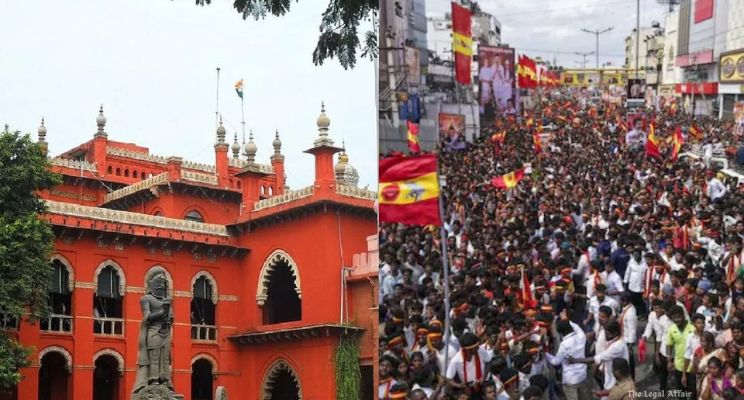
In a significant development, the Madras High Court has ordered the constitution of a Special Investigation Team (SIT) to probe the tragic Karur Stampede incident that occurred on September 27, 2025, which claimed the lives of 41 people during a political roadshow organized by Tamilaga Vettri Kazhagam (TVK) led by actor-turned-politician Vijay. The case, titled PH Dinesh v. Home Secretary State of Tamil Nadu, WP Crl 1000 of 2025, was heard by Justice N. Senthilkumar, who not only directed the appointment of Inspector General of Police Asra Garg as the head of the SIT but also strongly condemned the attitude of TVK in “abandoning” the scene after the tragedy without expressing remorse. The Court highlighted that such a massive loss of life could not be brushed aside as a mere accident and emphasized that the judiciary could not close its eyes to what had unfolded in full public view. The petition was filed by PH Dinesh, who had earlier sent a representation to the state government urging it to create safety guidelines for roadshows and rallies and to take concrete steps to prevent recurrence of such incidents. When the state failed to respond to his representation, he approached the Court seeking judicial intervention to ensure both accountability for the Karur tragedy and systemic reforms through the framing of Standard Operating Procedures (SOPs) for public gatherings.
Arguments of the Petitioner:
The petitioner argued that the Karur stampede was not a simple accident but the direct result of careless planning and gross negligence on the part of the organizers, namely TVK and its leadership. He submitted that the lack of crowd management strategies, inadequate safety measures, and absence of coordination with law enforcement authorities created a recipe for disaster, which tragically culminated in the loss of 41 innocent lives. According to him, the tragedy underscored a systemic failure that went beyond individual negligence and highlighted the urgent need for state authorities to establish clear and binding SOPs governing political rallies, public meetings, and roadshows. The petitioner pointed out that he had already submitted a representation to the government urging three key measures: the first being immediate formulation and implementation of comprehensive SOPs covering aspects such as crowd control, medical preparedness, fire and safety compliance, and security arrangements; the second being initiation of legal and punitive action against those responsible for the negligence that caused the Karur tragedy; and the third being suspension of further permissions for such large gatherings until SOPs were made mandatory and strictly enforceable. However, despite the gravity of the incident, the state authorities had failed to respond to his representation, demonstrating indifference to the safety of the public. He argued that this silence not only aggravated public mistrust but also increased the risk of similar tragedies occurring in the future. The petitioner further contended that political parties, in their bid to showcase strength through massive public shows, often neglected the basic safety and security needs of the people, thereby treating lives as expendable. He asserted that the judiciary had a duty to intervene in such situations to protect the right to life under Article 21 of the Constitution, which places an obligation on the state to ensure safe conditions for citizens in public spaces.
Arguments of the State and Respondents:
The State, through its counsel, submitted that investigations were already underway into the Karur incident and that steps were being taken to fix accountability and improve public safety measures. It was argued that the tragic occurrence was being examined from multiple angles, including administrative, organizational, and law enforcement lapses. The State further contended that while the petitioner’s concerns about the need for SOPs were not without merit, framing such guidelines required a comprehensive policy approach balancing constitutional rights such as the freedom of speech and assembly under Article 19 with the need for public order and safety. The government argued that an outright suspension of political rallies or roadshows, as suggested by the petitioner, would not be constitutionally permissible since the right to assemble peacefully is a fundamental right. Instead, it stressed that incremental improvements and modifications to existing procedures could be adopted to ensure greater safety. The State also highlighted that permissions for rallies were already regulated under existing statutory provisions such as the Police Act and municipal laws, which required organizers to seek prior approval and adhere to conditions regarding location, timing, and law and order. The tragedy in Karur, it was argued, was an aberration and should not be used to impose overly restrictive measures that could hamper democratic freedoms. At the same time, the State acknowledged that a review of current practices was necessary and informed the Court that the government was in the process of examining possible policy measures, including SOPs, to minimize risks at large gatherings.
Court’s Judgment:
The Madras High Court, after hearing both sides, delivered a strong and decisive order. Justice N. Senthilkumar began by observing that the Court could not turn a blind eye to the devastating Karur stampede, which had shocked not just Tamil Nadu but the entire nation. The Court categorically held that the incident was not an unfortunate accident but a preventable tragedy caused by gross negligence and poor planning. The judge noted with concern that the political party organizing the event, TVK, had failed to demonstrate even basic remorse and had “abandoned” the scene after the tragedy. This, according to the Court, reflected an irresponsible and insensitive attitude, especially given the magnitude of loss of life. In a scathing oral observation, the Court remarked that “the entire world has witnessed the events” and hence there could be no attempt to dilute responsibility. Turning to the legal relief sought, the Court agreed with the petitioner that the absence of an SOP created a dangerous vacuum and allowed political parties and organizers to conduct massive gatherings without adequate preparation for crowd management, safety, and emergency response. The Court emphasized that Article 21 of the Constitution enshrines the right to life, and this imposes an obligation upon the State to take proactive measures to safeguard citizens at public events. The Court therefore ordered the immediate constitution of a Special Investigation Team (SIT) to thoroughly investigate the Karur stampede. Inspector General of Police Asra Garg was appointed as the head of the SIT, with directions to probe into not only the proximate causes of the incident but also the systemic failures that enabled it. The Court directed that the SIT should fix accountability on organizers, law enforcement, and administrative agencies whose lapses contributed to the tragedy. At the same time, the Court issued directions to the state government to consider the petitioner’s representation and expedite the formulation of comprehensive SOPs for political rallies, roadshows, and public meetings. The SOPs, the Court directed, should cover crowd management techniques, emergency medical facilities, coordination with police and fire services, deployment of trained security personnel, and strict compliance with capacity norms of venues. The Court stressed that permissions for political gatherings in future must be conditional upon compliance with these SOPs, and that any deviation should invite strict action including cancellation of permission and penal consequences for organizers. Importantly, the Court balanced the need for public safety with democratic freedoms by clarifying that the right to hold rallies and roadshows was not being curtailed, but that this right had to be exercised responsibly and within the framework of safety regulations. The Court concluded by remarking that judicial intervention was necessary in this case because the lives lost in Karur could not be brought back, but their deaths should serve as a reminder to the state and political actors of their duty towards the people. Thus, by constituting the SIT and pushing for SOPs, the Court sought to ensure accountability in the present case and prevent recurrence of such tragedies in the future.