


Introduction:
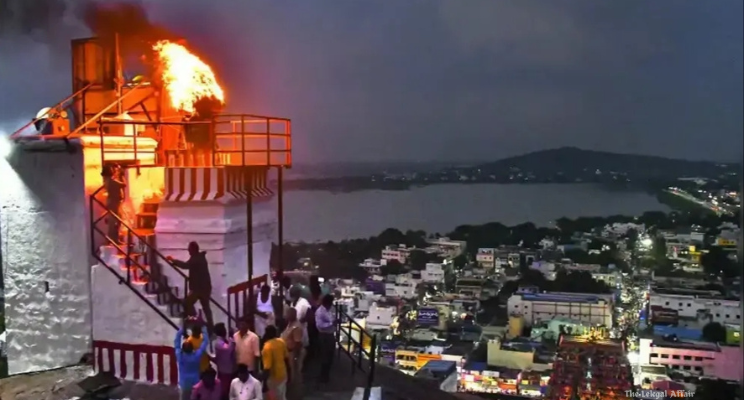
In a complex and historically rooted dispute titled State of Tamil Nadu and Others v. Rama Ravikumar and Connected Petitions, the Madras High Court (Madurai Bench) is presently examining a set of appeals and writ petitions arising from a single judge’s order concerning the lighting of the Karthigai Deepam lamp at Thiruparankundram Hills, an ancient and culturally significant site housing both the Arulmigu Subramaniyaswamy Temple and a centuries-old dargah located on the hill. The matter was placed before a Division Bench comprising Justice G. Jayachandran and Justice K.K. Ramakrishnan, who heard arguments from the State authorities, temple representatives, and devotees challenging different aspects of the single judge’s directions. The central issue revolves around whether the petitioner-devotee could claim a legal right to compel temple authorities, through a writ petition under Article 226 of the Constitution, to light the annual Karthigai Deepam lamp at a particular stone pillar known as “Deepathoon,” which the petitioner claimed to be the historically correct location for the ritual. The State contends that no devotee possesses a legal right to dictate where the lamp should be lit and that Article 226 cannot be invoked to create or modify religious customs, especially when those customs have been consistently upheld by courts for over a century. The single judge, however, had ordered temple authorities to light the lamp at the stone pillar in addition to the traditional site at the Uchi Pillaiyar Temple. This triggered multiple appeals challenging the jurisdiction, accuracy, and factual grounding of the order. With arguments spanning issues of religious custom, maintainability, historical practice, the limits of constitutional power, and the delicate coexistence of religious communities on the hill, the case presents an intricate intersection between faith, tradition, civil law, and judicial restraint.
Arguments by the State and Temple Authorities:
The State of Tamil Nadu, represented by Advocate General P.S. Raman, argued in a single continuous stream that the devotees’ petitions were nothing more than private interest litigations dressed as public causes, and that they wrongly assumed a legal right that does not exist in law. The AG stated that the dispute revolves around the petitioner’s claim for lighting the Karthigai Deepam at a place he identified as “Deepathoon,” a spot close to the dargah, even though historically and traditionally, the lamp has always been lit at the Uchi Pillaiyar Temple. He pointed out that the temple sits at the foot of a 500-foot hill, and the dargah is situated nearby, making the coexistence of religious communities delicate and requiring utmost judicial restraint. The AG argued that Article 226 is not intended to alter or create customs, nor can it be invoked to compel temple authorities to follow a practice for which there is no credible evidence. The AG further highlighted the historical record of litigation, beginning in 1920, where courts consistently held that the traditional site for lighting the lamp was the Uchi Pillaiyar Temple and not any other location. He noted that in a 1994 PIL and another case in 2014, the High Court had expressly refused to alter the practice of lighting the deepam, and those decisions were upheld by a Division Bench. He emphasized that no document exists to prove that the stone pillar is indeed Deepathoon or that any custom existed in which the lamp was lit there prior to the 1920 litigation. According to him, the petitioner’s representation was vague, lacked clarity, and failed even to specify that he wanted the lamp lit at the stone pillar. The AG argued that the petitioner sought to use the writ jurisdiction to create a new custom that has never existed and that such interference would be judicial overreach. He stressed that the duty of temple authorities, if any, must stem from statutory provisions or pre-existing customs, neither of which the petitioners could demonstrate. Senior Advocate G. Masilamani, appearing for the Executive Officer of the temple, argued that accepting such petitions would open a Pandora’s box, causing chaos across the State, as devotees everywhere could begin demanding changes in rituals, timings, or placements of religious ceremonies. He stated that temple administration would become impossible if courts granted such personalised religious requests. Masilamani pointed out that the petitioner had addressed his representation to the wrong authority—the Executive Officer instead of the HR&CE Joint Commissioner—meaning the representation was invalid from the start. He also argued that the single judge failed to note that Deepathoon, as described by the petitioner, is located just 15 meters away from the dargah and is not situated on the peak as wrongly recorded in the order. He emphasized that the practice of not lighting the lamp at the pillar has existed for over 175 years, and long-standing non-practice itself becomes the custom. He added that the petitioner essentially sought to revive a non-existent custom without any evidence. Masilamani further submitted that the single judge traveled beyond the pleadings, relied on opinions unsupported by expert testimony, and effectively attempted to introduce a new religious practice. Senior Advocate R. Shunmugasundaram appeared for the State’s HR&CE Department and stated that only the Devasthanam (temple administration) can decide on such matters and not individual worshippers. He warned that if one worshipper were granted such accommodation, thousands would follow, potentially leading to community tensions and administrative breakdown. The State contended that the single judge quashed Section 144 prohibitory orders, summoned top State officials in a contempt petition, and issued directions regarding religious practices without adequate foundational evidence or adherence to judicial constraints.
Arguments by the Petitioner-Devotees:
The petitioner-devotees, represented by counsel, argued in one smooth, uninterrupted paragraph that as worshippers of the ancient Murugan temple, they possess the right to ensure that age-old religious traditions are preserved and performed in their rightful manner. They contended that the stone pillar identified as Deepathoon is historically significant and the correct location where the Karthigai Deepam should be lit, asserting that the existing practice of lighting the lamp at only the Uchi Pillaiyar Temple was an alteration or deviation from the original custom. The petitioners claimed that they had made a valid representation requesting that temple authorities either themselves light the lamp at the stone pillar or permit the devotee to do so as part of the religious observance. They alleged that the authorities had failed to consider the representation adequately, and therefore, judicial intervention was necessary to restore the original custom. According to the petitioners, the single judge had rightly exercised judicial power to direct the lighting of the lamp at the stone pillar because it was a restoration of tradition rather than an introduction of a new practice. They argued that refusing to allow the lamp to be lit at Deepathoon deprived devotees of their right to worship and their right to participate meaningfully in the Karthigai Deepam festival, which holds immense spiritual significance. They maintained that Article 226 could indeed be used to revive abandoned or neglected customs if the neglect hampers religious freedom. They further argued that temple authorities had not offered any clear reason why the lamp should not be lit at Deepathoon and claimed that the refusal amounted to arbitrary exercise of power and disregard of religious sentiment. The petitioners also argued that temple administration is bound to safeguard tradition and that their prayer was not for creating a new custom but for enforcing what they believed to be the original practice. They urged the court to uphold the single judge’s direction, arguing that the historical coexistence of religious communities on the hill would not be disturbed by lighting a lamp in a place that stands symbols of shared cultural heritage.
Court’s Observations and Judgment:
The Madras High Court Division Bench, in an extensive and thoughtful deliberation summarised here in a single flowing paragraph, noted that the dispute touches upon deeply sensitive issues of custom, community practice, religious harmony, and judicial restraint. The Bench observed that the matter has a long history of litigation since 1920, where courts repeatedly considered and settled the location of temple lands, the areas belonging to the dargah, and the traditional site for lighting Karthigai Deepam. Justice Jayachandran remarked that the hill has witnessed peaceful coexistence of communities for over a century and that any judicial direction affecting such equilibrium must be issued with caution. The Court expressed concern that the single judge issued directions affecting religious customs without any definitive evidence establishing that the stone pillar was Deepathoon or that a historical tradition existed of lighting the lamp there. The Bench noted that the petitioner’s representation was vague, lacked clarity, and failed to specify the location in the manner later presented in court. The judges questioned whether they could, under Article 226, mandate the creation or revival of a custom that has not been substantiated. The Bench appeared inclined towards the State’s argument that judicial power cannot be used to alter a custom practiced consistently for over 175 years, particularly when several prior judgments had affirmed the traditional site for lighting the lamp and when the petitioner had failed to produce evidence of any contrary tradition. The Court also observed that the single judge had overlooked binding precedents and had ventured into areas traditionally reserved for temple administration and religious authorities. While acknowledging the petitioner’s devotion, the Bench emphasised that personal religious preference cannot be elevated to a legal right enforceable through writ jurisdiction. At the same time, the Court indicated that harmonious community dialogue may be the ideal path to resolve such sensitive matters. The case has been posted for further hearing, with the Bench making it clear that any permanent resolution must respect history, community harmony, and constitutional boundaries.