


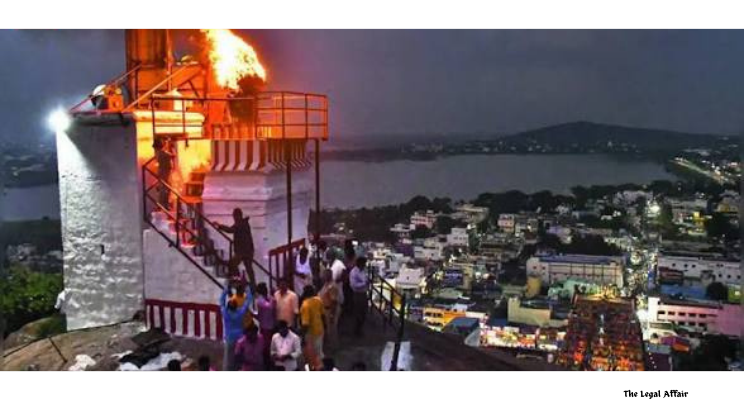
Introduction:
The Madras High Court has directed the Madurai District Collector and other concerned authorities to implement the Supreme Court’s order permitting the lighting of the Karthigai Deepam lamp at the Deepathoon on Thiruparankundram Hill on November 24, 2026. The Court made it clear that prohibitory orders issued by the District Collector could not be used to obstruct compliance with the Supreme Court’s directions or interfere with the fundamental rights of devotees under Article 25 of the Constitution.
The matter was heard by a Division Bench comprising Justice G.R. Swaminathan and Justice M.D. Sumathy. The proceedings arose from petitions challenging prohibitory orders issued by the Madurai District Collector under Section 163 of the Bharatiya Nagarik Suraksha Sanhita, 2023 (BNSS), in connection with the Karthigai Deepam celebrations at Thiruparankundram.
The controversy concerned the lighting of the traditional lamp at the Deepathoon, a location on the hill that has been the subject of a dispute. The Supreme Court, by an order dated November 20, 2026, had permitted the lighting of the lamp at the Deepathoon on November 24 as a one-time measure, taking into account the proximity of the festival. The Supreme Court, however, expressly clarified that the arrangement should not be treated as a final determination or endorsement of the claimed custom of lighting the lamp at the disputed location.
The Supreme Court had also prescribed conditions governing the ceremony. It directed that access to the Deepathoon would be restricted to authorised representatives of the Devasthanam and government officials. Members of the general public would not be permitted to reach the specific location. The Court further prohibited processions, public congregations, slogan-raising and demonstrations during the ritual. It directed the authorities to make adequate security arrangements and permitted the deployment of the Central Industrial Security Force (CISF), if necessary. The District Collector was also directed to submit a compliance report within three days and was given liberty to approach the Supreme Court in case of any exigency.
Despite these directions, the Madurai District Collector issued prohibitory orders under Section 163 BNSS in the district on November 23. The orders gave rise to concerns among the petitioners that devotees would be prevented from approaching the area and that the Supreme Court’s directions concerning the lighting ceremony would not be implemented effectively. The petitioners approached the High Court seeking appropriate directions to ensure that the lamp was lit in accordance with the Supreme Court’s order. They also sought permission for devotees to assemble at the foothills and witness the ceremony, as well as arrangements enabling officials of the Hindu Religious and Charitable Endowments Department and the Archaeology Department to participate in the ritual with the assistance of security personnel.
The petitioners also alleged that individuals had been prevented from entering the area and that several persons had been detained following the issuance of the prohibitory orders. They contended that the restrictions were being used in a manner that interfered with the devotees’ right to worship.
The State, represented by Senior Advocate Gopal Sankaranarayanan on behalf of the Madurai District Collector, maintained that the prohibitory order was intended to prevent unauthorised persons from climbing the hill and did not obstruct implementation of the Supreme Court’s directions. He also informed the Court that devotees were being permitted to visit the temple and were receiving tokens.
After considering the submissions, the High Court directed the Collector, police authorities and temple administration to comply with the Supreme Court’s order. It invoked Article 144 of the Constitution, which requires all civil and judicial authorities throughout India to act in aid of the Supreme Court. The Bench also held that prohibitory orders could not stand in the way of the exercise of fundamental rights under Article 25 and directed the release of persons unlawfully detained pursuant to the Collector’s orders.
Arguments of the Parties:
The petitioners approached the Madras High Court challenging the prohibitory orders issued by the Madurai District Collector under Section 163 of the BNSS. Their principal grievance was that the restrictions had been imposed immediately before the scheduled Karthigai Deepam ceremony and could prevent the effective implementation of the Supreme Court’s order dated November 20, 2026.
The petitioners argued that the Supreme Court had already permitted the lighting of the lamp at the Deepathoon on November 24 as a one-time arrangement. According to them, the District Collector’s prohibitory order risked defeating the purpose of that judicial direction by restricting access to the area and preventing the necessary arrangements from being carried out.
They submitted that the restrictions were particularly concerning because persons were allegedly being prevented from entering the area and some individuals had even been arrested or detained. The petitioners contended that the State could not rely on a general prohibitory order to frustrate a specific direction issued by the Supreme Court.
The petitioners further argued that the manner in which the restrictions were being implemented interfered with the devotees’ right to practise and profess their religion under Article 25 of the Constitution. They maintained that devotees should be permitted to assemble at the foothills and witness the lighting of the Karthigai Deepam, subject to the conditions imposed by the Supreme Court.
The reliefs sought also included directions to facilitate the participation of officials from the Hindu Religious and Charitable Endowments Department and the Archaeology Department in the lighting ceremony at the Deepathoon, with the assistance of Central Reserve Police Force (CRPF) personnel. Their request was therefore directed towards ensuring that the ritual could take place in accordance with the Supreme Court’s directions and that the restrictions imposed by the Collector did not prevent the authorities from carrying out their responsibilities.
During the morning hearing, the petitioners emphasised that the prohibitory order was inconsistent with the Supreme Court’s earlier direction and could amount to contempt if used to obstruct its implementation. They also alleged that devotees were being prevented from reaching the area and that the authorities were using the order to interfere with religious activity.
On behalf of the Madurai District Collector, Senior Advocate Gopal Sankaranarayanan submitted that the petitions essentially concerned the implementation of the Supreme Court’s order. He argued that questions relating to the interpretation or enforcement of that order should appropriately be placed before the Supreme Court itself.
The senior counsel also clarified that the prohibitory order had been issued to prevent unauthorised persons from climbing the hill. He drew the Bench’s attention to a specific recital in the order stating that the restrictions would not apply to actions undertaken to give effect to the Supreme Court’s directions.
He submitted that there was no general restriction on devotees visiting the temple and that people were being allowed to move within the temple premises. Tokens were also being issued to devotees. According to him, the authorities had not intended to prevent ordinary worshippers from visiting the temple or obstruct the ceremony authorised by the Supreme Court.
Sankaranarayanan further submitted that the persons detained were individuals associated with certain organisations and that their detention had taken place because of apprehensions concerning the situation. He informed the Court that 258 persons had been detained and two FIRs had been registered.
The Collector’s counsel also clarified that the Supreme Court’s order was not confined merely to the act of lighting the lamp at the top of the hill but covered the movement required for reaching the location and carrying out the ceremony in accordance with the prescribed conditions.
The State’s position was therefore that the prohibitory order was intended to maintain security and prevent unauthorised access, rather than to defeat the Supreme Court’s directions. The Collector also assured the High Court that he had acted, and would continue to act, in compliance with the Supreme Court’s order.
The principal disagreement between the parties concerned the practical effect of the prohibitory order. While the petitioners feared that it was being used to obstruct the Supreme Court’s directions and restrict religious rights, the Collector maintained that the order contained an express exception for actions necessary to implement those directions and was intended to prevent unauthorised movement on the hill.
Court’s Judgment:
The Division Bench of Justice G.R. Swaminathan and Justice M.D. Sumathy directed the Madurai District Collector and all other concerned authorities to ensure strict compliance with the Supreme Court’s order dated November 20, 2026. The High Court emphasised that the prohibitory orders issued under Section 163 BNSS could not be interpreted or enforced in a manner that defeated the Supreme Court’s directions or obstructed the exercise of fundamental rights.
Supreme Court’s order had to be implemented: The High Court first took note of the Supreme Court’s direction permitting the lighting of the lamp at the Deepathoon on November 24, 2026. The Bench observed that the Supreme Court had specifically directed that the ritual should take place on that date as a one-time measure.
The petitioners had approached the High Court expressing apprehension that the direction might not be implemented because of the prohibitory orders issued by the District Collector. The Bench therefore examined the Collector’s explanation and the terms of the prohibitory order.
Senior Advocate Gopal Sankaranarayanan submitted that the order was intended only to prevent unauthorised persons from climbing the hill. He also pointed out that the order contained a specific clarification that it would not apply to actions undertaken for giving effect to the Supreme Court’s directions.
The High Court recorded the Collector’s assurance that he had acted in compliance with the Supreme Court’s order and would continue to do so. Nevertheless, the Bench considered it necessary to make the legal position explicit, particularly in view of the concerns raised about the implementation of judicial directions in connection with the previous year’s Karthigai Deepam event.
Article 144 and the obligation to assist the Supreme Court: A central part of the High Court’s reasoning concerned Article 144 of the Constitution of India. This provision mandates that all civil and judicial authorities throughout the territory of India shall act in aid of the Supreme Court.
The Bench emphasised that the District Collector, being a civilian authority, was also bound by this constitutional obligation. The responsibility to assist the Supreme Court does not depend on whether an authority agrees with the directions issued or considers a different administrative approach preferable. Once the Supreme Court has passed an order, the concerned authorities are constitutionally required to facilitate its implementation.
The Court observed:
“Article 144 mandates all authorities in territory of India to act in aid of Supreme Court. The District Collector is a civilian authority and Article 144 will squarely apply to him since officials brazenly defied judicial authorities last year in connection with Karthigai Deepam event, we deem it fit to remind that Collector is a public servant answerable only to Supreme Court and should ignore any contra advise given to him. Pendency of review petition is not a ground for not complying with the order”
This observation underscored the binding nature of the Supreme Court’s directions. The High Court made it clear that the Collector could not rely on contrary advice or administrative considerations to avoid compliance with the order.
The Bench’s reference to the previous year’s events also reflected its concern about ensuring that judicial directions were not frustrated through administrative inaction or resistance. The Court considered it necessary to remind the Collector of his constitutional responsibility, particularly where the implementation of the Supreme Court’s order depended on the cooperation of district-level authorities.
Pendency of review petition is no excuse: The High Court also addressed the fact that the Commissioner of the Tamil Nadu Hindu Religious and Charitable Endowments Department had filed an application seeking review of the Supreme Court’s November 20 order.
The review application had not yet been heard. The High Court made it clear that the mere filing or pendency of a review petition did not suspend the operation of the Supreme Court’s directions.
This is an important aspect of the ruling. A judicial order remains binding unless it is modified, stayed or set aside by a competent court. The filing of a review petition does not, by itself, create a legal basis for an authority to disregard the order under challenge.
The High Court therefore reminded the Collector that the Supreme Court’s directions had to be followed notwithstanding the pending review application. If the concerned authorities had any genuine difficulty in implementing the order, they could seek appropriate clarification or relief from the Supreme Court rather than adopt an approach inconsistent with its directions.
Article 25 and the right to religious practice: The Bench also examined the implications of the prohibitory order for the fundamental rights of devotees. Article 25 of the Constitution guarantees freedom of conscience and the right freely to profess, practise and propagate religion, subject to public order, morality, health and the other provisions of Part III.
The Court observed that a prohibitory order should not come in the way of the exercise of fundamental rights under Article 25. The observation was particularly relevant because the petitioners had alleged that the restrictions were preventing devotees from participating in or witnessing the Karthigai Deepam celebrations.
The Court’s reasoning did not mean that every devotee was entitled to access every part of the hill or that all restrictions imposed for security purposes were invalid. The Supreme Court itself had prescribed specific limitations for the ceremony, including restricting access to the Deepathoon to authorised representatives of the Devasthanam and government officials.
The distinction was therefore between lawful restrictions imposed in accordance with the Supreme Court’s directions and restrictions that could obstruct the very ritual that the Supreme Court had permitted.
The High Court required the authorities to respect the devotees’ fundamental rights while simultaneously implementing the security conditions laid down by the Supreme Court. The right to practise religion had to be protected within the framework of the judicial directions governing the event.
Scope of the Supreme Court’s permission: The Bench also considered the Collector’s clarification regarding the scope of the prohibitory order. The senior counsel had informed the Court that the order did not restrict the movement of ordinary devotees within the temple and that tokens were being issued.
The High Court nevertheless emphasised that the Supreme Court’s order had to be implemented in its entirety. The Supreme Court had not merely permitted the lighting of the lamp in abstract terms; it had also prescribed the arrangements governing access, security and the conduct of the ceremony.
Under the Supreme Court’s November 20 order, only authorised representatives of the Devasthanam and government officials could access the Deepathoon for the ritual. The general public was not permitted to reach that specific location. The Supreme Court had also prohibited processions, public congregations, slogan-raising and demonstrations during the ceremony.
These restrictions were part of the arrangement approved by the Supreme Court and had to be respected. At the same time, the District Collector could not invoke the prohibitory order to prevent the authorised officials from reaching the location or carrying out the ritual.
The Supreme Court had also permitted adequate security arrangements, including the deployment of the CISF if necessary. It had directed the Collector to submit a compliance report within three days and permitted him to approach the Court in case of any exigency.
The High Court’s directions were therefore aimed at ensuring that the administrative restrictions did not undermine the specific arrangement approved by the Supreme Court.
Direction to release unlawfully detained persons: Another significant aspect of the order concerned the persons detained following the issuance of the prohibitory orders. The State’s counsel had informed the Court that 258 persons had been detained and that two FIRs had been registered.
The petitioners had raised concerns that people were being prevented from entering the area and that detentions were taking place in the name of enforcing the prohibitory order. After considering the issue, the High Court directed that persons who had been unlawfully detained pursuant to the Collector’s prohibitory orders be released.
This direction reinforced the principle that preventive restrictions cannot be used as a blanket justification for detention. Any deprivation of liberty must have an independent legal basis and comply with the applicable procedure. The existence of a prohibitory order does not automatically authorise the detention of every person who wishes to visit the area.
The Court’s direction was specifically concerned with persons unlawfully detained. It should not be understood as an unconditional order releasing every individual detained in connection with the events, irrespective of the legal grounds applicable to that person’s detention.
Directions to all concerned authorities: The High Court ultimately directed the District Collector, the Commissioner of Police and the temple authorities to comply with the Supreme Court’s order. The Bench made it clear that the prohibitory order could not be used to frustrate the lighting ceremony or interfere with the rights of devotees.
The Court’s intervention sought to ensure that the Supreme Court’s one-time permission was implemented on the scheduled date while maintaining the restrictions expressly prescribed for the ceremony. It also sought to prevent the exercise of administrative powers from becoming an obstacle to the enforcement of judicial directions.
The ruling does not finally determine the disputed historical or religious claim concerning the custom of lighting the lamp at the Deepathoon. The Supreme Court had expressly clarified that its November 20 arrangement was a one-time measure and should not be treated as a final endorsement of the claimed custom. The broader dispute therefore remains distinct from the immediate question of implementing the permission granted for the 2026 festival.
The Madras High Court’s order ultimately reinforces three important principles: authorities are constitutionally bound to act in aid of the Supreme Court under Article 144; the pendency of a review petition does not automatically suspend a judicial order; and administrative restrictions cannot be enforced in a manner that unlawfully interferes with fundamental rights.
By directing strict compliance wth the Supreme Court’s order and requiring the release of p