


Introduction:
The Madhya Pradesh High Court has upheld an order of the Single Judge directing the State’s Animal Husbandry Department to extend the benefit of time-scale pay to Veterinary Assistant Surgeons and Veterinary Surgeons on par with Medical Officers and Dental Surgeons. The Division Bench comprising Justice Anand Pathak and Justice B.P. Sharma dismissed the State’s appeal in State of M.P. v. Vishnu Kumar Gupta, WA-1301-2026, reported as 2026 LiveLaw (MP) 373.
The dispute before the Division Bench essentially concerned the principle of pay parity and whether veterinarians employed in the Animal Husbandry and Dairy Department could be denied a particular time-scale pay benefit merely because they were governed by service rules different from those applicable to doctors and dental surgeons working in the Health and Family Welfare Department.
Time-scale pay refers to a system of remuneration in which an employee’s salary progresses through periodic increments from the minimum to the maximum of a prescribed pay scale. The benefit is therefore connected not merely with the initial salary attached to a post, but also with progression in remuneration over the course of service. The respondents, who were veterinary professionals, claimed that they were entitled to the same benefit that had been extended to Medical Officers and Dental Surgeons.
The matter arose in the backdrop of a notification dated January 24, 2008, concerning upgradation and grant of time-scale pay to employees serving as civil servants in various departments of the State. The veterinary professionals relied upon this notification to contend that the State could not selectively extend the benefit to one category of professional doctors while denying it to another category performing an equivalent professional function, particularly when the State itself treated the services of Medical Officers, Dental Surgeons and Veterinary Surgeons on similar footing for several other service-related benefits.
The State, however, challenged the Single Judge’s decision before the Division Bench. Its principal contention was that Veterinary Assistant Surgeons and Veterinary Surgeons were governed by a distinct set of service rules framed for the Animal Husbandry and Dairy Department. Medical Officers and Dental Surgeons, on the other hand, were governed by separate rules applicable to the Health and Family Welfare Department. According to the State, the existence of different service rules itself prevented the veterinary professionals from claiming parity with employees belonging to another department.
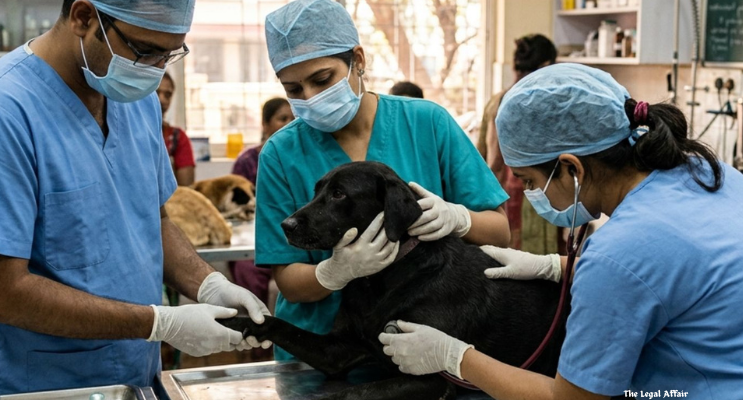
The Division Bench was therefore required to examine whether the distinction in departmental rules was sufficient to justify denial of the time-scale benefit. While considering the issue, the Court also took note of the nature and social significance of veterinary services in Madhya Pradesh. It observed that animal husbandry had assumed considerable importance in the State, with dairy farms, goat farms, vaccination programmes and measures for prevention and treatment of animal diseases forming an important part of rural life and the State’s economic activity.
The Bench also highlighted the distinctive nature of veterinary practice. A veterinarian is required to diagnose and treat an animal that cannot communicate its symptoms or medical history. Referring to the well-known observation of American cowboy humorist and social commentator Will Rogers, the Court remarked that the veterinarian has to identify the problem without being able to ask the patient what is wrong.
Against this backdrop, the Court considered whether veterinarians could be treated differently for purposes of the particular pay benefit when their professional status and service contributions were otherwise recognised by the State. Ultimately, the Division Bench concluded that the Single Judge had correctly granted the benefit and found no reason to interfere with the impugned order.
Arguments of the Parties:
Appearing for the State, Additional Advocate General Janhavi Pandit argued that the Single Judge had erred in directing parity in the matter of time-scale pay. The State’s case was primarily founded upon the distinction between the service conditions governing different categories of employees.
It was submitted that qualified Veterinary Assistant Surgeons and Veterinary Surgeons serving under the Animal Husbandry and Dairy Department were governed by a separate set of service rules. In contrast, Medical Officers and Dental Surgeons employed under the Health and Family Welfare Department were governed by another set of rules. The State argued that service conditions, including pay-related benefits, were required to be examined within the framework of the rules applicable to the concerned department and cadre.
According to the State, the mere fact that veterinarians, Medical Officers and Dental Surgeons were all qualified professionals working in the healthcare sector could not automatically result in identical service benefits. The State therefore contended that the respondents could not claim parity solely by comparing themselves with employees governed by a different statutory or administrative framework.
The State consequently sought setting aside of the Single Judge’s order. Its argument proceeded on the premise that the different rules applicable to the respective services constituted a legitimate basis for treating them separately and that the Court ought not to extend a benefit from one service to another where the governing rules were different.
The respondents, represented by Advocate Manikant Sharma, defended the Single Judge’s order and relied upon the State’s own policy concerning time-scale pay. They referred particularly to the notification dated January 24, 2008, which dealt with upgradation and grant of time-scale pay to civil servants working in various departments.
The respondents argued that the notification demonstrated a broader policy of extending the benefit to eligible employees across government departments. Their contention was that the State, being a model employer, was expected to administer such benefits fairly and consistently and could not arbitrarily create a distinction between professionals who were otherwise being treated similarly.
The respondents also emphasised the professional nature of veterinary service. According to their case, Veterinary Surgeons perform the essential function of diagnosis and treatment, just as Medical Officers and Dental Surgeons do in relation to human patients. The difference in the identity of the patient, they contended, could not by itself justify denial of an otherwise applicable financial benefit.
Another significant aspect of the respondents’ case was the State’s own conduct. They pointed out that veterinarians were already being treated at par with Medical and Dental Surgeons for several other benefits. This, according to them, weakened the State’s attempt to rely upon departmental classification for denying the particular pay-scale benefit.
The respondents further placed emphasis on the fact that the three categories were professionals engaged in healing and healthcare, albeit for different beneficiaries. Medical Officers treat human beings, Dental Surgeons treat dental conditions in human beings, while Veterinary Surgeons provide medical treatment to animals. Their argument was that the State could not selectively recognise equivalence for some purposes and simultaneously deny it for pay progression without a rational basis.
The Division Bench therefore had before it two competing approaches. The State sought to place emphasis on the separate service rules governing the respective cadres, while the respondents relied on the State’s broader pay policy, the nature of their professional duties and the treatment already accorded to veterinarians in other service matters.
Court’s Judgment:
The Division Bench dismissed the State’s appeal and affirmed the Single Judge’s direction granting veterinarians the benefit of time-scale pay on par with Medical Officers and Dental Surgeons.
A significant part of the Court’s reasoning concerned the nature of veterinary service itself. The Bench observed that veterinarians perform a specialised form of medical practice in circumstances that are inherently different from those faced by doctors treating human patients. An animal cannot describe pain, identify the location of a symptom, explain the duration of an illness or provide a medical history in the manner a human patient can.
The Court used this distinction to underline the specialised skill required in veterinary medicine. Referring to Will Rogers’ famous observation about veterinarians, the Bench noted that a veterinarian has to determine what is wrong with the patient without being able to ask the patient about the problem. The reference was not merely rhetorical. It served to highlight the professional skill, clinical judgment and diagnostic ability required from veterinary professionals.
The Court observed that the work of veterinarians in Madhya Pradesh has significant relevance to the State’s rural and economic structure. Animal Husbandry has developed into an important activity, with dairy farms, goat farms, animal vaccination programmes and efforts to address animal diseases forming part of the State’s larger system of rural and agricultural support.
The Bench noted that veterinarians remain in contact with a substantial portion of the rural population. According to the Court, their services reach more than 80 per cent of village communities, while a significant part of the population depends upon products and economic activities connected with livestock and animal husbandry.
This observation was important because it placed the question of pay parity in the larger context of public service rather than treating veterinary work as a marginal or ancillary activity. The Court made it clear that the contribution of veterinary professionals to the State’s economy, rural communities and public welfare could not simply be discounted.
The Court ultimately held that the Single Judge had rightly granted the benefit of time-scale pay to the respondents at par with Medical Officers and Dental Surgeons. The Division Bench found no sufficient justification for interfering with that conclusion.
The Court also examined the State’s own treatment of the three categories of professionals. It noted that the State itself had treated Veterinary Surgeons on par with Medical Officers and Dental Surgeons while extending various other benefits. This conduct assumed significance in determining whether the State could draw a distinction when it came to the higher pay scale.
The Bench specifically took note of the respondents’ assertion that Dental Surgeons, Medical Officers and Veterinary Surgeons carried equal pay. The Court observed that this assertion had not been rebutted by the State in its reply. In the absence of an effective rebuttal, the Court found further support for the respondents’ claim of parity.
The Court’s reasoning proceeded from the broader proposition that the State, as an employer, must act fairly and consistently in dealing with its employees. The existence of different departmental rules cannot, by itself, become an automatic justification for unequal treatment where the relevant employees are otherwise similarly situated for the purpose under consideration.
At the same time, the judgment does not appear to hold that every employee belonging to different departments must invariably receive identical service conditions. Rather, the Court’s reasoning was tied to the particular circumstances before it, including the State’s own treatment of veterinarians, the nature of their duties, the existing pay structure and the notification relating to time-scale benefits.
The Court was particularly persuaded by the fact that the professionals performed comparable healing functions, though their patients belonged to different categories. The Bench observed that all three categories could be regarded as healers serving society. Medical Officers treat human beings, Dental Surgeons provide specialised treatment to human patients, and Veterinary Surgeons treat animals, which the Court described as voiceless beings.
The Court therefore rejected a distinction based merely upon the identity of the patient. In substance, the Bench treated the difference between human and veterinary medicine as a difference in the target group of the professional service, rather than a sufficient reason to deny the financial benefit in the circumstances of the case.
The judgment also reflects the principle that classification in public employment must have a rational basis when it results in differential treatment. A government department may frame different service rules for different cadres, but where the State itself has recognised substantial parity between the services, it cannot rely on departmental separation alone to justify withholding a particular benefit.
The Division Bench’s approach was also influenced by the absence of any convincing material showing why the respondents should be denied the benefit. The State’s principal argument was that different rules governed the two categories of employees. However, the Court found that this distinction did not adequately answer the respondents’ case, particularly in view of the notification of January 24, 2008 and the State’s own treatment of the three professional categories in other respects.
The Court thus affirmed the principle that a government employer must maintain consistency in extending service benefits when employees are placed in materially comparable circumstances. The designation of the department or the existence of separate service rules cannot become an end in itself if the distinction does not correspond to a relevant difference for the benefit being claimed.
Another important feature of the judgment is the Court’s recognition of veterinary medicine as a specialised professional discipline. The observations regarding the difficulty of diagnosing animals reinforce the proposition that veterinary professionals cannot be treated as occupying a lesser category merely because their patients are animals.
The Bench’s discussion of animal husbandry in Madhya Pradesh further demonstrated that the work of Veterinary Surgeons has consequences extending beyond individual treatment. Veterinary services contribute to disease prevention, livestock health, vaccination programmes, dairy production, goat farming and the economic well-being of rural communities. The Court therefore considered their public service role to be substantial.
In this context, the Court found the Single Judge’s direction to be justified. The respondents were not seeking a benefit based solely on a superficial similarity in professional titles. Their claim was supported by the State’s own policy and treatment of comparable professional services, as well as by the nature of their duties.
The decision also reinforces the broader concept of the State as a model employer. Government employment carries an obligation of fairness not only in recruitment and disciplinary matters but also in the administration of service benefits. Where a government policy confers a financial or career-related benefit, differential treatment must be supported by a meaningful and legally sustainable distinction.
The Bench consequently declined to interfere with the Single Judge’s order. The appeal filed by the State was dismissed, thereby confirming that Veterinary Assistant Surgeons and Veterinary Surgeons covered by the proceedings were entitled to the benefit of time-scale pay at par with Medical Officers and Dental Surgeons.
The ruling is significant beyond the immediate dispute because it recognises the professional and public importance of veterinary services while applying principles of fairness in government employment. It also demonstrates that pay parity disputes cannot always be resolved merely by pointing to separate departmental rules. The Court may examine the actual nature of duties, the State’s treatment of comparable services, the applicable policy and whether the alleged distinction has a rational connection with the benefit being denied.
Ultimately, the Madhya Pradesh High Court’s judgment rests on a combination of professional equivalence, State policy, fairness in public employment and the practical importance of veterinary services. By upholding the Single Judge’s order, the Division Bench made it clear that veterinarians performing an essential healing function cannot be denied a service benefit merely because their patients are animals or because they belong to a different administrative department, particularly when the State itself has otherwise recognised parity between the concerned professional categories.
The decision in State of M.P. v. Vishnu Kumar Gupta thus provides an important illustration of how courts approach claims of parity in government service. While separate service rules may govern separate cadres, the ultimate question remains whether the distinction relied upon by the State is relevant and sufficient to justify differential treatment. In the present case, the Division Bench found that it was not, and therefore affirmed the entitlement of the veterinary professionals to time-scale pay on par with Medical Officers and Dental Surgeons.