


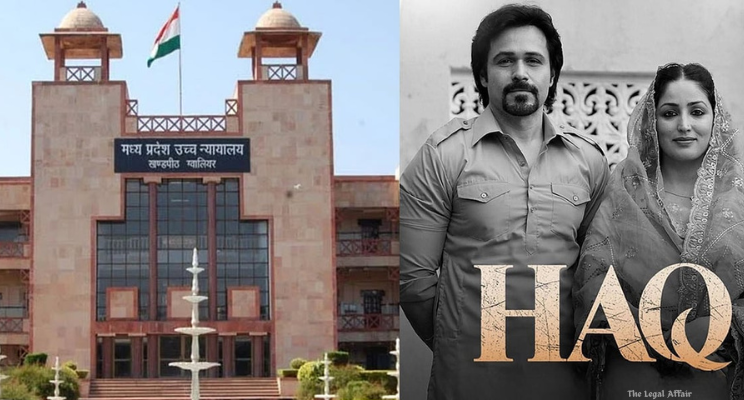
Introduction:
In a significant judgment reaffirming the delicate balance between artistic freedom and individual rights, the Madhya Pradesh High Court in Ms. Siddiqua Begum Khan v. Union of India and Others (Writ Petition No. 42708 of 2025) dismissed a petition filed by Shah Bano’s daughter challenging the release of the film Haq, a cinematic portrayal inspired by the 1985 Supreme Court landmark decision in Mohd. Ahmed Khan v. Shah Bano Begum. The petitioner, represented by Advocate Tousif Warsi, contended that the film portrayed her late mother in a false and derogatory manner and violated her right to privacy and dignity. The respondents included the Union of India, represented by Deputy Solicitor General Romesh Dave, and the film’s producers and writers, represented by Senior Advocate Ajay Bagadia, Advocate Ritik Gupta, and others. The petitioner argued that the movie, claiming inspiration from the Shah Bano case, distorted facts and sensationalized events, thereby defaming her mother’s legacy and hurting the sentiments of the family. She urged the Court to revoke or suspend the CBFC’s UA 13+ certification granted to the movie and to restrain its release scheduled for November 7, 2025. The core of the petitioner’s argument revolved around the assertion that the film Haq falsely depicted her mother’s life and presented fabricated dialogues and scenes that could mislead the public into believing they reflected real events. She further argued that while artistic liberties are permissible, the filmmakers had a moral and legal obligation to ensure accuracy when referencing a real person and a landmark legal case. It was contended that the disclaimer in the film claiming it to be “a fictional dramatization inspired by the book ‘Bano: Bharat Ki Beti’ and the 1985 Supreme Court judgment” was merely a smokescreen to escape liability for defamation and invasion of privacy.
Arguments:
The petitioner submitted that the film’s promotional material and teaser explicitly connected the storyline with Shah Bano’s life and the Supreme Court verdict, creating a clear impression that it was a biopic rather than a fictional adaptation. Thus, she asserted that by using her mother’s identity and case as the foundation, the filmmakers were misusing her mother’s name, fame, and reputation for commercial gain. Additionally, the petitioner alleged that the respondents had failed to seek consent from the family before producing or releasing the film, which she claimed amounted to moral and legal impropriety. She relied upon the Supreme Court’s decisions in K.S. Puttaswamy v. Union of India (2017) recognizing the right to privacy as a fundamental right and Justice K.S. Puttaswamy (Retd.) v. Union of India (Aadhaar case), asserting that an individual’s dignity and reputation are integral to privacy. The petitioner argued that the right to privacy and protection against defamation extends beyond death as it affects the dignity of surviving family members. She further cited Deepa Jayakumar v. A.L. Vijay (Madras High Court, 2021), where the Court had restrained the release of a film allegedly misrepresenting the life of former Chief Minister J. Jayalalithaa, arguing that a similar principle should apply to protect Shah Bano’s image. On these grounds, she sought an injunction against the release and a direction to the CBFC to withdraw its certification.
On the other hand, the respondents, represented by the Deputy Solicitor General and senior counsel, vehemently opposed the petition, arguing that it was misconceived, premature, and barred by delay. They emphasized that the film was a fictional and dramatized adaptation inspired by public records and the landmark judgment, not a biographical account. The respondents argued that the film’s disclaimer clearly stated that it was a work of fiction, adapted from the book Bano: Bharat Ki Beti, which itself was a dramatized literary work inspired by the 1985 judgment. Therefore, it was contended that the film did not purport to portray real events or persons and hence could not amount to defamation or violation of privacy. The producers asserted that artistic freedom is a facet of the fundamental right to freedom of speech and expression under Article 19(1)(a) of the Constitution and that reasonable artistic interpretation must be protected to encourage creative expression. They cited the Supreme Court’s judgment in R. Rajagopal v. State of Tamil Nadu (1994), also known as the “Auto Shankar” case, where it was held that once information is part of the public record, including court records, its publication cannot be restrained on grounds of privacy. Relying on this, they argued that the Shah Bano case and related materials have been in the public domain for decades and have been discussed, published, and analyzed globally. Hence, using those facts as a creative foundation does not violate any right. They further highlighted that the right to privacy, as per the rulings in K.S. Puttaswamy and Deepa Jayakumar, extinguishes upon the death of the individual, and the same cannot be inherited by their descendants. Thus, the petitioner could not claim a continuing right to privacy or reputation on behalf of her deceased mother. The respondents also drew attention to the CBFC’s certification process, noting that the film had been granted a UA 13+ certificate on August 28, 2025, after careful scrutiny. As per Section 5-E of the Cinematograph Act, 1952, any person aggrieved by such certification must first approach the Central Government for suspension or revocation of the certificate before invoking writ jurisdiction. The petitioner, having bypassed this statutory remedy, had rendered her petition non-maintainable. Moreover, they argued that the petitioner’s delay and conduct showed lack of bona fides — news of the film’s development, script, and shooting had been public since early 2024, yet the petitioner only filed the petition a week before the film’s release. Such last-minute litigation, they contended, was intended to obstruct the release for publicity rather than to protect any genuine legal right.
Judgement:
After hearing both sides, the bench of Justice Pranay Verma delivered a detailed judgment dismissing the petition and upholding the CBFC certification and the film’s release. The Court observed that the disclaimer accompanying the movie made it abundantly clear that the film was fictional, dramatized, and merely inspired by the 1985 Shah Bano judgment. It noted that since the film explicitly claimed to be a dramatization and adaptation, it could not be said to contain fabricated content or misrepresentation. The Court stated: “Since the disclaimer itself states that the same is dramatization and is fictional and an adaptation of a book and is inspired by a judgment of the Apex Court, it cannot be said that the contents of the film are fabricated. Since the film is an inspiration and a fiction, some amount of leeway is certainly permissible.” The Court emphasized that a film based on inspiration from real events need not replicate the original case with absolute precision and that creative liberties are inherent in the process of dramatization. It further remarked that to claim the film distorted private lives or personalities of individuals was unsustainable since the film never claimed to be a factual biopic. The Court further reasoned that even if some personal or matrimonial details were used to enhance dramatization, such inclusion could not render the film objectionable. “The film is not stated to be based purely upon the decision in the case of Shah Bano; hence if it contains any personal or matrimonial details for dramatization, nothing wrong can be found in the same,” the Court said.
A critical aspect of the Court’s reasoning was its reliance on the principle that once a matter enters public record, the right to privacy no longer subsists. Referring to R. Rajagopal v. State of Tamil Nadu, the Court observed that any publication based on public records, including court proceedings, becomes legitimate for public commentary. “The film is apparently based on public records including court records; hence it cannot be said that the script/dialogues have not been drawn from any legitimate or judicial source. Once a matter becomes a matter of public record, the right of privacy no longer subsists,” Justice Verma observed. The Court also noted that the Shah Bano judgment and its historical significance have been part of India’s socio-legal discourse for nearly four decades, with extensive coverage in print and electronic media. Thus, dramatizing its impact does not infringe any privacy right.
On the question of whether the right to privacy or reputation survives death, the Court referred to the Supreme Court’s judgment in K.S. Puttaswamy and the Madras High Court’s decision in Deepa Jayakumar v. A.L. Vijay (2021), holding that such rights extinguish upon the individual’s death and cannot be inherited by their heirs. The Court stated: “Since Shah Bano is no longer alive, her right of privacy and reputation has come to an end with her, and it is not the petitioner’s case that the film violates her own privacy or reputation.” Therefore, the contention that the film violated Shah Bano’s posthumous rights was rejected. The Court further ruled that there was no legal obligation on the producers to seek prior consent from the petitioner before releasing the film, as it was a work of fiction inspired by a matter of public record.
Addressing the procedural aspect, the Court noted that the CBFC had granted a UA 13+ certificate to the film after due consideration and that the petitioner had an alternate statutory remedy under Section 5-E of the Cinematograph Act to challenge the certification before the Central Government. Since she had not availed that remedy, her writ petition was liable to be dismissed for want of maintainability. The Court also criticized the petitioner’s conduct, noting that she had ample opportunity to raise objections earlier but had approached the Court only at the eleventh hour, just days before the release. Justice Verma remarked that a vigilant litigant would have acted promptly when the film’s production was publicly announced or when its teaser was released on September 23, 2025. The petitioner’s delayed approach, the Court held, indicated a lack of diligence and suggested an afterthought rather than a bona fide legal grievance.
In conclusion, the High Court dismissed the petition, upholding the constitutional protection of creative expression under Article 19(1)(a) while reiterating that such freedom must operate within the bounds of reason and responsibility. The judgment underscores that filmmakers enjoy artistic liberty to dramatize and adapt real events, provided they do not claim factual authenticity or defame identifiable individuals. It further reinforces that once facts become part of public judicial records, they are legitimate material for commentary, adaptation, or dramatization. The Court’s verdict thus harmonizes the freedom of artistic expression with the principle that privacy and reputation rights, though constitutionally safeguarded, are not absolute and cannot extend beyond life.