


Introduction:
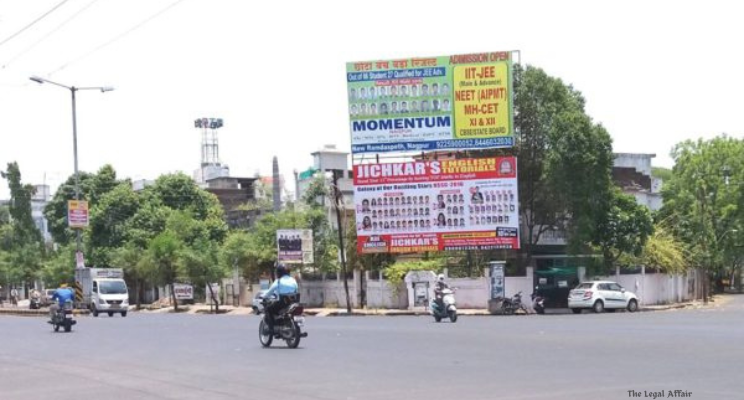
In Sudesh Gupta v. The State of Madhya Pradesh, WP-46800-2025, the Madhya Pradesh High Court was called upon to examine a public interest litigation concerning the alleged widespread installation of illegal hoardings on road dividers and footpaths in the city of Indore. The matter was heard by a Division Bench comprising Justice Vijay Kumar Shukla and Justice Alok Awasthi, which, at the interim stage, directed the Commissioner, Indore Municipal Corporation to identify all hoardings installed on dividers or footpaths in violation of the applicable rules and to take action in accordance with law. The case raises issues that go beyond a mere dispute over outdoor advertisements, for it touches the interconnected concerns of urban governance, public safety, municipal accountability, tender compliance, and public revenue. According to the petitioner, the installation of such hoardings violates the Madhya Pradesh Outdoor Advertisement Media Rules, 2017, particularly the provisions that prohibit advertisement structures from being placed in areas such as road medians and footpaths where they can obstruct movement, distract motorists, and endanger pedestrians. The petition also points to serious irregularities in the manner in which tenders issued in 2019 and 2020 were implemented. It is alleged that the contracts were granted much later without appropriate revision of rates and were extended for periods going up to seven years, thereby causing substantial financial loss to the municipal corporation. On behalf of the petitioner, reliance was placed on photographic material allegedly showing actual hoardings standing on road dividers and footpaths, thereby demonstrating a continuing breach of the statutory rules. Taking note of these assertions, the High Court issued notice to the respondents and passed an interim order directing the municipal corporation to verify the position and proceed against illegal installations. Though the matter remains pending for fuller adjudication, the interim order is significant because it reflects judicial concern over the normalization of unlawful urban encroachments in the name of advertisement and underlines that municipal authorities cannot permit revenue considerations or contractor convenience to override statutory safety norms. The case thus presents an important example of how public interest litigation can be invoked to compel civic authorities to enforce their own regulatory framework in matters that directly affect the daily safety and convenience of the public.
Arguments of the Petitioner:
The petitioner approached the High Court in the nature of a public interest litigant, raising the grievance that illegal hoardings had been allowed to come up in prohibited locations across Indore, especially on road dividers and footpaths, in clear violation of the governing statutory framework. The principal submission was that the Madhya Pradesh Outdoor Advertisement Media Rules, 2017 specifically regulate the manner and place of installation of hoardings and unipoles, and these rules cannot be diluted by executive convenience, tender arrangements, or private commercial interests. The petitioner’s counsel argued that the rules are designed not merely for aesthetic regulation of city advertisements but for ensuring public safety, orderly use of urban spaces, and lawful management of municipal property. In particular, emphasis was placed on Rule 28, which prohibits the installation of hoardings on road medians and footpaths, recognising that such sites are sensitive public spaces meant either for pedestrian movement or for traffic regulation and visibility. When such areas are occupied by advertising structures, the petitioner argued, the result is not only illegal encroachment but also a direct threat to citizens.
The petitioner’s case was that the violation was not theoretical or occasional, but visible and widespread. To substantiate this, the petitioner relied on photographic evidence before the Court, purportedly showing advertisement structures erected on dividers and footpaths. These photographs were used to demonstrate that the alleged violations were capable of immediate visual verification and did not involve complicated questions of disputed private title or hidden contractual conduct. According to the petitioner, the municipal authorities could not claim ignorance when such structures were standing in plain sight in public places. The presence of the hoardings on prohibited sites, it was submitted, revealed a pattern of regulatory failure and a lack of enforcement on the part of the Indore Municipal Corporation and other concerned authorities.
A second and equally important limb of the petitioner’s argument related to the tender process. The petition pointed out that tenders had been floated in 2019 and 2020 on the basis of particular revenue calculations and conditions. However, according to the petitioner, the actual award and operation of the contracts took place much later, yet the rates were not revised in line with changed circumstances, market realities, or the passage of time. The petitioner argued that this not only undermined public interest from a financial standpoint but also showed a disturbing administrative casualness in handling municipal assets. The contracts were allegedly extended for periods going up to seven years, despite the fact that they were founded on revenue assumptions that had become stale and unrealistic. This, according to the petitioner, caused substantial loss to the municipal corporation, which in turn meant a loss to the public exchequer.
The petitioner thus framed the case as involving two parallel forms of illegality: first, the physical illegality of hoardings being installed in places expressly prohibited by the 2017 Rules; and second, the administrative and financial illegality arising from non-compliance with tender conditions and the failure to revise contractual terms in a manner that protected municipal revenue. The petitioner’s counsel would have argued that when statutory rules prohibit particular structures in the interest of public safety, authorities are under a positive duty to enforce those rules. They cannot turn a blind eye merely because contracts have been awarded or revenue is being generated. Public safety norms, especially those concerning road users and pedestrians, must prevail over commercial advertisement interests.
The petitioner also implicitly invoked the logic of public trust. Roads, footpaths, and dividers are public spaces held by municipal authorities for the benefit of all citizens. Footpaths are meant for pedestrians, and dividers serve traffic management and safety purposes. Their use for advertisements contrary to statutory restrictions constitutes a distortion of the purpose for which such spaces are maintained. The petitioner therefore sought judicial intervention not as a means to challenge a mere contract, but to restore legality in the use of civic infrastructure and to ensure that urban governance remains accountable to law and public welfare.
Arguments of the Respondents:
At the interim stage reflected in the reported proceedings, the full defence of the State and the municipal corporation does not appear to have been recorded in detail. However, from the nature of the dispute, the likely stand of the respondents would be that the matter required detailed examination of facts, including whether all the impugned hoardings were in fact illegal, whether they were covered by existing contracts or permissions, and whether the allegations in the PIL correctly represented the position on the ground. The State and municipal authorities may have sought time to file their response because cases involving advertisement permissions often require scrutiny of site plans, tender documents, contracts, permissions, renewals, and field inspections. It is therefore likely that the respondents did not at that stage offer a full factual rebuttal and instead sought the opportunity to place the complete record before the Court.
The municipal corporation may also be expected to contend that outdoor advertisement management in a large urban centre is a complex administrative function involving tendering, regulation, revenue collection, removal drives, and coordination among various departments. Authorities often distinguish between authorised structures, structures erected pursuant to contract, and unauthorised or excess structures put up by contractors in breach of permission. In such a setting, the corporation may argue that not every hoarding visible in a public area is necessarily illegal, and that some may require verification as to dimensions, location, licence, or contractual scope. The respondents may also seek to clarify whether the impugned structures were temporarily erected, recently installed, or inherited from earlier contractual arrangements. These are common lines of administrative defence in municipal regulation cases.
With regard to the allegation of revenue loss, the respondents may contend that the award and continuation of contracts based on earlier tenders were influenced by practical and administrative factors, including delays, market conditions, and tender process timelines. They may argue that whether there was actual financial loss, and whether rates ought to have been revised, are matters requiring detailed financial scrutiny rather than immediate judicial conclusion. Similarly, they may attempt to justify the continuation or extension of contracts on administrative grounds or in terms of specific tender conditions, if any such provisions existed. At the same time, it is possible that the respondents would resist any broad inference of mala fides or wrongdoing without a fuller examination of the record.
However, the fact that the Court granted interim relief indicates that, at least prima facie, it found enough substance in the petitioner’s allegations, especially concerning hoardings on dividers and footpaths, to warrant immediate protective directions. Therefore, even if the respondents intended to contest the broader allegations regarding tender irregularities and financial loss, the immediate concern before the Court was whether obvious statutory violations affecting public spaces and safety needed prompt attention. The Court’s order suggests that it was unwilling to let such potentially unlawful structures remain untouched merely because the matter required a fuller reply on other issues.
Court’s Judgment:
The Madhya Pradesh High Court, while not finally adjudicating the PIL, passed a significant interim order that reflects both caution and urgency. The Division Bench issued notice to the respondents, making it returnable within four weeks, thereby indicating that the matter requires a fuller hearing after the respondents place their stand on record. At the same time, the Court was not prepared to await the completion of pleadings before addressing what appeared, at least prima facie, to be an issue of immediate public concern. Therefore, as an interim measure, the Bench directed the Commissioner, Indore Municipal Corporation to identify hoardings installed on dividers or footpaths contrary to the rules and to take action in accordance with law. This limited but pointed direction is the heart of the order.
The significance of the Court’s direction lies in the way it balances institutional restraint with preventive intervention. The Court did not itself embark upon a factual survey of each hoarding, nor did it pronounce at this stage upon every allegation raised in the PIL regarding tender irregularities, contractual non-compliance, or municipal revenue loss. Instead, it confined its interim direction to a narrower but urgent issue: hoardings erected on road dividers and footpaths in violation of the rules. By doing so, the Court ensured that its intervention remained tied to an objective legal standard already embodied in the statutory framework. It did not create a new norm; it simply required the municipal authority to enforce the existing one.
The reference point for this intervention is clearly the MP Outdoor Advertisement Media Rules, 2017, especially the provisions that prohibit the installation of advertisement structures on medians and footpaths. These rules exist because such locations are inherently sensitive in urban planning and public safety terms. Dividers are part of the road design intended to regulate and separate traffic, while footpaths are reserved for pedestrian use. Any obstruction or commercial occupation of these spaces can compromise visibility, crowd movement, and the safety of vulnerable road users. The Court’s interim order thus reflects a judicial recognition that regulatory non-enforcement in such matters is not a mere procedural lapse but a matter with real consequences for citizens.
Another important feature of the order is that the Court directed action “in accordance with law.” This phrase is crucial because it means the Commissioner is not being asked to undertake an arbitrary demolition drive, but to verify which hoardings violate the applicable rules and then proceed legally. The direction therefore preserves procedural fairness while ensuring enforcement. It leaves room for the municipal corporation to distinguish between authorised and unauthorised structures, but it removes any excuse for inaction where structures are plainly found on prohibited sites.
The order also indicates that the Court was persuaded, at least prima facie, by the photographic evidence relied upon by the petitioner. Though the Court did not record detailed findings on each photograph, the fact that it passed immediate directions suggests that the visual material was sufficient to raise serious concern. This is typical of PIL proceedings involving civic violations, where photographic documentation often plays a key role in showing the existence of visible and continuing illegality in public spaces.
The broader allegations in the PIL—concerning delayed awarding of contracts, failure to revise rates from tenders issued in 2019 and 2020, and the resulting loss to municipal revenue—remain open for fuller consideration. These issues are likely to require examination of tender notices, contractual terms, dates of award, duration of licences, extension mechanisms, and financial calculations. The Court did not decide those questions at this stage, and rightly so, because they require a more developed record. However, by issuing notice and keeping the matter pending, the Court signalled that these questions are not being brushed aside. The interim order addresses the most urgent public safety dimension while reserving the larger governance and revenue issues for subsequent adjudication.
From a constitutional and administrative law perspective, the order is an example of the Court exercising supervisory jurisdiction to compel statutory compliance by local authorities. Municipal corporations are statutory bodies entrusted with management of public spaces, and when allegations arise that they have either permitted or failed to prevent illegal occupation of such spaces, judicial oversight can become necessary. The Court’s order reinforces the principle that municipal discretion is not absolute; it is bounded by the rules framed under law. Revenue generation through advertisement cannot legitimise structures erected in places expressly prohibited by the regulatory framework.
The interim nature of the order should not obscure its practical impact. Directions of this kind can immediately trigger inspections, removal notices, enforcement action, and administrative accountability within the municipal corporation. They also send a larger message that footpaths and dividers are not commercial blank spaces available for exploitation at the cost of safety and urban order. In a city environment where illegal hoardings often become normalised due to administrative tolerance, such judicial intervention can re-establish the primacy of rule-based governance.
The matter being listed again in April means that the Court will likely consider the respondents’ replies, examine whether compliance has taken place, and decide how to proceed on the broader claims in the PIL. Depending on the material produced, the case may evolve into a deeper scrutiny of how advertisement contracts are awarded and monitored by the municipal corporation, whether public safety rules are being routinely violated, and whether public revenue has been compromised through flawed tender administration. For the moment, however, the Court’s order stands as a clear interim directive that illegal hoardings on dividers and footpaths must not be allowed to remain merely because they are profitable or administratively convenient.
In essence, the High Court’s order affirms a simple but important principle: urban governance must operate within the bounds of law, and public spaces designed for safety and movement cannot be sacrificed to unlawful advertising practices. The interim relief granted in this case reflects judicial sensitivity to the everyday realities of city life—pedestrians forced off footpaths, drivers distracted by cluttered road medians, and civic authorities failing to enforce their own rules. By stepping in at the interim stage, the Court ensured that legality and public safety receive immediate priority while the larger questions in the PIL await fuller adjudication.