


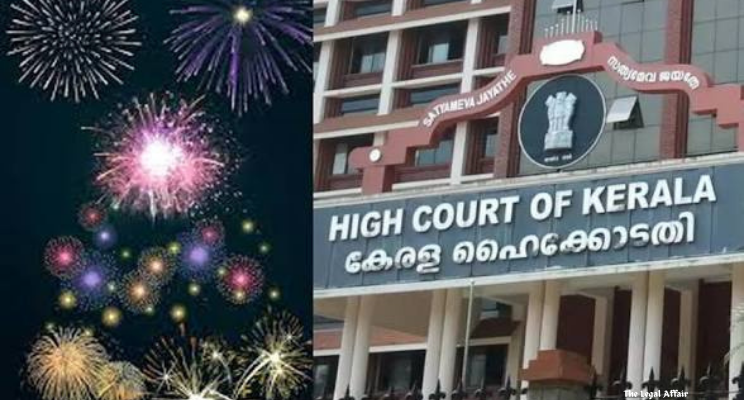
Introduction:
The Kerala High Court has clarified that the amended safety requirements prescribed under Rules 83 and 86 of the Explosives Rules, 2008, for permanent fireworks shops cannot be automatically imposed on applications seeking licences for temporary fireworks shops operated during festival seasons. The Court held that Rule 84 specifically governs the eligibility conditions and requirements for granting temporary licences for the possession and sale of fireworks, and the authorities must consider such applications under the applicable provisions rather than insist on compliance with requirements intended for permanent establishments.
The ruling was delivered by Justice G. Girish while considering a writ petition filed by a fireworks seller who sought directions to the licensing authorities to consider his application for a temporary fireworks shop licence without applying the additional conditions introduced through amendments to Rules 83 and 86 of the Explosives Rules, 2008. The decision is reported as 2026 LiveLaw (Ker) 384.
The dispute arose when the petitioner, who had been conducting the temporary sale of fireworks during festive occasions, submitted an application to the District Collector, Thiruvananthapuram, seeking permission to operate temporary fireworks shops during the forthcoming festival season. Following the application, the District Collector directed the concerned authorities, including the Tahsildar, the Station House Officer and the Fire and Rescue Services Department, to verify whether the petitioner had complied with the requirements introduced through amendments to Rules 83 and 86 of the Explosives Rules.
The petitioner approached the High Court contending that these amended requirements were not applicable to temporary fireworks shops and that his application should instead be examined under the provisions specifically governing temporary licences. According to him, insisting on compliance with the additional conditions applicable to permanent establishments could unfairly prevent him from obtaining permission to operate a temporary shop during the festival season.
The controversy required the High Court to examine the scope and application of the amended provisions of the Explosives Rules, 2008, particularly the distinction between the regulatory framework governing permanent fireworks shops and the conditions prescribed for temporary establishments.
Fireworks sales are subject to regulatory controls because the storage, possession and sale of explosive materials involve substantial safety risks. The Explosives Rules establish requirements intended to minimise the possibility of accidental fires, explosions and injuries to members of the public. These requirements may include conditions relating to the location and construction of shops, emergency exits, firefighting equipment and other safety arrangements.
However, the existence of stringent safety regulations does not eliminate the need to apply the correct legal provision to the category of licence under consideration. Where the rules distinguish between permanent and temporary establishments, licensing authorities must examine the application within the framework specifically prescribed for the relevant category.
Rule 83 of the Explosives Rules, 2008, deals with requirements relating to fireworks shops, while Rule 86 contains additional provisions concerning safety arrangements. Rule 84, on the other hand, governs the eligibility conditions and requirements for the grant of temporary licences for the possession and sale of fireworks in temporary shops.
The amendments to Rules 83 and 86 introduced more specific requirements concerning the physical structure of fireworks shops and their fire-safety arrangements. The petitioner argued that these changes could not be extended to temporary shops when the applicable rules separately addressed the licensing of such establishments.
The High Court accepted the central distinction raised by the petitioner and held that there was no justification for insisting on compliance with the amended requirements of Rules 83 and 86 as a condition for granting a temporary fireworks shop licence. The Court also relied on the language of Rule 86(7), particularly its reference to an “existing fireworks shop”, to support the conclusion that the relevant requirements were intended for fireworks shops of a permanent nature.
The judgment is significant because it clarifies how regulatory provisions must be interpreted when different categories of establishments are governed by separate rules. It also reinforces the principle that administrative authorities must exercise their powers within the limits of the applicable statutory framework, rather than impose additional conditions without a sufficient legal basis.
Arguments of the Parties:
The petitioner approached the Kerala High Court seeking appropriate directions to the licensing authorities to consider his application for a temporary fireworks shop licence without insisting on the additional requirements incorporated through amendments to Rules 83 and 86 of the Explosives Rules, 2008.
The petitioner’s primary contention was that the statutory framework distinguishes between permanent fireworks shops and temporary establishments operated during festival seasons. According to him, the requirements introduced by the amendments to Rules 83 and 86 were not applicable to his application because temporary licences were governed by Rule 84.
The petitioner had been engaged in the temporary sale of fireworks during festive occasions and had applied to the District Collector, Thiruvananthapuram, for a licence to operate temporary fireworks shops during the forthcoming festival season. His grievance arose after the District Collector instructed the relevant officials to verify whether the petitioner had complied with the amended conditions prescribed under Rules 83 and 86.
The petitioner argued that the licensing authority could not lawfully insist on compliance with requirements that were not intended to govern the category of licence for which he had applied. He maintained that the application had to be assessed under the provisions specifically dealing with temporary fireworks shops, rather than under provisions imposing additional conditions on permanent establishments.
One of the important changes introduced through the amendment to Rule 83 concerned the location and structural configuration of a fireworks shop. Under the amended provision, the shop was required to be situated on the ground floor of a single-storeyed building used exclusively for the relevant activity, with an independent entrance and an emergency exit opening directly into open space. The provision also required the doors to open outwards.
Before the amendment, the rule required the shop to be located on the ground floor of a building but did not expressly prescribe that the building must be a standalone, single-storeyed structure. The amendment therefore introduced more specific requirements concerning the physical arrangement and accessibility of the premises.
The amended provisions also prescribed the placement of at least two fire extinguishers of specified types, namely Dry Chemical Powder and Carbon Dioxide extinguishers, at strategic locations within the shop. These requirements were intended to improve the ability to respond to a fire emergency.
The petitioner contended that these additional structural and firefighting conditions could not be treated as automatically applicable to temporary establishments merely because they involved the sale of fireworks. The existence of a separate provision dealing with temporary licences was central to his argument that the nature and duration of the proposed activity had to be taken into account while determining the applicable requirements.
The amendment to Rule 86 introduced further safety measures concerning existing fireworks shops. These included requirements relating to automatic fire detection and alarm systems, automatic portable or gravity-fed water sprinkler systems for fire suppression, alternative power supply or battery backup, and centralised large electric panels, among other arrangements.
According to the petitioner, extending these additional requirements to temporary fireworks shops would effectively subject temporary establishments to a regulatory framework intended for permanent shops. He argued that such an approach would create an unjustified obstacle to the consideration of his licence application and could result in its rejection for non-compliance with conditions that did not legally govern his case.
The petitioner’s challenge was therefore directed not at the general importance of fire safety or the authority of the State to regulate fireworks sales, but at the applicability of the particular amended requirements to a temporary licence. His request was that the licensing authorities assess the application under the correct statutory provision and refrain from treating the requirements introduced under Rule 86 as mandatory conditions for the grant of a temporary licence.
The petitioner was represented by advocates Biju Balakrishnan, V.S. Rakhee, Akshaya S. Nair, Jayakumar C. and Sandra Sunny Otta.
The State, represented by Government Pleader O.M. Shalina, opposed the writ petition on a preliminary ground. The Government Pleader submitted that the petition was premature because the District Collector had not yet passed a final order on the petitioner’s application for a temporary fireworks shop licence.
According to the State, the District Collector had merely directed the relevant authorities to verify compliance with the prescribed requirements. Since the application remained under consideration, the petitioner had approached the High Court before the licensing authority had made a final decision.
The State’s objection raised a question concerning the stage at which judicial intervention was appropriate in administrative licensing proceedings. Where an authority has not yet decided an application, the State may contend that a challenge to the anticipated decision is premature, particularly when the applicant has not yet suffered a final adverse order.
The Government Pleader’s submission was thus focused on the procedural status of the application rather than on establishing that every amended requirement under Rules 83 and 86 necessarily applied to temporary fireworks shops.
The High Court nevertheless proceeded to examine the substantive issue concerning the interpretation of the Explosives Rules. The central question was whether the authorities could insist on compliance with the amended requirements of Rules 83 and 86 while considering an application for a temporary licence governed by Rule 84.
The Court’s consideration of the matter demonstrated that the existence of an administrative process does not prevent a court from examining the legal basis of a requirement when the dispute concerns the proper interpretation of the governing rules and the applicant seeks directions for lawful consideration of the pending application.
Court’s Judgment:
The Kerala High Court allowed the petitioner’s request for appropriate directions and held that the amended requirements under Rules 83 and 86 of the Explosives Rules, 2008, could not be insisted upon as conditions for granting a temporary fireworks shop licence where Rule 84 governed the application.
Justice G. Girish examined the structure of the relevant provisions and concluded that the rules themselves distinguished between the requirements for temporary fireworks shops and those applicable to permanent establishments. The Court emphasised that Rule 84 specifically governed the eligibility conditions and requirements for granting temporary licences for the possession and sale of fireworks in temporary shops.
This distinction was decisive. When a statutory framework contains a provision specifically dealing with a particular category of licence, the licensing authority must identify and apply the requirements relevant to that category. The existence of additional conditions under other provisions does not, by itself, justify extending those conditions to a different category where the statutory language and structure indicate otherwise.
The Court therefore rejected the approach of treating the amended provisions of Rules 83 and 86 as automatically applicable to the petitioner’s temporary licence application. Instead, it held that the application had to be considered in accordance with the regulatory framework governing temporary fireworks shops.
The Court’s reasoning was particularly relevant to the amendment of Rule 83. The amended provision prescribed a specific physical arrangement for fireworks shops, including their location on the ground floor of a single-storeyed building, an independent entrance, an emergency exit opening directly into open space and outward-opening doors. It also incorporated more detailed fire-extinguishing requirements.
These conditions concern the structural configuration and safety arrangements of the premises. While such measures may be important for preventing accidents and facilitating emergency responses, their applicability must be determined by reference to the relevant statutory provision.
The High Court’s decision did not establish that temporary fireworks shops were exempt from all safety obligations. Rather, it clarified that the particular amended requirements relied upon by the authorities could not be imposed merely by referring to Rules 83 and 86 when the application was for a temporary licence governed by Rule 84.
This distinction is important because an exemption from a particular set of requirements does not necessarily mean that an establishment is free from every other condition prescribed by law. Temporary fireworks shops remain subject to the requirements that legally govern their licensing, including those applicable under Rule 84 and any other validly applicable provisions.
The Court’s interpretation also addressed the amendments to Rule 86, which introduced additional fire-safety measures for existing fireworks shops. These measures included automatic fire detection and alarm systems, sprinkler-based fire suppression arrangements, alternative power supplies or battery backups, and centralised large electric panels.
The Court paid particular attention to the wording of Rule 86(7), which uses the expression “existing fireworks shop”. According to the Bench, this language provided an important indication of the category of establishments for which the requirements were intended.
The Court observed that the legislature had consciously incorporated the expression “existing fireworks shop” to make clear that the requirements specified under that sub-rule were meant for fireworks shops of a permanent nature. The wording therefore supported the petitioner’s contention that those requirements should not be automatically extended to temporary shops operating under a separate licensing framework.
The significance of this reasoning lies in the Court’s reliance on the language chosen by the rule-making authority. Statutory interpretation requires courts to examine the words used in a provision, read them in the context of the surrounding rules, and determine the scope of the obligation that the provision creates.
Where the wording of a rule identifies a particular category of establishment, that language cannot ordinarily be disregarded while applying the provision to another category. The reference to an “existing fireworks shop” was therefore relevant to determining the intended scope of the amended requirements under Rule 86(7).
The Court found that the separate treatment of temporary licences under Rule 84, read alongside the wording of Rule 86(7), supported the conclusion that the additional requirements were intended for permanent fireworks shops rather than temporary festival establishments.
Consequently, the Court held that there was no justification for insisting on compliance with the amendments made to Rules 83 and 86 through the amendment referred to in the petition as Ext.P3 when considering the grant of a temporary fireworks shop licence.
The ruling also reflects the broader principle that administrative authorities must act within the boundaries of the powers and obligations established by the governing legislation. Licensing authorities may verify compliance with applicable safety conditions and reject an application where the relevant statutory requirements have not been met. However, they cannot make compliance with an inapplicable requirement a precondition for granting a licence merely because the additional condition appears relevant to the general subject matter.
In regulatory matters involving public safety, it is particularly important to maintain a clear distinction between the authority to impose safety standards and the legal basis for imposing a specific standard on a particular establishment. Fireworks are hazardous materials, and appropriate safeguards are essential. At the same time, safety regulation must operate through the statutory framework prescribed for the activity concerned.
The High Court’s decision did not question the importance of the amended safety measures for permanent fireworks shops. Nor did it hold that the State lacked the authority to regulate temporary fireworks sales. Its conclusion was narrower: the authorities could not insist upon the amended requirements of Rules 83 and 86 as conditions for granting a temporary licence where those requirements were not applicable to that category of establishment.
This approach preserves the distinction between regulatory objectives and the legal means adopted to achieve them. A legitimate public-safety objective does not, by itself, permit an administrative authority to disregard the categories and conditions established by the governing rules. The authority must act in accordance with the relevant provisions while ensuring that the safety requirements applicable to the proposed activity are properly examined.
The Court also addressed the procedural objection raised by the Government Pleader that the petition was premature because the District Collector had not yet taken a final decision on the application. Although the State relied on the pending status of the application, the petitioner had raised a specific legal issue concerning the conditions the authorities had been directed to verify.
The High Court examined that issue and determined that the applicable statutory framework did not justify insisting on the amended requirements in the manner challenged by the petitioner. It consequently issued directions requiring the concerned authorities to consider and decide the application in accordance with that interpretation.
The operative direction was that the authorities must consider and take a decision on the petitioner’s application for a temporary fireworks shop licence without insisting on the requirements incorporated through the amendment to Rule 86 of the Explosives Rules, 2008. The judgment thus addressed the immediate grievance by ensuring that the pending application would be assessed without treating the disputed requirements as mandatory conditions for a temporary licence.
The order did not amount to an automatic grant of the licence. The distinction is legally significant. A direction to consider an application in accordance with the applicable rules is different from a judicial order granting the licence itself. The authorities retain the responsibility to examine whether the applicant satisfies the conditions that lawfully govern temporary fireworks shops and to take a decision on the application accordingly.
The decision, reported as 2026 LiveLaw (Kr) 384, is therefore relevant to the interpretation of t