


Introduction:
The Kerala High Court has granted interim relief in a significant case concerning the balance between university administration, student autonomy, and freedom of expression within educational institutions. In Mahatma Gandhi University Students’ Union and Another v. Mahatma Gandhi University and Others (WP(C) No. 27279 of 2026), Justice Bechu Kurian Thomas stayed the operation of an order issued by the Vice-Chancellor of Mahatma Gandhi University withdrawing financial assistance sanctioned for conducting a National Conference. The interim order came after the Students’ Union challenged the University’s decision to revoke funding on the allegation that certain promotional posters for the conference carried “political overtones.”
Although the High Court has only granted interim relief and a detailed order is awaited, the case raises important questions regarding the limits of administrative discretion, procedural fairness, academic freedom, and the extent to which symbolic artwork used in university events can be construed as political expression warranting disciplinary action.
The controversy arose in connection with a three-day National Conference proposed to be organised by the Mahatma Gandhi University Students’ Union. According to the petition, the conference was conceived as a purely academic event to be held within the university campus after obtaining all necessary approvals from the University authorities. The University sanctioned financial assistance of ₹3.75 lakh for the programme, out of which ₹2.81 lakh, constituting seventy-five per cent of the sanctioned amount, was released to the Students’ Union. Based on the approval and financial sanction, the organisers commenced preparations for the conference, including publicity, logistics, and academic arrangements.
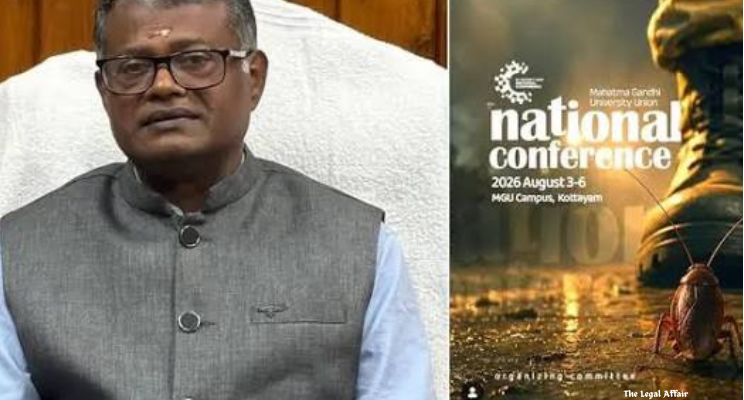
During the course of these preparations, the University issued a circular stating that political activities would not be permitted in programmes conducted using University funds. The circular also required prior permission before the University’s emblem could be used in publicity materials. According to the Students’ Union, the issuance of this circular was triggered by two promotional posters prepared for the conference. One poster depicted a cockroach standing defiantly before a large boot, while another portrayed a cockroach apparently pushing against or resisting a large curtain. These images subsequently became the focal point of the dispute.
The Director of Students’ Welfare thereafter issued a notice alleging that the posters carried political overtones and violated the Mahatma Gandhi University Students’ Code of Conduct Rules, 2005, together with other applicable circulars governing student activities. Following consideration of the matter, the Vice-Chancellor withdrew the financial sanction already granted for the conference, prompting the Students’ Union to approach the High Court seeking judicial intervention.
The case highlights the recurring constitutional tension between institutional discipline within universities and the fundamental rights of students to organise academic programmes, engage in creative expression, and enjoy procedural fairness before adverse administrative action is taken.
Arguments of the Parties:
The Students’ Union, represented by its counsel, challenged the Vice-Chancellor’s decision primarily on the ground that the withdrawal of financial assistance was arbitrary, disproportionate, and unsupported by any objective material establishing violation of University regulations.
The petitioners submitted that the proposed National Conference was conceived entirely as an academic programme intended to facilitate scholarly discussion and participation by students, academicians, and researchers. Before initiating preparations, the Union had followed the prescribed procedure by obtaining approval from the University and securing financial sanction. Pursuant to such approval, the University had released seventy-five per cent of the sanctioned amount, thereby creating a legitimate expectation that the event would proceed in accordance with the approved proposal.
According to the petitioners, extensive preparations had already commenced by the time the impugned circular and subsequent notice were issued. Financial commitments had been made, organisational arrangements had progressed substantially, and invitations and publicity had already been circulated. Consequently, the sudden withdrawal of funding seriously prejudiced the successful conduct of the conference.
The principal allegation levelled against the Students’ Union concerned the use of two cockroach-themed posters in connection with publicity for the event. The petitioners argued that these posters did not contain any political symbols, flags, slogans, campaign material, or references to any political party recognised by the Election Commission of India. It was specifically submitted that the posters were artistic representations incapable of being automatically characterised as political propaganda merely because they employed symbolic imagery.
The Students’ Union further contended that after receiving the notice issued by the Director of Students’ Welfare, its representative appeared before the authority and furnished a detailed explanation clarifying the nature of the posters. During the proceedings, it was expressly pointed out that none of the publicity materials promoted any political ideology or electoral campaign and therefore could not be said to violate the Students’ Code of Conduct or other applicable regulations.
Despite the explanation submitted by the petitioners, it was alleged that the Vice-Chancellor proceeded to withdraw the sanctioned funds without properly appreciating the factual position or assigning adequate reasons demonstrating how the posters violated the relevant rules.
The petitioners characterised the action as mechanical, arbitrary, and violative of principles of natural justice. According to them, the authorities had acted solely on subjective assumptions regarding the possible interpretation of the artwork rather than any objective evidence showing that the conference itself had been converted into a political event.
On behalf of the University, it appears that the administrative authorities justified their action by relying upon the recently issued circular regulating programmes conducted using University funds. The University maintained that political activities could not be permitted in events financed through public funds and that organisers were required to comply with institutional guidelines governing publicity materials.
The respondents also relied upon the notice issued by the Director of Students’ Welfare alleging that the impugned posters possessed political overtones and violated the Mahatma Gandhi University Students’ Code of Conduct Rules, 2005, together with other applicable circulars.
The University’s apparent position was that it possesses the authority to regulate activities conducted within the campus using University resources and to ensure that officially funded programmes remain consistent with institutional regulations. It therefore considered withdrawal of financial assistance appropriate after concluding that the publicity materials violated applicable norms governing student activities.
Thus, while the petitioners maintained that the posters represented protected artistic expression devoid of political content, the University viewed them as possessing political overtones incompatible with the conditions governing utilisation of University funds.
Court’s Judgment:
At the present stage, the Kerala High Court has not finally adjudicated the merits of the controversy. Justice Bechu Kurian Thomas considered the petition seeking urgent interim relief and stayed the operation of the Vice-Chancellor’s order withdrawing financial assistance for the National Conference.
Since the detailed reasons supporting the interim order have not yet been published, the precise legal reasoning adopted by the Court remains awaited. Nevertheless, the grant of interim protection indicates that the Court found it appropriate to preserve the existing position pending fuller consideration of the issues raised by the Students’ Union.
By staying the withdrawal order, the High Court has ensured that the immediate consequences of the impugned administrative action do not irreversibly affect the proposed academic conference before the legality of the University’s decision is finally examined.
The interim order assumes significance because disputes concerning university administration frequently involve competing constitutional and institutional considerations. Universities undoubtedly possess the authority to regulate campus discipline, supervise utilisation of public funds, and ensure compliance with academic regulations. At the same time, such powers must ordinarily be exercised fairly, reasonably, and consistently with constitutional guarantees protecting freedom of expression and procedural fairness.
One of the principal issues likely to arise during the final hearing concerns the extent to which symbolic artwork or creative expression can legitimately be characterised as having political overtones. Modern artistic expression frequently employs metaphor, symbolism, and abstract imagery open to multiple interpretations. Whether such expression can justify administrative sanctions depends upon careful examination of the context, purpose, and actual content of the material in question rather than subjective perceptions alone.
The case may also require the Court to examine whether the University’s decision-making process satisfied the principles of natural justice. Although the petition records that the Students’ Union was issued a notice and permitted to submit an explanation, the adequacy of consideration given to that explanation, as well as the sufficiency of reasons recorded by the Vice-Chancellor, may become important aspects of judicial scrutiny.
Another issue likely to receive consideration concerns the doctrine of legitimate expectation. Having granted prior approval and released seventy-five per cent of the sanctioned financial assistance, the University arguably created a legitimate expectation that the conference would proceed unless clear and legally sustainable grounds subsequently emerged justifying withdrawal of approval.
Courts have consistently recognised that where administrative authorities alter an earlier decision affecting rights or legitimate expectations, such action must ordinarily be supported by rational reasons, procedural fairness, and adherence to applicable statutory or regulatory provisions.
The dispute may further involve examination of the scope of the Mahatma Gandhi University Students’ Code of Conduct Rules, 2005, and the validity of the University’s conclusion that the impugned posters actually violated those rules. Whether the posters objectively amounted to political activity or merely constituted artistic or symbolic expression will likely form one of the central questions during final adjudication.
The High Court’s interim intervention does not amount to a final declaration that the University’s action was illegal. Rather, it reflects the settled principle that interim protection may be granted where refusal of relief could render the ultimate adjudication ineffective or cause irreversible prejudice before the legal issues are finally decided.
The matter has now been posted for further consideration on 10 September 2026, when the Court is expected to examine the rival contentions in greater detail after receiving complete responses from the University authorities.
The forthcoming adjudication is likely to have implications extending beyond the immediate dispute. Universities across the country increasingly encounter questions concerning the permissible limits of student expression, institutional regulation, artistic freedom, and administrative oversight. The final judgment may therefore provide valuable guidance regarding the balance between preserving academic discipline and protecting the expressive freedoms traditionally associated with institutions of higher education.
Until then, the interim order ensures that the Students’ Union receives temporary protection against the withdrawal of funds while the legality of the Vice-Chancellor’s decision undergoes judicial examination. The case serves as an important reminder that administrative decisions affecting academic activities are ultimately subject to constitutional scrutiny and must satisfy the standards of fairness, reasonableness, and legality expected under public law.