


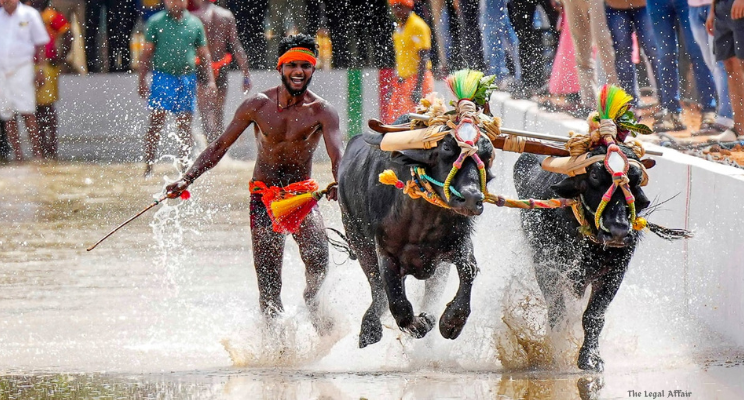
Introduction:
In a landmark judgment that blends cultural preservation with regulatory compliance, the Karnataka High Court has allowed the conduct of the traditional bull race event known as Kambala beyond the coastal districts of Dakshina Kannada and Udupi, rejecting a plea filed by People for the Ethical Treatment of Animals (PETA), India. The case, PETA India v. State of Karnataka & Others (WP No. 18406/2024), was heard by a Division Bench comprising Chief Justice N. V. Anjaria and Justice K. V. Aravind. The Bench firmly held that tradition and culture are not confined to geography and that festivals promoting the state’s heritage cannot be restricted to specific districts unless explicitly prohibited by law. The Court emphasized that while animal welfare must remain safeguarded through proper regulation and monitoring, cultural practices like Kambala symbolize Karnataka’s rural ethos and should not be confined to limited regions merely based on historical occurrence. The judgment addressed the concerns of both cultural proponents and animal rights advocates, balancing heritage preservation with statutory safeguards under the Prevention of Cruelty to Animals Act, 1960, and the Karnataka Amendment Act, 2017. The Court’s nuanced approach reaffirmed the judiciary’s stance of respecting legislative and executive discretion in matters of cultural and traditional affairs, while ensuring that ethical standards governing animal welfare are not compromised.
Arguments of the Petitioner (PETA):
Represented by Senior Advocate Dhyan Chinnappa, PETA advanced a detailed argument urging the Court to restrict the conduct of Kambala to its traditional heartlands — the rural districts of Dakshina Kannada and Udupi. The petitioner contended that the bull race event is inherently tied to the coastal agrarian tradition and was historically conducted as part of post-harvest celebrations. Extending the event to urban regions like Bengaluru, they argued, was a deviation from its original cultural purpose and purely motivated by commercial and entertainment interests. PETA’s petition emphasized that holding such events outside their traditional contexts not only distorts their cultural essence but also raises serious concerns under the Prevention of Cruelty to Animals Act, 1960, and its Karnataka amendment. The organization claimed that expanding the geographical scope of Kambala would encourage the transportation of animals across long distances, causing stress, exhaustion, and potential injury to the participating bulls. It was further argued that the conditions of urban venues — often lacking in adequate infrastructure, veterinary oversight, and environmental suitability — would increase the risk of cruelty and exploitation, thereby defeating the objectives of the PCA Act.
PETA relied on the Supreme Court’s ruling in Animal Welfare Board of India v. Union of India (2023), where the apex court had emphasized the need to protect animals from unnecessary pain and suffering while balancing cultural practices. The petitioner maintained that the state government’s November 14, 2017 notification permitting the conduct of Kambala races was intended only for the coastal districts where the sport has a historical and cultural foundation. According to PETA, this notification must be interpreted restrictively and not extended to urban areas under the guise of cultural promotion. The organization further argued that the state government’s attempt to hold a Kambala race in Bengaluru’s Pilikula or near a biological park was contrary to environmental and wildlife protection norms, as the designated area was reserved for vegetation and ecological conservation. They asserted that transforming such a biological park into a festival ground was inconsistent with the sanctity of its master plan and violated principles of sustainable use of land. In essence, PETA’s argument was grounded in the assertion that the cultural justification for Kambala could not be extended arbitrarily across the state, and any such expansion was in violation of statutory provisions and ethical mandates protecting animals from cruelty.
Arguments of the Respondent (State of Karnataka):
Defending the state’s decision, Advocate General Shashi Kiran Shetty argued that Kambala is not merely a sport confined to certain coastal districts but a vibrant reflection of Karnataka’s cultural identity that transcends geographical boundaries. He submitted that the government had not violated any statutory provisions, as all necessary regulations and guidelines under the Prevention of Cruelty to Animals (Karnataka Amendment) Act, 2017 were duly complied with. The AG emphasized that the expansion of Kambala to other regions, including Bengaluru, was intended to promote the rich cultural heritage of the state and create awareness about its traditional rural customs. Drawing an analogy, he stated that horses and other animals are often transported for races or cultural exhibitions across regions, provided due care and precautionary measures are followed. The AG maintained that similar safeguards were in place for Kambala, ensuring that animal welfare standards were not compromised.
He further asserted that the government had issued specific regulations governing the transportation, handling, and participation of bulls in Kambala events, ensuring veterinary checks, rest intervals, and adequate supervision. Therefore, the apprehension of cruelty or abuse was misplaced. The Advocate General also invoked the principle of cultural unity, stating that the “tradition of one part of the state is the culture of the entire state,” and to limit it to specific districts would be divisive and contrary to the spirit of inclusive cultural preservation. The state’s stand was that Kambala, being a sport of significant cultural and emotional value, deserved to be celebrated across Karnataka as a symbol of rural pride and identity.
Responding to the Court’s query regarding the suitability of conducting such events near the Pilikula Biological Park, the AG clarified that the event would not interfere with areas reserved for vegetation or wildlife conservation. He assured the Bench that no violation of environmental norms would occur and that additional safeguards could be imposed by the Court if deemed necessary. He emphasized that the government’s approach was not one of defiance but of cooperation and cultural promotion within the boundaries of law. The AG concluded that prevention of cultural expression on speculative grounds of cruelty was unjustified, especially when regulations existed to ensure humane treatment of animals.
Court’s Judgment:
After carefully considering the submissions, the Division Bench of Chief Justice N. V. Anjaria and Justice K. V. Aravind dismissed PETA’s plea to restrict Kambala to Dakshina Kannada and Udupi districts and upheld the state’s right to conduct the event beyond these regions. The Court held that there was no statutory prohibition preventing the conduct of Kambala in other parts of the state, provided it is done in accordance with the relevant laws and regulations. The Bench observed that the Prevention of Cruelty to Animals Act and its Karnataka amendment do not restrict Kambala to specific districts; rather, they regulate the conditions under which such events can be held. Therefore, it was beyond judicial authority to impose geographical limitations not envisaged by the legislature.
The Court emphasized that cultural practices evolve with time and geography, and to confine them artificially to certain areas would be contrary to the very essence of culture, which is dynamic and inclusive. The Bench stated that “the tradition of one part of the state is the culture of the entire state; anything otherwise would be divisive.” The Court rejected the petitioner’s contention that conducting Kambala in Bengaluru was purely for commercial gain, noting that there was no evidence to suggest that the state government’s intent was profit-driven. Instead, the Court accepted the AG’s submission that extending the event aimed to promote Karnataka’s collective cultural heritage.
Addressing concerns about animal welfare, the Court underscored that all Kambala events must strictly adhere to the regulations framed under the PCA Act and the 2017 Karnataka amendment. It directed that veterinary supervision, humane handling, and transportation safeguards be strictly implemented to ensure compliance. The Bench made it clear that while cultural preservation is important, it must not come at the cost of animal cruelty. It further observed that preventive mechanisms should focus on monitoring and enforcing existing regulations rather than prohibiting cultural expressions altogether.
However, the Court expressed reservations regarding the proposal to hold the event within or near a biological park. It remarked, “A biological park cannot be made into a festival ground. If an area is demarcated for vegetation and wildlife, it must be respected.” The Bench asked the state to justify whether such usage was permissible under the park’s master plan and whether necessary environmental clearances had been obtained. The Court thus directed that till the next hearing, no Kambala event shall be conducted within the zoo premises or the Pilikula Biological Park. The matter was kept pending for limited consideration of whether Kambala could be held in proximity to the park, while the PIL stood closed concerning all other prayers.
In its parting remarks, the Court reiterated the principle that judicial restraint must prevail where legislative and executive discretion govern matters of cultural policy. The Bench noted, “Courts will not examine or substitute legislative wisdom in deciding where a sport or festival should be held, as long as statutory compliance is ensured.” This observation reinforced the Court’s stance that its role is not to determine the geographical boundaries of cultural events but to ensure adherence to legal norms protecting both culture and welfare.
The judgment, therefore, strikes a delicate balance between animal rights and cultural autonomy. It acknowledges the legitimacy of Kambala as a centuries-old tradition intrinsic to Karnataka’s identity, while simultaneously emphasizing that the conduct of such events must conform to humane and lawful standards. By refusing to confine Kambala to the coastal belt, the Court has expanded its cultural footprint while safeguarding the principles of compassion and legality.