


Introduction:
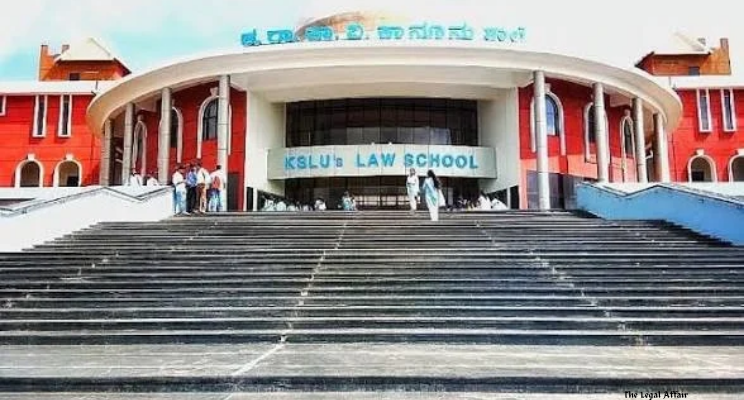
The Karnataka High Court has taken on record a fresh admission notification issued by the Karnataka State Law University (KSLU) providing 1% reservation for transgender students in its three-year LL.B. programme, following a special order issued by the Karnataka Government pursuant to the Court’s earlier directions.
A Division Bench comprising Justice Anu Sivaraman and Justice T.P. Vivekananda was hearing Writ Appeal No. 96 of 2025, filed by the National Law School of India University (NLSIU) in connection with directions concerning reservation for transgender persons in legal education. The proceedings also involved Mugil Anbu Vasanth and others, including a transgender candidate who appeared before the Court in person.
The dispute arose in the backdrop of an earlier Single Bench order directing NLSIU to provide 0.5% reservation for transgender persons in admissions. The matter subsequently came before the Division Bench in appeal. During the pendency of the proceedings, the Division Bench had, by an order dated July 20, 2026, directed the State Government to take steps towards providing reservation for transgender students in legal education.
Pursuant to those directions, the State Government issued a special order on September 15, 2026. The following day, KSLU issued its admission notification incorporating the reservation. The notification specifically provided for 1% reservation for transgender persons and also reduced the eligibility requirement to 40% marks for admission to the three-year LL.B. course.
The development assumes significance because the reservation was not merely incorporated as a general administrative measure. It followed judicial intervention concerning the participation of transgender persons in legal education and an executive decision specifically addressing admissions to law courses. The State also informed the High Court that a broader proposal concerning 1% horizontal reservation for transgender persons in education had been forwarded by the State Women’s Development Corporation and would require corresponding amendments to the applicable rules.
However, since legal education falls within the jurisdiction of the Law Department, the Government stated that a special order had been issued specifically for legal education in compliance with the High Court’s earlier directions.
When the matter came up on September 21, 2026, counsel appearing for KSLU placed the university’s Admission Notification dated September 16, 2026 before the Division Bench. The Court recorded that the notification expressly incorporated 1% reservation for transgender persons and lowered the eligibility criterion to 40% marks for the three-year LL.B. programme.
At the same time, the Court was confronted with an immediate practical concern raised by Mugil Anbu Vasanth, who submitted that the short period between publication of the notification and the application deadline made it difficult for transgender applicants to complete the required documentation and submit their applications.
Vasanth told the Court that the notification had been issued only a few days before the deadline and that obtaining the necessary documents had itself taken considerable time. According to the submission, the documentation process had taken approximately a month even under the supervision of the Court, while the newly issued notification did not prescribe adequate procedural safeguards for transgender applicants.
The application deadline was September 22, while the merit list was scheduled to be published on September 23. The Court therefore had to consider not only the broader question of reservation but also the immediate admission position of the respondent candidate.
Ultimately, the Division Bench did not issue the additional directions sought by the respondent. It noted that the present proceedings arose from an appeal filed by NLSIU and were not proceedings in the nature of a public interest litigation seeking comprehensive directions concerning transgender reservation across legal education. The Court also noted that an interim arrangement had already been made for the respondent and that his application had been entertained by KSLU.
The matter has now been listed for further hearing on September 29, 2026.
Arguments of the Parties:
The proceedings before the Division Bench involved competing concerns relating to implementation of transgender reservation, the limited scope of the pending appeal, and the immediate admission rights of the respondent candidate.
On behalf of KSLU, counsel placed the university’s admission notification dated September 16, 2026 before the Court. The principal submission was that the university had acted upon the Government’s special order and the earlier directions of the High Court. The notification expressly incorporated 1% reservation for transgender persons in the three-year LL.B. programme.
KSLU also informed the Court that the eligibility requirement had been specifically reduced to 40% marks for the three-year LL.B. course in the context of the notified arrangement. Thus, the university’s position was that the Court’s concern regarding access to legal education for transgender students had been acted upon through a formal admission notification.
The State Government explained the sequence of events leading to the notification. The Additional Government Advocate submitted that the Government Order had been issued only on September 15, 2026, while the KSLU notification followed on September 16. The authorities, therefore, had very little time to incorporate the new reservation provision while simultaneously keeping the admission process on schedule.
According to the State, the short period between the Government’s order and the admission notification was an important factor in assessing the respondent’s request for an extension of time. The Government maintained that the authorities had acted promptly after the order was issued and that the KSLU notification was the immediate administrative consequence of the Government’s decision.
The State further contended that the present proceedings could not be treated as a broad public interest litigation seeking directions for restructuring the entire system of reservation in legal education. The appeal before the Division Bench had arisen from the proceedings involving NLSIU and the earlier order concerning reservation. Therefore, according to the State, the Court ought to confine itself to the issues arising within the scope of the appeal rather than issue directions on every aspect of transgender admission policy.
The Government also pointed out that the immediate grievance of the respondent candidate had substantially been addressed. It informed the Court that arrangements had already been made to reserve seats for the candidate at BMS College of Law and Seshadripuram Law College, subject to the applicable admission process.
The State’s submission was therefore that the candidate was not left without an avenue for admission. The existence of two available options, coupled with the fact that the candidate’s application had already been entertained by KSLU, reduced the need for the Court to issue further directions at that stage.
The Government also brought to the Court’s notice the broader policy position concerning transgender reservation. It submitted that a proposal for 1% horizontal reservation for transgender persons in education had been forwarded by the State Women’s Development Corporation. However, implementation of such a general reservation policy would require amendments to the relevant rules.
The State explained that legal education stood on a somewhat different administrative footing because it was dealt with by the Law Department. Consequently, rather than waiting for a general amendment applicable across educational institutions, a special Government Order had been issued specifically concerning legal education pursuant to the High Court’s earlier direction.
The respondent, Mugil Anbu Vasanth, appeared in person and raised a more immediate concern. The respondent submitted that while the State had now provided for reservation, the practical implementation of the policy was being affected by the extremely short application period.
Vasanth pointed out that the admission notification had been issued only a few days before the deadline for applications. The submission was that transgender candidates could not necessarily be expected to complete all documentation within such a short period, particularly when some of the documents required for claiming the benefit of reservation could involve additional procedural steps.
The respondent specifically informed the Court that it had taken approximately one month to complete the required documentation, even while the process was being undertaken under the supervision of the Court. On that basis, it was argued that merely issuing a notification was insufficient unless adequate procedural safeguards and reasonable time were provided to transgender applicants to actually avail themselves of the reservation.
The respondent therefore sought an extension of the application deadline. It was pointed out that the existing schedule contemplated closure of applications on September 22, followed by publication of the merit list on September 23. According to the respondent, without an extension, the newly introduced reservation could become difficult for eligible transgender candidates to effectively access.
The respondent’s argument thus focused on the distinction between formal recognition of a reservation and its effective implementation. The submission was, in substance, that a right incorporated into an admission notification should also be accompanied by a reasonable opportunity to exercise that right.
The State, however, maintained that its immediate administrative response had already addressed the candidate’s grievance. It reiterated that the Government Order had been issued on September 15 and the KSLU notification on September 16, leaving little scope for a prolonged alteration of the admission schedule.
The State also emphasised that the candidate had already applied to two affiliated institutions and that arrangements had been made to accommodate the candidate in accordance with the admission process. The issue, therefore, according to the State, was no longer one of complete exclusion from the admission process but rather of choosing between the available institutions within the prescribed timeline.
The competing submissions consequently placed before the Court two distinct issues. One concerned the implementation of the larger reservation policy following the Court’s July 20 directions. The other concerned the immediate procedural relief sought by the respondent in the form of an extension of the application deadline.
Court’s Judgment:
The Division Bench took note of the significant administrative development that had occurred since its earlier order. Counsel for KSLU placed on record the Admission Notification dated September 16, 2026, and informed the Court that the notification specifically incorporated 1% reservation for transgender persons in the three-year LL.B. course.
The Court recorded that the notification also provided for a reduced eligibility criterion of 40% marks for the three-year LL.B. programme. In doing so, the Bench acknowledged that the directions issued earlier in the proceedings had resulted in concrete steps being taken by the State and the university.
The Court also noted an important qualification attached to the Government’s decision. The Government Order provided that the incorporation of the reservation in the notification would remain subject to further orders of the Court and subject to guidelines to be framed in the matter.
This meant that while the reservation had been incorporated into the current admission framework, the arrangement was not treated as an immutable or finally settled policy independent of the pending proceedings. The Court therefore kept the larger issue open while taking note of the steps already taken by the Government and KSLU.
The significance of the Court’s approach lies in the fact that the Bench did not disregard the administrative action merely because the broader policy framework was still under consideration. Instead, it recorded the immediate compliance steps and proceeded to consider the practical grievance raised by the respondent candidate.
The respondent’s request for an extension of the application deadline was considered in light of the nature of the proceedings. The State argued that the matter was an appeal arising out of an existing proceeding and not a public interest litigation in which the Court was called upon to frame a comprehensive policy applicable to all educational institutions.
The Division Bench accepted the relevance of that procedural context while deciding whether further directions were warranted at that stage. The Court ultimately declined to issue the additional directions sought by the respondent.
The Bench noted that an interim direction had already been issued for reservation of a seat for the respondent candidate. It also recorded that the candidate’s application had already been entertained by KSLU. Consequently, the Court did not find it necessary to grant the further relief sought in relation to extending the application deadline.
At the same time, the Court did not leave the respondent’s admission position unresolved. KSLU informed the Bench that the candidate had applied for seats at two affiliated law colleges. In view of this position, the Court directed the candidate to choose one of the two options by the time the merit lists were published.
The Court made it clear that if the candidate failed to exercise the choice within the prescribed period, the other seat would lapse. This arrangement effectively required the candidate to finalise one admission option while maintaining the benefit of the reservation already extended to him.
The approach adopted by the Division Bench was therefore focused on resolving the immediate admission issue without expanding the scope of the pending appeal into a general exercise of judicial policy-making concerning transgender reservation throughout the State’s educational institutions.
The Court’s order also has to be understood against the background of its earlier direction dated July 20, 2026. On that occasion, the Division Bench had directed the State Government to take steps towards providing reservation for transgender students in legal education. The subsequent Government Order and KSLU notification represented the administrative response to that direction.
The resulting arrangement provides for a 1% reservation, which is higher than the 0.5% reservation that had been the subject of the earlier Single Bench direction concerning NLSIU. However, the Division Bench’s September 21 order, as reflected in the supplied case material, did not finally adjudicate the legality or permanence of every aspect of the new reservation framework. Instead, it took the notification on record and noted the Government’s stipulation that the arrangement remained subject to further orders and guidelines.
The proceedings also demonstrate the practical distinction between a reservation policy and the administrative machinery necessary to implement it. The respondent’s submissions drew attention to documentation requirements and the limited time available to applicants. Although the Court did not grant the requested extension, the issue was placed before the Bench as part of the implementation concerns arising from the newly introduced reservation.
The State’s submission regarding the proposed general policy is also relevant. The Government informed the Court that the State Women’s Development Corporation had forwarded a proposal for 1% horizontal reservation for transgender persons in education, but that implementation of such a broader measure would require an amendment to the relevant rules.
The Court’s present order did not finally determine that broader policy question. Instead, the special arrangement for legal education was treated separately because legal education was within the administrative domain of the Law Department. The special Government Order was therefore issued specifically in response to the High Court’s earlier directions.
No separate precedent has been identified in the supplied case material as having been relied upon by the Division Bench in its September 21 order. The Court’s immediate decision instead turned primarily on the procedural posture of the appeal, the Government’s compliance with the earlier direction, the KSLU notification, and the existing interim arrangement for the respondent.
The order consequently reflects a measured approach to an evolving issue. The Bench took note of the fact that the State had moved from the stage of considering reservation to actually incorporating it into the admission framework for the three-year LL.B. programme. At the same time, it preserved the possibility of further judicial consideration by recording that the Government Order and notification remained subject to further orders and guidelines.
For the respondent candidate, the Court’s directions ensured that the immediate admission process continued without leaving the candidate without an available institution. Since applications had been made to two affiliated colleges and both options had been placed before the Court, the candidate was required to select one before publication of the merit list. The other seat would lapse if no choice was exercised within the stipulated period.
The Court accordingly declined to issue the additional directions sought by the respondent but continued to supervise the matter. The case has been listed for further hearing on September 29, 2026.
The proceedings thus mark an important stage in the development of transgender reservation in legal education in Karnataka. The immediate result is that KSLU’s three-year LL.B. admission notification now expressly recognises 1% reservation for transgender persons, coupled with a 40% eligibility threshold, following the State Government’s special order and the High Court’s earlier intervention.
The larger questions concerning the precise framework, procedural safeguards, guidelines and the broader implementation of transgender reservation in education, however, remain open for consideration in the continuing proceedings.