


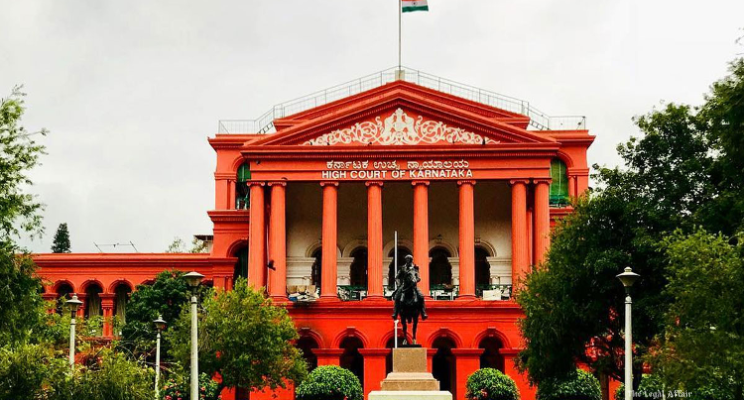
Introduction:
In the case of M/s Sapthagiri Shelters and others v. State of Karnataka and Others [WP No. 23086/2022 with connected matters; 2025 LiveLaw (Kar) 203], the Karnataka High Court quashed and set aside two crucial amendments brought by the State Government in 2021 and 2023 to the Karnataka Municipal Corporations Act, 1976, which empowered the Bruhat Bengaluru Mahanagara Palike (BBMP) to collect various fees and penalties during the sanctioning of building plans. The judgment delivered by Justice R. Devdas partly allowed the writ petitions filed by residents and builders who had challenged the retrospective amendments passed through the Karnataka Municipal Corporations and Certain Other Law (Amendment) Act, 2021 (Karnataka Act No.01 of 2022) and the Amendment Act, 2023 (Karnataka Act No.37 of 2024). The State had introduced these amendments after a single-judge bench of the High Court earlier quashed the BBMP’s building bylaws that enabled such collections. In the earlier judgment, the court had declared these byelaws ultra vires, lacking statutory backing, and unenforceable. However, the court had allowed the State and BBMP to bring in suitable statutory amendments to enable such levies. Pursuant to this liberty, the State introduced the two impugned amendments with retrospective effect, thereby attempting to validate previous collections amounting to approximately ₹2363 crores. The petitioners argued that the amendments were an abuse of legislative power designed to nullify a judicial order under the guise of statutory reform. They contended that since the fees had already been declared ultra vires, the State could not reintroduce them merely by amending the law without addressing the core issue of the lack of legal rationale and absence of quid pro quo.
Arguments:
The petitioners also questioned the State’s decision to link the levy to the “guidance value”—a market-driven parameter set under the Karnataka Stamp Act that had no rational nexus with the services rendered by BBMP. It was further argued that no empirical data or detailed costing had been presented to demonstrate how the rates for these imposts were fixed, especially when the Palike had failed to substantiate the cost incurred by its planning department. The petitioners maintained that the amended legislation bypassed the rule of law by seeking to justify an otherwise illegal act through retrospective validation without any data or cost-based assessment of services rendered by BBMP, thereby violating the principles of reasonableness and proportionality enshrined under Article 14 of the Constitution. Additionally, the petitioners argued that the BBMP had incorrectly applied these levies across all development plans, whereas, under Section 18A of the Karnataka Town and Country Planning Act, 1961 and Rules 37-A and 37-C of the Karnataka Planning Authority Rules, 1965, such levies were permissible only for large plots measuring more than 20,000 square meters.
The Additional Advocate General defending the State argued that the impugned amendments were intended merely to validate already-existing levies that had been enforced earlier through circulars and byelaws and that the amendments were necessary to avoid a severe financial impact on the Palike. He further argued that there was no fresh levy being introduced, only a formal statutory validation of long-standing practices. Defending the use of guidance value, the State submitted that the legislature has a wide berth in choosing standards for determining fees and that using guidance value provided a uniform benchmark.
Judgement:
However, the Court decisively rejected these submissions, stating that any collection termed as a “fee” must bear a direct correlation with the services rendered and that the concept of quid pro quo was squarely applicable. The court found no evidence that the levies were in proportion to services provided by BBMP and held that the mere reiteration of earlier rates struck down by the Court in the Sunderam Shetty case without fresh rationale or data was legally unsustainable. It further held that the guidance value had no relevance to the actual services rendered by the BBMP’s planning department. In strongly worded observations, the Court stated, “There is no rational nexus between the rates and linking of the same to the guidance value. Therefore, this Court is also of the considered opinion that the linking of the impugned levy and imposts to the guidance value cannot be sustained.” The Court also pointed out that applying these levies uniformly across all development plans was a misapplication of planning law, noting that such imposts are only applicable to large plots exceeding 20,000 square meters. Conclusively, the Court quashed both Karnataka Act No.01 of 2022 and Karnataka Act No.37 of 2024, thereby invalidating the legislative attempt to revive the BBMP’s authority to collect the disputed fees and penalties during building plan approvals. The ruling reaffirms that legislative action cannot be used to retrospectively sanctify actions held to be ultra vires unless supported by demonstrable data and legal rationale. The case also highlights the boundaries of legislative validation and reasserts the doctrine of separation of powers by reaffirming that judicial decisions cannot be undermined through indirect legislative maneuvers. The matter has significant implications not only for BBMP and Bengaluru residents but also for urban governance across India, particularly on issues of municipal accountability, transparency in urban planning, and statutory adherence in levying development charges.