


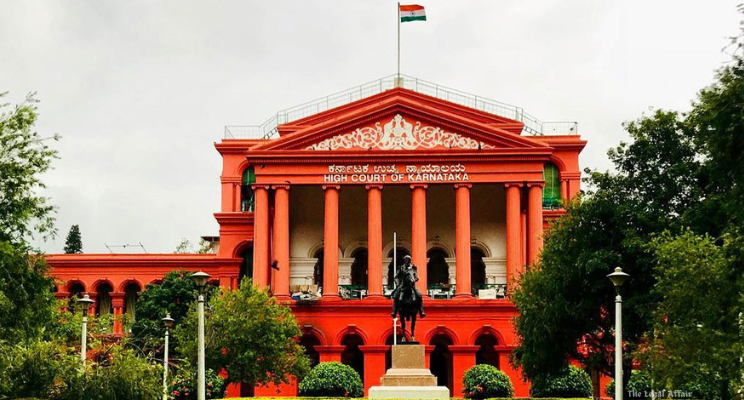
Introduction:
In a recent ruling, the Karnataka High Court has categorically held that no court has the power to pass an order contrary to the rules, regulations, and norms framed by a University or statutory regulatory body. The decision came in Nishat R. Kolyal v. Union of India & Others (Writ Petition No. 23759 of 2025, citation 2025 LiveLaw (Kar) 329), where the petitioner, a medical student, had sought an extraordinary direction from the Court to permit her to take a fifth attempt at clearing her Biochemistry subject examination, despite regulations limiting her to only four attempts. The judgment, delivered by Justice R. Devdas, dismissed the petition, emphasizing that judicial intervention cannot be used to dilute or override academic regulations that are formulated in accordance with statutory guidelines, including those of the National Medical Commission.
The petitioner, Nishat R. Kolyal, a student of Dr. Ambedkar Medical College and Hospital, had already exhausted her four permissible attempts to clear Biochemistry, one of her foundational medical subjects. Faced with the reality of being unable to proceed further in her academic career due to this one pending subject, she filed what the Court described as a “mercy petition,” urging that a fifth attempt be granted to her on humanitarian and equitable considerations. The Court, however, was not persuaded, reiterating that when regulations prescribe a specific number of attempts, courts cannot grant exceptions simply out of sympathy, as doing so would undermine the integrity of the education system and the standards set by regulatory authorities.
Arguments of the Petitioner:
The petitioner’s counsel, Advocate Chandrakanth R. Goulay, argued that the situation called for judicial compassion and equitable relief, rather than a rigid adherence to regulatory restrictions. It was contended that the petitioner had successfully cleared all other subjects in the medical curriculum and was only left with Biochemistry. Thus, denying her a fifth attempt would not only jeopardize her years of academic effort but also effectively extinguish her aspirations of becoming a qualified doctor. The counsel stressed that the principle of proportionality should be considered — the petitioner’s entire career should not be sacrificed for a single remaining paper.
The petitioner also submitted that the failure to clear the subject in four attempts was not due to lack of diligence but owing to circumstances beyond her control, including health issues and academic stress. The counsel sought to rely on the broader principles of Article 21 of the Constitution, which guarantees the right to life and personal liberty, including the right to education and livelihood. It was argued that the court, as a protector of constitutional rights, could intervene to ensure that a meritorious student is not denied the opportunity to fulfill her dream of practicing medicine merely because of a rigid application of regulations.
Furthermore, the petitioner contended that academic regulations must be interpreted in a manner that promotes justice and accommodates individual hardships. While acknowledging the existence of limits under the National Medical Commission regulations, the petitioner argued that these limits are not meant to stifle students but to maintain standards, and an exception in a deserving case would not dilute the system but would instead demonstrate the humane application of the law. Reliance was placed on precedents where courts have shown leniency in educational matters when strict enforcement of regulations would lead to grave injustice.
Arguments of the Respondents:
The respondents, represented by various counsels including CGC Swathi Panduranga for the Union of India, Advocate N. Khetty for the University, and other government advocates for state authorities, strongly opposed the plea. They argued that the regulations framed by the University and the National Medical Commission are binding in nature and leave no scope for judicial modification. Permitting the petitioner to appear for a fifth attempt would set a precedent where every student failing beyond the prescribed attempts would approach the courts, thereby completely defeating the regulatory framework.
The respondents stressed that Biochemistry is a core subject forming the foundation of medical knowledge, and repeated failure to clear it indicates that the petitioner may not have the necessary competence to proceed further in the medical profession. They argued that the regulations prescribing a maximum of four attempts are neither arbitrary nor unreasonable but are specifically designed to ensure that only students who demonstrate adequate proficiency are allowed to continue.
Counsel for the respondents further contended that the jurisdiction of the Court under Article 226 of the Constitution, while wide, cannot be invoked to rewrite regulations framed by expert bodies such as the National Medical Commission. The Court is not an appellate authority over academic policies, and stepping into such territory would undermine the autonomy of educational institutions and regulatory bodies. The respondents emphasized that the doctrine of separation of powers requires courts to exercise restraint in academic matters and not encroach upon the domain of academic experts.
Additionally, it was argued that the plea being styled as a “mercy petition” is legally untenable. Courts cannot grant relief on the basis of mercy or sympathy when clear statutory norms are in place. The only remedy available to the petitioner, if at all, is to approach the competent regulatory authority for a change in policy, but even that would apply prospectively and not retrospectively. Thus, the respondents sought dismissal of the petition with costs, reiterating that permitting such exceptions would dilute medical standards and could adversely affect public health if unqualified students are allowed to become doctors.
Judgment of the Court:
Justice R. Devdas delivered the judgment, carefully analyzing the contentions of both parties. The Court noted at the outset that the petitioner’s plea was essentially a mercy petition seeking an extraordinary indulgence on the ground that only one paper remained. However, the Court stressed that the law is clear — both the University Regulations and the National Medical Commission guidelines prescribe a maximum of four attempts for clearing any subject, and the Court cannot override such norms.
The bench observed, “It is clear from the prayer itself that this is a mercy petition filed on the ground that there is only one paper for the petitioner to clear and therefore the prayer that a fifth attempt may be permitted. When it is clear from the petition that the Regulations of the University as well as the National Medical Commission prescribe only four attempts for a student, this Court is not in a position to accede to the prayer made by the petitioner.”
Justice Devdas further underscored that judicial sympathy, however genuine, cannot form the basis for granting relief that runs contrary to binding statutory norms. Courts are bound by law and cannot exercise discretion in a manner that contravenes explicit regulatory provisions. The judgment made it clear that allowing the petitioner’s plea would open the floodgates for similar claims, eroding the credibility of academic standards and inviting misuse.
The Court reiterated the settled principle that judicial review does not extend to rewriting academic policies. Courts may intervene in cases where regulations are arbitrary, discriminatory, or unconstitutional, but where the regulations are clear, rational, and uniformly applied, the courts have no role in granting exceptions. In this case, the limit of four attempts had been uniformly applied, and there was no evidence of arbitrariness or discrimination. The Court therefore dismissed the petition outright.
Broader Significance of the Judgment:
This judgment carries broader implications for academic governance and the role of judicial intervention in educational matters. First, it reaffirms the principle that academic regulations framed by expert bodies like universities and professional councils are binding and cannot be overridden by courts. This preserves the autonomy of academic institutions and ensures consistency in academic standards. Second, the ruling discourages the practice of filing mercy petitions to seek exceptions to academic rules. By firmly dismissing such a plea, the Court has sent a message that judicial compassion cannot substitute academic competence. Third, the decision emphasizes the importance of regulatory frameworks in maintaining the quality of education, especially in professional courses like medicine where public interest and public health are directly at stake. The insistence on limiting the number of attempts reflects the need for students to demonstrate adequate proficiency before progressing in their medical education. Fourth, the case highlights the balance between individual hardship and systemic integrity. While the petitioner’s situation was undoubtedly sympathetic, the Court chose to uphold systemic integrity, reasoning that the larger interest of maintaining medical standards outweighs individual hardship.
The judgment also aligns with earlier decisions where courts have emphasized that academic matters are best left to academic experts. In multiple rulings, the Supreme Court and High Courts have held that judicial review in academic matters is limited to cases of illegality, arbitrariness, or mala fides, and that courts should avoid substituting their views for that of academic authorities. This case, therefore, reinforces the jurisprudence of judicial restraint in academic policy matters.