


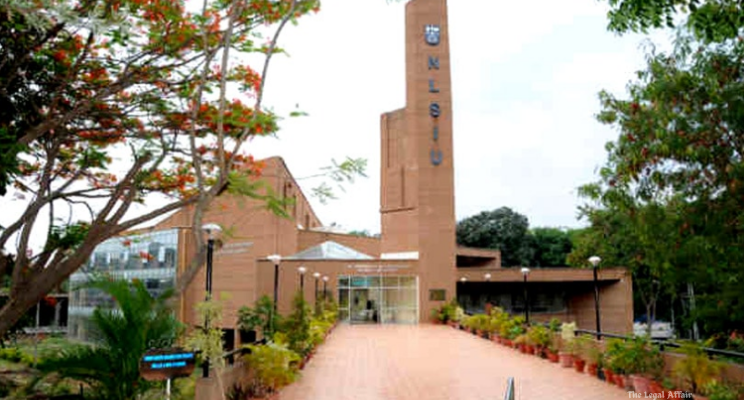
Introduction:
In a recent hearing, the Karnataka High Court addressed the National Law School of India University (NLSIU) regarding its stance on providing reservations for transgender candidates. The court inquired whether the university had considered, “in principle,” the implementation of such reservations. Representing NLSIU, Senior Advocate K.G. Raghavan informed the bench that the matter is under active deliberation by the university’s Executive Council, emphasizing that any decision would be “reasoned, conscious, and objective.” He further highlighted that the council comprises eminent legal experts who are evaluating the issue comprehensively.
This development follows a single judge’s directive for NLSIU to allocate a 0.5% reservation to transgender individuals, accompanied by a fee waiver, until the university formulates a comprehensive reservation policy in alignment with the Supreme Court’s 2014 judgment in the NALSA v. Union of India case. The petitioner, a transgender individual seeking admission to NLSIU’s three-year LL.B. program, argued that the university’s lack of a specific reservation policy for transgender candidates contravenes the NALSA judgment, which mandates the inclusion and recognition of transgender persons in educational institutions.
NLSIU, in its defense, contended that the formulation of reservation policies falls within the purview of its Executive Council and cannot be instituted through judicial directives. The university expressed concerns that ad hoc reservations could disrupt its merit-based admission process and interfere with institutional autonomy. Raghavan underscored that while NLSIU is not opposed to the inclusion of transgender individuals, any reservation policy must be the result of meticulous consideration by the Executive Council, rather than a court-mandated imposition.
Arguments:
The petitioner countered by asserting that the NALSA judgment unequivocally recognizes the rights of transgender persons, including the right to reservations in educational institutions. They argued that NLSIU’s failure to implement such reservations constitutes a violation of constitutional rights under Articles 14 and 21, which guarantee equality before the law and the right to life and personal liberty, respectively. The petitioner further highlighted that despite the Supreme Court’s directives, NLSIU has yet to take concrete steps toward formulating and implementing a reservation policy for transgender candidates.
Judgement:
The division bench, comprising Justice V. Kameshwar Rao and Justice T.M. Nadaf, acknowledged the complexity of the issue and the necessity for a policy-driven approach. The court emphasized that while the judiciary can provide guidance, the actual formulation and implementation of reservation policies should be undertaken by the university’s governing bodies. Consequently, the bench scheduled the next hearing for April 29, allowing NLSIU’s Executive Council additional time to deliberate and arrive at a decision regarding the reservation for transgender candidates.
This case underscores the ongoing challenges faced by transgender individuals in accessing equitable educational opportunities in India. The Supreme Court’s 2014 NALSA judgment was a landmark decision affirming the rights of transgender persons, including the right to self-identify their gender and the entitlement to reservations in educational institutions and public employment. However, the practical implementation of these directives has been inconsistent, with many institutions yet to adopt specific policies accommodating transgender individuals.
NLSIU’s current deliberations reflect a broader national discourse on the inclusion of transgender persons within the educational framework. While the university asserts that policy decisions should emanate from its Executive Council to maintain institutional autonomy and ensure meritocracy, advocates for transgender rights argue that immediate measures are necessary to rectify longstanding exclusions and systemic discrimination. The interim relief of a 0.5% reservation with a fee waiver, as directed by the single judge, represents a provisional attempt to bridge this gap until a comprehensive policy is established.
As the case progresses, it brings to the forefront critical questions about the balance between institutional autonomy and the enforcement of constitutional rights through judicial intervention. The outcome may set a precedent for other educational institutions grappling with similar issues, potentially influencing the broader landscape of affirmative action and inclusivity in Indian higher education.