


Introduction:
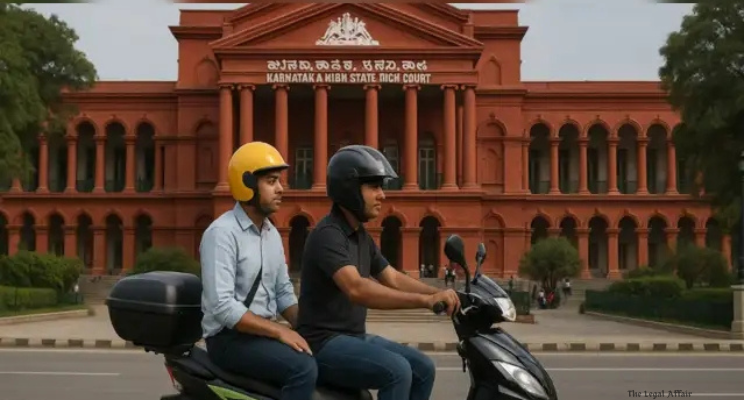
In a significant ongoing legal battle before the Karnataka High Court, leading bike taxi aggregators—including Uber India, Rapido, and ANI Technologies (operating as Ola)—have mounted a legal challenge to a state government policy decision that bans the operation of bike taxis within Karnataka. The appeal is against a prior single-judge bench decision that upheld the state’s policy, effectively restricting the aggregators from conducting business involving motorcycle taxis. The core issue at hand is the clash between state executive decisions and the fundamental right to trade enshrined in Article 19(1)(g) of the Constitution of India. The aggregators argue that the ban is not only arbitrary but directly violates both constitutional rights and statutory provisions under the Motor Vehicles Act, 1988 (MV Act). Represented by Senior Advocate Arun Kumar and other legal luminaries, the companies insist that the central government’s policy recognizes motorcycle taxis and that the State of Karnataka is acting beyond its statutory powers in enforcing a blanket ban. The matter has become a significant constitutional and policy issue, with implications for the future of mobility services and regulatory jurisdiction in the Indian federation. The appeals remain pending, with the court set to continue hearing the matter on Friday.
Arguments of the Aggregators:
Representing one of the primary appellants, Senior Advocate Arun Kumar passionately argued that the state government’s refusal to allow bike taxis to operate within Karnataka amounts to an unjustifiable restriction on the aggregators’ right to trade and profession guaranteed under Article 19(1)(g) of the Constitution. He began by emphasizing that the Motor Vehicles Act permits registration of motorcycles and the issuance of contract carriage permits, and that the state’s blanket ban was based merely on executive policy, not law. He cited that if a central statute—the MV Act—allows for a certain right, no state-level executive order or policy can contravene it. He questioned whether the executive power of the state can override the statutory framework created by the central legislation, submitting that the answer must necessarily be in the negative.
He further contended that such a policy decision made by the Karnataka government, without proper legislative backing or rational basis, must be subjected to the test of reasonableness under constitutional scrutiny. According to the counsel, any subordinate legislation or executive action must conform to the parent statute and cannot nullify or override the legislative intent of the central government. Referring to the aggregator rules framed under the Motor Vehicles Act and approved by the central government, Kumar noted that these rules explicitly permit motorcycles to be used for aggregation services, i.e., to be used for commercial purposes by technology-based platforms like Ola, Uber, or Rapido.
He pointed out that there exists no dispute that the rules cover motorcycles. However, despite this, the state refuses to issue permits for such motorcycles to be used as contract carriages. He added that applications made for registering motorcycles as transport vehicles were not considered by the authorities and that the State had categorically refused to issue the requisite carriage permits. Hence, the aggregators were left without recourse, and judicial intervention was the only remaining avenue to protect their constitutional and statutory rights.
Kumar also emphasized that central government policy under the MV Act, and recent amendments made therein, were introduced to support innovations in the mobility sector and reduce bureaucratic hurdles—commonly referred to as the “license raj.” He cited this as a legislative intent to ease the entry of new transport services, including app-based aggregators. The policy direction, he said, was toward promoting safe, affordable, and accessible transport options, and a blanket ban like that of Karnataka goes against this core objective. He maintained that the state’s policy to ban bike taxis is not only irrational but regressive in nature, hampering technological growth and consumer welfare.
Counsel for other aggregators echoed these sentiments, stressing that the authority to grant permits lies with the Regional Transport Authority (RTA) and not with the state government per se. Therefore, the state’s imposition of a policy to ban issuance of bike taxi permits is ultra vires and encroaches upon the jurisdiction of the RTAs, which are statutory bodies under the MV Act. The object of the Act, the counsel noted, is to facilitate transport, not restrict it unnecessarily. By denying permits for motorcycles, the state is acting contrary to the object and purpose of the Act. He added that under the framework of the MV Act, contract carriage permits must be issued unless there’s a compelling and legally tenable reason for denial—which in this case, there isn’t.
State Government’s Position and the Earlier Single Bench Order:
While the state government was yet to present its full counter before the division bench, the arguments made in the single judge’s order—now under appeal—were summarized and dissected during the hearing. The single bench had previously held that although motorcycles can indeed be registered and may qualify for contract carriage permits under the MV Act, the state government had taken a conscious policy decision to prohibit their operation as taxis. The order had relied on the state’s autonomy in framing transport policies tailored to its specific regional concerns. It had emphasized that motor vehicle regulation falls within the Concurrent List of the Constitution, and that states have the power to frame policies under delegated powers from the central Act.
In the earlier ruling, it was held that allowing motorcycles to function as taxis raised safety and regulatory concerns. The state’s contention was that two-wheelers are inherently unsafe for passengers in a public transport context, especially in congested or accident-prone areas. The single judge had accepted the argument that the state was within its rights to refuse such services in the interest of public safety and urban management. Furthermore, the state’s legal stance was that the aggregator rules do not automatically entitle an operator to a permit unless the local RTA or government deems it appropriate under prevailing circumstances.
Rebuttal and Interim Relief Discussion:
Countering these contentions, Senior Advocate Arun Kumar argued that the denial of permission on policy grounds—absent legislative authority or explicit statutory backing—cannot override fundamental rights or central laws. He submitted that such denials are not merely administrative decisions but are violative of the doctrine of proportionality, which requires that any restriction on fundamental rights must be reasonable, necessary, and the least restrictive alternative available. Moreover, safety concerns cited by the state were speculative and unsubstantiated, especially when the central government had already taken a considered decision to include motorcycles under the scope of aggregators.
Addressing the issue of interim relief, Kumar pointed out that the refusal of authorities to even entertain applications for registering motorcycles as commercial transport vehicles had left the aggregators in a state of legal limbo. He urged the court to at least grant interim relief that would allow aggregators to operate while the appeals were pending, citing irreparable harm to livelihood and business operations. He reminded the court that the right to trade under Article 19(1)(g) is a protected right and cannot be arbitrarily restricted through informal policy decisions. The counsel emphasized that the court’s intervention was necessary because the executive authorities had failed to act in accordance with the law and had, instead, taken a blanket and inflexible position.
Court’s Observations and Proceedings:
The division bench, while not issuing a judgment, heard the arguments with keen interest and acknowledged that the matter raised significant constitutional and statutory questions. The Court queried whether the state could indeed override a central statutory provision or central policy directive purely on the basis of an executive order or informal policy stance. The bench observed that the object of the MV Act is indeed to liberalize and regulate transport in a manner that is citizen-friendly and economically inclusive.
While the court refrained from granting interim relief at this stage, it indicated that the issue at hand is not just a policy disagreement but involves the broader principle of cooperative federalism, the limits of executive discretion, and the enforceability of fundamental rights in commercial contexts. The matter is set to continue on Friday, with the bench expected to hear submissions from the state government and deliberate further on the question of whether an interim arrangement can be made to permit limited operations of bike taxis under stringent safety protocols, pending final adjudication.