


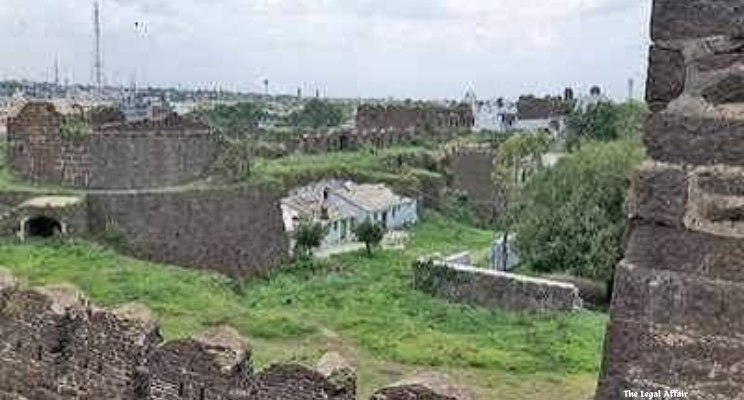
Introduction:
The Karnataka High Court has directed the Archaeological Survey of India (ASI) to verify whether illegal encroachments exist within the 100-metre protected area surrounding the historic Gulbarga Fort in Kalaburagi. The direction was issued on September 15, 2026, by a Division Bench comprising Justice Anu Sivaraman and Justice T.P. Vivekananda while hearing a long-pending public interest litigation concerning the removal of unauthorised constructions around the protected monument.
The proceedings arose in Sharan Desai v. The Superintending Archaeologist and Others, Writ Petition No. 4370 of 2018. The petitioner, architect and urban planner Sharan Desai, approached the High Court seeking implementation of an order passed by the ASI in 1998 for removing illegal encroachments in and around the Gulbarga Fort. The petition also concerns subsequent directions issued by the Court to ensure that the protected monument and its surrounding area are preserved in accordance with the law.
The latest direction focuses specifically on the area outside the fort but within the 100-metre zone surrounding the monument. While the State Government has been undertaking rehabilitation measures for families residing inside the fort, the petitioner has raised concerns that several unauthorised occupants continue to remain in the surrounding protected area.
The Court has accordingly sought clarification from the ASI regarding the existence of such encroachments and the action required if they are found.
Historical and legal background
The Gulbarga Fort, along with the Great Mosque situated within it, is an important historical monument in Kalaburagi. The monument was declared an ancient and historical monument and archaeological site of national importance through a Government of India notification dated November 29, 1951.
The preservation of such monuments is governed by the Ancient Monuments and Archaeological Sites and Remains Act, 1958. The legislation establishes a legal framework for protecting monuments of national importance and regulating activities that may affect their historical and archaeological significance.
Section 19 of the Act deals with restrictions on the use of protected areas. In particular, Section 19(1) prohibits the construction of buildings within a protected area without permission from the Central Government, subject to the statutory framework.
The provision is intended to prevent unauthorised construction from damaging or adversely affecting protected monuments and their surroundings. It also ensures that development within protected areas remains subject to the required legal scrutiny.
The present litigation arose from concerns that constructions had been undertaken in violation of these restrictions.
On December 14, 1998, the Superintending Archaeologist of the ASI passed an order for the removal of illegal encroachments in the area surrounding the Gulbarga Fort. However, the petitioner subsequently approached the High Court alleging that the order had not been implemented effectively.
In its order dated June 4, 2019, the High Court referred to the provisions of the 1958 Act and directed the authorities to ascertain whether buildings had been constructed in violation of Section 19(1). The authorities were also directed to take necessary action in accordance with law.
A subsequent survey identified 282 structures inside the protected area as having been constructed in violation of the statutory restrictions.
The identification of these structures created a further challenge for the authorities because families were residing in the affected buildings. The State Government therefore informed the Court that arrangements were being made to provide alternative accommodation to the affected families.
In March 2020, the High Court took on record a memo filed by the State Government stating that rehabilitation arrangements were being undertaken for the 282 families residing inside the fort.
The rehabilitation process subsequently became an important aspect of the proceedings. In an affidavit sworn on August 4, 2025, the Deputy Commissioner of Kalaburagi stated that approximately 12 to 18 months would be required to complete the rehabilitation activities.
During the September 15, 2026 hearing, the State Government informed the Court that rehabilitation was progressing and that drainage work at the rehabilitation site would be completed shortly. Once the drainage work was completed, sites would be allotted to the identified families.
However, the petitioner brought a separate concern to the Court’s attention. According to him, while the authorities were addressing encroachments inside the fort, illegal occupants continued to remain outside the fort but within the 100-metre protected zone.
The petitioner claimed that 167 illegal occupants were present outside the fort, in addition to the 282 families identified for rehabilitation from within the fort area.
The issue before the Court was therefore whether the authorities had adequately examined encroachments throughout the protected area or had limited their attention to structures located inside the fort.
The High Court’s latest direction seeks to clarify this question and ensure that the protection of the monument extends to the entire legally protected area.
Arguments of the Parties:
The submissions before the Karnataka High Court concerned the progress of rehabilitation for families residing inside the Gulbarga Fort and the alleged continuation of illegal occupation within the surrounding 100-metre protected zone.
The petitioner and the State Government presented different aspects of the implementation process. While the Government highlighted the progress made in rehabilitation, the petitioner urged the Court to ensure that encroachments outside the fort were also identified and addressed.
Petitioner’s Submissions:
Sharan Desai, the petitioner in the public interest litigation, submitted that the authorities had not adequately addressed all the encroachments within the protected area surrounding the Gulbarga Fort.
The petitioner had approached the High Court in 2018 seeking implementation of the ASI’s order dated December 14, 1998, which directed the removal of illegal encroachments in the area surrounding the monument.
His grievance was that despite the passage of several years and the issuance of subsequent judicial directions, unauthorised occupation continued to affect the protected area.
During the September 15 hearing, the petitioner acknowledged that action was being taken in respect of encroachments inside the fort. However, he pointed out that the problem extended beyond the fort’s physical boundaries.
According to the petitioner, 167 illegal occupants continued to remain outside the fort but within the 100-metre protected zone. These occupants were in addition to the 282 families already identified for rehabilitation from inside the fort.
The submission was significant because the protected area surrounding a monument is also subject to statutory restrictions. The preservation of the monument cannot be ensured merely by removing unauthorised structures from within its walls while leaving potentially unlawful constructions in the surrounding protected zone unexamined.
The petitioner therefore sought the Court’s attention towards the need for a comprehensive assessment of encroachments throughout the protected area.
His contention was that the authorities should not limit their efforts to the rehabilitation of families residing inside the fort. The alleged occupation of land outside the fort but within the protected zone also required verification and appropriate action.
The petitioner also highlighted the distinction between the two groups of occupants. The 282 families inside the fort had already been identified for rehabilitation, whereas the alleged 167 occupants outside the fort raised a separate question concerning the extent of the encroachments and the action required against them.
The submission prompted the Bench to ask whether any report had been placed on record regarding encroachments outside the fort within the protected area.
The petitioner’s grievance thus brought the focus of the proceedings to the need for a clear and comprehensive status report on the entire protected zone.
Submissions of the State Government:
The State Government informed the High Court that rehabilitation of the inhabitants residing inside the Gulbarga Fort was progressing.
The Government Advocate submitted that drainage work at the rehabilitation site would be completed shortly. Following the completion of this work, sites would be allotted to the families identified for rehabilitation.
The State also informed the Court that a report concerning the rehabilitation process had been prepared and would be placed before the Bench.
These submissions were relevant to the implementation of the earlier directions concerning the 282 families residing inside the fort.
The rehabilitation process was intended to provide alternative accommodation to the affected families while facilitating the removal of structures identified as being in violation of the statutory restrictions.
The Government’s position reflected the practical difficulties involved in implementing the earlier directions. The removal of occupied structures required arrangements for the rehabilitation of the families concerned, and the State had been undertaking measures to facilitate that process.
However, when the Court raised the question of encroachments outside the fort, the State indicated that the matter would have to be verified.
This response revealed that the existence and extent of encroachments in the surrounding 100-metre zone required further examination.
The State’s submissions did not establish that the alleged 167 occupants had been verified as illegal occupants or that a final determination had been made concerning their removal.
Instead, the question of whether such encroachments existed remained subject to verification.
Submissions of the Archaeological Survey of India:
Additional Solicitor General Arvind Kamath, appearing for the ASI, was directed by the Bench to obtain instructions on whether any encroachments existed outside the fort but within the 100-metre protected area.
The ASI’s submission addressed the respective responsibilities of the archaeological authorities and the local administration.
The ASG stated that if illegal occupants were found within the protected area, directions could be issued to the local authorities for their eviction.
He submitted that the removal of such encroachments was to be carried out by the local authorities and not by the ASI itself.
This distinction was important because the dispute involved both the preservation of a protected monument and the administrative steps required to remove unauthorised occupation.
The ASI was required to clarify the existence of encroachments within the protected zone, while the local authorities would be responsible for carrying out eviction measures if illegal occupation was established.
The submission therefore placed before the Court a practical framework for addressing any encroachments that might be identified through the verification exercise.
The Bench considered these submissions while determining what further information was required from the authorities before the matter could proceed.
Court’s Judgment:
The Karnataka High Court directed the Archaeological Survey of India to verify whether any encroachments existed outside the Gulbarga Fort but within the 100-metre protected area surrounding the monument.
The Division Bench of Justice Anu Sivaraman and Justice T.P. Vivekananda issued the direction after considering the petitioner’s submission that illegal occupants continued to remain in the surrounding protected zone, even as rehabilitation measures were being undertaken for families residing inside the fort.
The Court also took note of the State Government’s explanation regarding the progress of rehabilitation and the ASI’s submission concerning the respective responsibilities of the archaeological authorities and the local administration.
Need for verification of encroachments outside the fort
During the hearing, the Bench asked whether any report had been placed on record regarding encroachments outside the fort but within the 100-metre protected area.
The question arose after the petitioner submitted that 167 illegal occupants continued to remain in the surrounding area, in addition to the 282 families identified for rehabilitation from within the fort.
The Court sought clarification because the alleged encroachments outside the fort raised a separate issue from the rehabilitation process already underway.
While the authorities had identified structures inside the fort and were making arrangements for the affected families, the petitioner claimed that unauthorised occupation continued in the surrounding protected zone.
The Bench therefore considered it necessary to ascertain whether the alleged encroachments existed and whether the authorities had undertaken any examination of the area concerned.
The Court accordingly directed Additional Solicitor General Arvind Kamath, appearing for the ASI, to obtain instructions regarding the existence of encroachments outside the fort but within the protected zone.
The direction was intended to ensure that the authorities examined the entire area covered by the statutory protection rather than concentrating exclusively on structures located within the fort.
The Court did not accept the petitioner’s allegation as an established finding that all 167 occupants were illegal occupants. Instead, it sought verification from the competent authorities.
This distinction is important because the identification of an alleged encroachment and the determination of the legal status of the occupation are separate matters. The authorities must first establish the relevant facts before taking action in accordance with law.
Rehabilitation of families residing inside the fort
The Bench also considered the State Government’s submissions regarding rehabilitation.
The Government informed the Court that drainage work at the rehabilitation site would be completed shortly and that sites would thereafter be allotted to the identified families.
The State further submitted that a report concerning the rehabilitation process had been prepared and would be placed before the Court.
These developments were relevant to the implementation of the earlier directions concerning the 282 families residing inside the fort.
The rehabilitation process forms an important part of the proceedings because the removal of occupied structures involves practical and administrative considerations beyond the identification of illegal construction.
The State had previously informed the Court that alternative accommodation was being arranged for the affected families. The Deputy Commissioner’s affidavit dated August 4, 2025, had indicated that approximately 12 to 18 months would be required to complete the rehabilitation activities.
The latest submission indicated that the process was continuing, with drainage work and allotment of sites forming part of the remaining steps.
However, the High Court’s latest direction did not determine the completion date of the rehabilitation process or declare that the 282 families had already been relocated.
Instead, the Court took note of the Government’s statement and separately addressed the question of encroachments outside the fort.
The proceedings therefore continued to involve two distinct but related concerns: the rehabilitation of families identified inside the fort and the verification of alleged unauthorised occupation within the surrounding protected zone.
Responsibility of the ASI and local authorities
An important aspect of the hearing was the clarification concerning the respective responsibilities of the ASI and the local authorities.
Additional Solicitor General Arvind Kamath submitted that if illegal occupants were found within the protected area, directions could be issued to the local authorities for their eviction.
He stated that the removal of encroachments was to be carried out by the local authorities and not by the ASI.
The Court’s direction to the ASI to obtain instructions was therefore aimed at establishing whether encroachments existed in the first place.
The ASI’s verification would provide the factual basis for determining what further steps were necessary.
If illegal occupation was established, the local authorities could be called upon to undertake the required action in accordance with the applicable law and the directions issued in the proceedings.
The distinction between identifying encroachments and carrying out eviction measures is significant in cases involving protected monuments.
The preservation of a monument may require the cooperation of several authorities, each functioning within its respective legal and administrative responsibilities.
The Court’s approach sought to clarify the position without treating the alleged encroachments as conclusively established before verification.
Earlier directions under the Ancient Monuments Act
The latest order forms part of the continuing implementation of the High Court’s earlier directions concerning the Gulbarga Fort.
The litigation originated from the petitioner’s request for enforcement of the ASI’s order dated December 14, 1998, directing the removal of illegal encroachments in the area surrounding the monument.
In its June 4, 2019 order, the High Court referred to Section 19(1) of the Ancient Monuments and Archaeological Sites and Remains Act, 1958.
The provision prohibits construction of buildings within a protected area without permission from the Central Government, subject to the applicable statutory framework.
The Court had directed the authorities to ascertain whether buildings had been constructed in violation of the provision and to take necessary action.
A subsequent survey identified 282 structures inside the protected area as having been erected in violation of the law.
The identification of these structures led to the rehabilitation arrangements undertaken by the State Government.
The March 2020 proceedings recorded the State’s assurance that alternative accommodation was being arranged for the 282 families.
The September 15, 2026 hearing extended the focus of the proceedings to the alleged encroachments outside the fort.
The Court’s latest direction therefore seeks to ensure that the earlier efforts to protect the monument are not confined to the rehabilitation of families residing within the fort but also take account of the surrounding protected zone.
Legal significance of the direction
The proceedings highlight the importance of distinguishing between the physical boundaries of a protected monument and the larger area subject to statutory restrictions.
The protection afforded to an ancient monument may extend beyond its immediate structure. Activities within the surrounding protected area are also regulated under the applicable legislation.
Consequently, the removal of unauthorised structures from within a monument does not, by itself, establish that the entire protected area has been cleared of illegal construction.
The petitioner’s allegation concerning the 167 occupants outside the fort raised precisely this issue.
The High Court’s direction requires the ASI to verify whether such encroachments exist, thereby ensuring that the authorities have a factual basis for determining the next course of action.
The order also reflects the Court’s continuing supervision of the implementation of its earlier directions. The rehabilitation process and the verification of encroachmens remain subject to judicial scrutiny.
At the same time, the Court has not conclusively determined that the al