


Introduction:
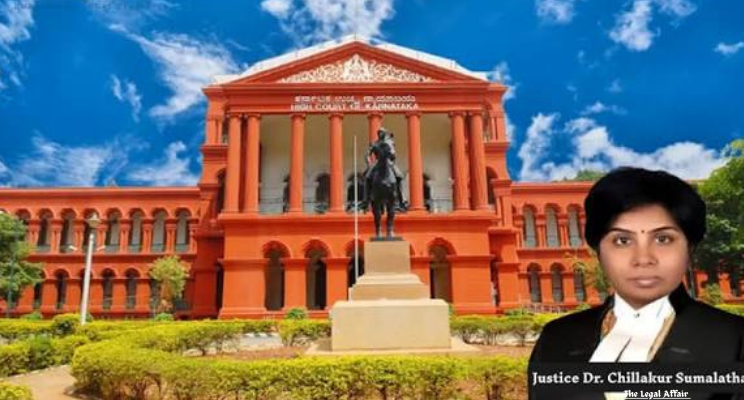
The Karnataka High Court, in a significant judgment reinforcing the principle that maintenance is a need-based remedy rather than an automatic entitlement, has held that a wife who earns substantially more than her husband and is financially capable of maintaining herself cannot ordinarily claim maintenance from him in the absence of any special circumstances. The decision was delivered by Justice Dr. Chillakur Sumalatha in Sri Ravi S. @ Jeevan S. v. Smt. Sahana Devi A. & Others, Writ Petition No. 2327 of 2026 (GM-FC), reported as 2026 LiveLaw (Kar) 222.
The judgment arose from a challenge to an order passed by the trial court directing the husband to pay interim maintenance of ₹20,000 per month to his wife during the pendency of proceedings initiated under the Protection of Women from Domestic Violence Act, 2005. While the trial court had granted the relief considering the wife’s application, the High Court found that the order overlooked one of the most fundamental considerations governing maintenance jurisprudence—whether the claimant actually requires financial support to sustain herself.
Maintenance laws in India, including those contained in the Domestic Violence Act, the Hindu Adoptions and Maintenance Act, 1956, and the provisions relating to maintenance under the criminal procedure framework, are intended to prevent destitution and economic hardship. These provisions are welfare-oriented and seek to ensure that a spouse who lacks sufficient means of livelihood is not left without support. However, courts have consistently held that such provisions are not intended to confer an unconditional financial advantage upon one spouse merely because of the marital relationship. Instead, every maintenance claim must be examined in light of the financial status, earning capacity, liabilities, and overall circumstances of both parties.
In the present case, the marriage between the petitioner-husband and the respondent-wife was solemnised in the year 2024. Soon after the marriage, matrimonial disputes arose between the parties, resulting in their separation after a brief period of cohabitation. Alleging domestic violence, the wife approached the competent court under the Protection of Women from Domestic Violence Act, 2005, seeking various reliefs, including interim maintenance of ₹1,13,515 per month.
The trial court, after considering the application, did not grant the entire amount claimed but directed the husband to pay interim maintenance of ₹20,000 per month. Aggrieved by this direction, the husband approached the Karnataka High Court by filing a writ petition, contending that the order was legally unsustainable because the wife was earning considerably more than him and was financially self-sufficient.
The controversy before the High Court, therefore, did not revolve around the existence of the marital relationship or the maintainability of proceedings under the Domestic Violence Act. Instead, the central issue was whether a financially independent wife, whose admitted income substantially exceeded that of her husband and who had no proven financial liabilities, could legitimately claim interim maintenance solely because she was his wife.
The decision assumes considerable importance because it reiterates that maintenance jurisprudence is guided by principles of financial necessity and fairness rather than gender-based presumptions. The judgment also highlights that courts must carefully evaluate the economic realities of both spouses before directing payment of maintenance and should avoid treating maintenance as an automatic consequence of matrimonial litigation.
Arguments of the Parties:
The petitioner-husband challenged the order of the trial court on the ground that it completely ignored the undisputed financial position of the parties. He submitted that while he earned a monthly salary of approximately ₹60,646, the respondent-wife was employed and drawing a salary of nearly ₹1,00,000 per month. Thus, according to him, the wife was earning substantially more than he was and possessed sufficient financial means to maintain herself without requiring any support from him.
It was argued that the very object of maintenance laws is to prevent economic hardship and ensure subsistence of a dependent spouse. Where the spouse claiming maintenance is already financially secure and earns more than the person from whom maintenance is sought, directing payment of maintenance defeats the purpose of these beneficial provisions and imposes an unreasonable burden upon the earning spouse.
The husband further contended that the respondent had not produced any material demonstrating that her monthly income was insufficient to meet her day-to-day expenses or maintain her standard of living. In the absence of any evidence establishing financial incapacity or dependency, the order granting interim maintenance was liable to be set aside.
On the other hand, the respondent-wife defended the order passed by the trial court. She submitted that she was the only daughter of her parents and that substantial expenditure had been incurred on her marriage. According to her, loans had been raised to meet the marriage expenses, and she was under an obligation to repay those liabilities. She contended that these financial commitments affected her economic condition and justified the grant of interim maintenance despite her employment.
The wife further argued that the purpose of maintenance is not merely to prevent starvation but also to ensure that a spouse is able to live with dignity during the pendency of matrimonial proceedings. She maintained that the trial court had exercised its discretion judiciously by awarding only ₹20,000 per month against her much higher claim of ₹1,13,515 and therefore no interference was warranted.
However, the husband disputed these assertions by pointing out that no documentary evidence whatsoever had been placed before the court to establish the alleged loans, outstanding EMIs, or any legally enforceable financial liabilities arising out of the marriage. He argued that the wife’s affidavit of assets and liabilities clearly disclosed her monthly income but did not support her claim regarding repayment of marriage-related debts.
The petitioner therefore submitted that the trial court had proceeded on assumptions instead of evidence and had failed to appreciate that maintenance cannot be granted merely because an application has been filed under the Domestic Violence Act. According to him, the statutory right to claim maintenance is always subject to proof of genuine financial necessity.
The dispute thus presented an important legal question concerning the proper approach to maintenance claims where both spouses are employed but the claimant-wife earns substantially more than the husband.
Court’s Judgment:
Allowing the writ petition, the Karnataka High Court set aside the trial court’s order dated December 19, 2025, directing payment of interim maintenance. Justice Dr. Chillakur Sumalatha held that the trial court had failed to properly evaluate the financial position of both parties before directing the husband to pay maintenance.
The Court observed that maintenance laws are enacted to provide financial support to a spouse who is genuinely unable to maintain herself or himself. These provisions are intended to prevent economic deprivation and ensure that a dependent spouse can live with dignity. However, the Court emphasised that they cannot be interpreted as creating an automatic obligation upon every husband to pay maintenance irrespective of the financial condition of the wife.
Rejecting the notion that maintenance should be awarded merely because the claimant is a wife, the Court held that judicial discretion must always be exercised after carefully examining whether the claimant actually lacks sufficient independent means of livelihood. The Court remarked that the statutory right to claim maintenance cannot be transformed into an unconditional right detached from the financial realities of the parties.
A significant factor that weighed with the High Court was the admitted income of the respondent-wife. The affidavit produced before the Court showed that she was earning approximately ₹1,00,000 per month, whereas the petitioner-husband earned only ₹60,646 per month. This undisputed difference in income clearly demonstrated that the wife possessed greater financial resources than the husband.
The Court further noted that although the wife claimed to have incurred debts for marriage expenses, no supporting documents were produced to establish the existence of loans, repayment obligations, or EMIs. Mere assertions unsupported by evidence could not be accepted as proof of financial hardship.
Justice Sumalatha also observed that the respondent-wife had no additional responsibilities such as maintaining minor children or other dependants that could justify financial assistance from the husband. In the absence of such liabilities, and considering her substantial income, there was no legal basis for directing the husband to part with a significant portion of his comparatively modest salary.
The Court laid down an important principle that when the wife is financially sound, earns more than the husband, and has no exceptional financial burdens to discharge, courts should not grant maintenance merely because traditional notions suggest that a husband must always maintain his wife. Such an approach, the Court held, would ignore the actual purpose of maintenance laws and undermine the principle of fairness.
The judgment further clarified that maintenance provisions under the Domestic Violence Act, the Hindu Adoptions and Maintenance Act, and the criminal procedure framework all recognise a right to seek maintenance only where financial need is established. Therefore, courts must avoid mechanically awarding maintenance without examining the earning capacities and financial obligations of both spouses.
The High Court observed that only where it is shown that the wife lacks sufficient independent income to maintain herself according to the standard of living enjoyed during the marriage or that she faces genuine financial hardship should maintenance—whether interim or final—be awarded. Conversely, where the evidence demonstrates financial independence and self-sufficiency, compelling the husband to pay maintenance would be contrary to both law and equity.
Applying these principles to the facts of the case, the Court concluded that the respondent-wife was fully capable of maintaining herself from her admitted monthly income. Since her earnings exceeded those of the petitioner-husband and no exceptional liabilities had been established, there existed no justification for directing the husband to pay ₹20,000 every month towards interim maintenance.
Accordingly, the Karnataka High Court allowed the writ petition and set aside the trial court’s order. The judgment serves as an important reminder that maintenance is fundamentally a remedy against financial dependency and not an automatic consequence of marriage or matrimonial litigation. By emphasising financial necessity over gender-based assumptions, the Court reaffirmed that maintenance laws must be applied with fairness, balancing the rights, responsibilities, and economic realities of both spouses while ensuring that the object of the legislation remains the protection of genuinely dependent individuals.