


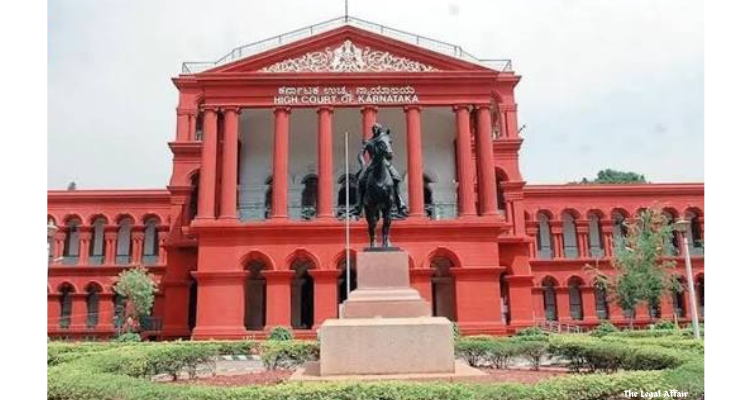
Introduction:
The Karnataka High Court has held that a change in political dispensation, by itself, cannot justify abandoning, shifting or stalling a government scheme or developmental project that has already been duly approved and processed in accordance with law. The Court observed that once a project has been sanctioned, beneficiaries identified, the tender process completed and a work order issued, the State cannot arbitrarily render the entire process meaningless merely because a new political executive has assumed office.
Justice Sachin Shankar Magadum made the significant observation while allowing a batch of writ petitions concerning an irrigation project intended to benefit marginal farmers in Ibrahimpur and Mannur villages. The project was designed to draw water from the Tungabhadra River and provide irrigation facilities to agricultural lands in the two villages.
The proceedings arose from a decision to shift the project from Ibrahimpur village to Nagalapur village. The decision was communicated through a letter issued by the sitting MLA of Siruguppa on September 8, 2023. The communication came after a change in the Government and sought to alter the location of the already approved irrigation project.
The petitioner, Amaresh H. @ Amaresh Pompana Gouda Hulugunchi, was the contractor to whom the project had been awarded. The project had already gone through the governmental approval and tender process, following which the tender was awarded to the petitioner and a work order was issued on November 15, 2022.
The petitioner approached the High Court contending that substantial work had already been undertaken at Ibrahimpur village and that the subsequent attempt to shift the project had deprived him of amounts lawfully payable under the contract.
The controversy therefore involved not merely the contractual rights of a contractor but also a larger question concerning continuity and fairness in governmental administration. The High Court was called upon to examine whether an elected representative could intervene and seek relocation of an approved developmental project after the statutory and tender processes had already been completed.
The State sought to justify the decision by contending that although a work order had been issued, the site had not formally been handed over to the contractor. It was argued that standing crops initially prevented commencement of the work and that the Model Code of Conduct came into operation before the Karnataka Assembly elections, creating a further impediment.
The State further submitted that after the formation of the new Government, directions had been issued not to commence works that had remained unstarted under the previous Government until further orders. On this basis, it was contended that the project could not be treated as an irrevocably completed governmental decision merely because a work order had been issued.
The High Court, however, found that the State had failed to establish any legally sustainable reason for shifting the project from Ibrahimpur to Nagalapur. It took note of photographs showing trenches, laid pipelines and an installed transformer at Ibrahimpur and held that these circumstances could not simply be disregarded.
The Court ultimately quashed the communications seeking to shift the project. It directed the authorities to consider the invoices and bills raised by the petitioner-contractor in accordance with the contractual terms, after verifying the work actually executed.
At the same time, the Court clarified that its decision would not prevent the Government from considering an independent proposal for extending irrigation facilities to Nagalapur village, provided such a proposal is considered independently and in accordance with law.
The ruling in Amaresh H. @ Amaresh Pompana Gouda Hulugunchi v. Government of Karnataka & Others and batch, arising from W.P. Nos. 105825/2024, 105789/2023 and 105795/2023, reinforces the principle that governmental decisions affecting public projects must be governed by legality, fairness and relevant considerations rather than political changes.
Arguments of the Parties:
The petitioner challenged the communications through which the irrigation project originally intended for Ibrahimpur and Mannur villages was sought to be shifted to Nagalapur village.
The petitioner contended that the project was not merely a proposal at an initial or conceptual stage. It had already passed through the necessary governmental process. The project had been approved, a tender had been floated and awarded, and a formal work order had been issued in his favour on November 15, 2022.
According to the petitioner, these steps created a legitimate expectation that the project would proceed in accordance with the approved plan and the contractual arrangement entered into with the State.
The petitioner further submitted that work had, in fact, been substantially undertaken at Ibrahimpur village. The materials placed before the Court included photographs showing trenches dug for the project, pipelines laid at the site and a transformer installed in connection with the irrigation scheme.
The petitioner therefore disputed the State’s suggestion that the project was an entirely unstarted work. According to him, even if certain portions of the project remained incomplete, substantial work had already been carried out and the infrastructure created at the site demonstrated that the project had moved beyond the stage of a mere proposal.
The petitioner also contended that the project was intended to benefit marginal farmers of Ibrahimpur and Mannur villages. Shifting it after substantial work had been carried out would therefore not only affect the contractor but would also deprive the identified beneficiaries of the irrigation facility for which the project had been sanctioned.
The petitioner argued that the intervention of the sitting MLA could not legally override a decision that had already gone through the governmental and tender process. An elected representative could certainly raise the concerns of constituents, but such representation could not substitute for a decision by the competent authority or nullify a project already approved in accordance with law.
Another important grievance raised by the petitioner concerned payments under the contract. It was submitted that he had been deprived of amounts legally due for the work already executed. The attempted relocation of the project had consequently created contractual and financial consequences for the contractor.
The petitioner maintained that the State could not simply rely upon a subsequent political change or a general direction concerning unstarted works to disregard the work already completed at the original location.
The State, represented by the Additional Government Advocate, resisted the petitions and sought to justify the decision concerning the project.
The State’s principal submission was that the issuance of a work order did not necessarily mean that actual work had commenced at the site. According to the State, the site had never formally been handed over to the petitioner.
The State explained that the project could not initially be commenced because standing crops were present at the relevant location. Subsequently, the Model Code of Conduct came into force in connection with the Karnataka Assembly elections, which also prevented the commencement of the work during the relevant period.
The State therefore sought to distinguish between the formal issuance of a work order and actual commencement of work. Its argument was that where the work had not formally commenced, the Government retained the authority to review or reconsider projects sanctioned by the previous administration.
The Additional Government Advocate further submitted that after the new Government came to power, directions had been issued not to commence works sanctioned by the earlier Government which had remained unstarted, until further orders.
On that basis, the State argued that the decision to shift the project could not be treated as arbitrary merely because it followed a change in Government.
The State’s position essentially rested on administrative discretion and the contention that a new Government is entitled to review decisions and projects inherited from an earlier administration, particularly where the work had not formally commenced.
The Court therefore had to determine whether the State had exercised that discretion on the basis of relevant and legally sustainable considerations or whether the impugned decision amounted to an arbitrary departure from an already approved governmental project.
The controversy also required the Court to reconcile two competing principles. On one hand, governmental authorities must retain sufficient flexibility to review public projects, correct mistakes and alter policies where genuine public interest requires it. On the other hand, that discretion cannot be exercised arbitrarily, particularly after substantial administrative and contractual steps have already been completed.
The petitioner argued that the latter principle applied with particular force in the present case because the project was already approved, the beneficiaries had been identified, the tender had been completed, the work order had been issued and physical work had been carried out at Ibrahimpur.
The State, however, relied upon the absence of formal site handover and the subsequent Government’s general instructions concerning unstarted works.
The High Court was therefore required to examine the actual state of the project rather than determine the matter solely on the basis of formal descriptions such as “started” or “unstarted”.
Court’s Judgment:
Justice Sachin Shankar Magadum of the Karnataka High Court allowed the petitions and quashed the communications seeking to shift the irrigation project from Ibrahimpur village to Nagalapur village.
A central principle underlying the Court’s decision was that governmental schemes and developmental projects cannot be treated as political possessions that automatically change direction whenever there is a change in Government.
The Court made a strong observation that “a change in political dispensation, by itself, cannot furnish a ground to obliterate or undo decisions already taken in accordance with law.”
The Court emphasised that this principle becomes particularly important in relation to public developmental projects intended for the benefit of vulnerable or marginalised sections of society.
The irrigation project in the present case was intended to provide water to agricultural lands belonging to marginal farmers of Ibrahimpur and Mannur villages. The Court therefore viewed the project not merely as an administrative file or contractual arrangement but as a public project designed to provide a specific benefit to identified beneficiaries.
The Court held that such schemes cannot be abandoned, shifted or stalled merely because a different political executive has assumed office.
The ruling does not mean that every project sanctioned by a previous Government becomes permanently immune from review. The Court expressly recognised that Government policies can be reviewed, modified or even discontinued when there are legitimate public reasons for doing so.
However, such a decision must be based on relevant considerations and must be taken by the competent authority in accordance with law. Political change, standing alone, cannot constitute the legal basis for undoing an earlier governmental decision.
The Court referred to the doctrine of fairness in administration and observed that the State is bound by the requirement of fairness when exercising its administrative powers.
The Court stated that once a project has been duly approved, its beneficiaries identified, the tender process completed and a work order issued, the State cannot, without a legally sustainable reason, render the entire process nugatory.
Any decision to alter or abandon such a project, according to the Court, must be founded upon relevant considerations, supported by reasons and taken by the competent authority in accordance with law.
This reasoning was particularly significant because the project had already progressed beyond the stage of governmental approval. The petitioner had been selected through the tender process and had received a work order dated November 15, 2022.
The State’s argument that the site had not formally been handed over was also considered in light of the actual physical circumstances placed before the Court.
The Court took note of photographs showing trenches, laid pipelines and an installed transformer at Ibrahimpur village. These physical developments demonstrated that there had been activity connected with the project at the original site.
Justice Magadum observed that these circumstances could not simply be brushed aside by relying upon the general proposition that no work should commence unless the site is formally handed over.
The Court therefore refused to examine the matter exclusively through a technical or formal lens. The factual material before it indicated that the project had acquired a degree of physical implementation at Ibrahimpur.
The presence of trenches, pipelines and a transformer was relevant because shifting the project after such work had been undertaken could result in wastage of public resources and deprive the intended beneficiaries of the facility for which the infrastructure had been created.
The Court was particularly concerned with the consequences of stalling the project. It observed that doing so would deprive farmers of the intended irrigation facility and would render the public expenditure already incurred “futile”.
The public interest dimension therefore weighed heavily in the Court’s assessment.
The Court also rejected the suggestion that the impugned communication could be sustained merely because it came from an elected representative. While elected representatives unquestionably have a role in bringing the needs and concerns of their constituents to the attention of the Government, that representative role does not confer an unfettered power to alter an approved governmental project.
The High Court observed that elected representatives, while representing the interests of their constituents, cannot interfere with an already approved governmental project after completion of the statutory and tender process.
The distinction drawn by the Court is important. An MLA may legitimately recommend a developmental project or raise a request for an alternative location. However, such a recommendation cannot by itself displace a project that has already undergone the prescribed administrative and tender procedures.
A decision to relocate such a project must originate from the competent authority and must be supported by legally relevant reasons.
In the present case, the High Court found that the State had failed to establish any public interest consideration, technical impediment, financial irregularity or other legally sustainable ground for shifting the project from Ibrahimpur to Nagalapur.
The Court therefore held that the impugned communication could not be sustained merely because it emanated from an elected representative or because a subsequent Government had issued a general circular concerning works that had not started.
The Court’s reasoning also addresses the broader question of continuity in governance. Government is a continuing institution even though political administrations change. Decisions taken lawfully by one administration cannot ordinarily be treated as automatically invalid simply because another administration assumes office.
If every change in political leadership were permitted to nullify projects already approved and processed, it could create uncertainty for contractors, beneficiaries and public institutions alike. It could also lead to unnecessary expenditure where partially completed projects are abandoned and replaced by new ones.
The doctrine of fairness in administration serves as an important safeguard against such arbitrary governmental action.
At the same time, the Court carefully avoided laying down an absolute rule that governments can never change previously sanctioned projects. It recognised that public authorities must retain the ability to modify or discontinue schemes where genuine public interest, technical considerations, financial concerns or other legally relevant factors justify such action.
The crucial requirement is that the decision must be lawful, rational and based on relevant considerations.
Thus, the Court’s ruling does not freeze government policy. Instead, it places limits on the manner in which governmental discretion may be exercised.
The Court ultimately directed the State authorities to consider the invoices and bills raised by the petitioner-contractor in accordance with the terms of the contract, after verifying the work carried out.
This direction was significant because the petitioner had alleged that he had been deprived of amounts lawfully payable for work already executed. The Court did not mechanically direct payment of every amount claimed but required the authorities to examine the bills in accordance with the contractual terms and after verification.
The Court also made it clear that its order would not prevent the authorities from considering an independent proposal for extending irrigation facilities to Nagalapur village.
In other words, the Court did not hold that Nagalapur could never receive an irrigation project. What it rejected was the arbitrary shifting of the already approved Ibrahimpur project without legally sustainable justification.
If the Government considers that Nagalapur requires irrigation facilities, it remains open to initiate an appropriate proposal in accordance with law.
This distinction preserves administrative flexibility while protecting the legality of decisions already taken.
The judgment consequently strikes a balance between governmental policy-making power and the requirement of administrative fairness. A new Government may certainly review the policies and projects of its predecessor, but it cannot assume that political change itself supplies the justification for undoing decisions already taken through lawful procedures.
The decision is also important from the perspective of public expenditure. Once public money has been spent on infrastructure, abandoning the project without a legitimate reason can result in the State bearing the cost of incomplete or unusable works while the intended beneficiaries receive no corresponding benefit.
The Court’s concern that public expenditure should not be rendered futile reflects the need for responsible administration of public resources.
Ultimately, the Karnataka High Court held that the attempt to shift the irrigation project from Ibrahimpur to Nagalapur could not be sustained on the material placed before it. The communications seeking the shift were quashed, and the authorities were directed to process the contractor’s invoices and bills in accordance with the contract after verifying the work.
The ruling in Amaresh H. @ Amaresh Pompana Gouda Hulugunchi v. Government of Karnataka & Others and batch therefore carries a wider message beyond the particular irrigation project. Developmental projects are matters of public administration, not political dispensations. Once lawful governmental processes have been completed, subsequent administrations must act on the basis of reasons recognised by law rather than political change alone.
The judgment reinforces the principle that continuity, fairness and accountability are essential components of governance. While governments retain the power to reconsier policies and projects in genuine public interest, that power must be exercis