


Introduction:
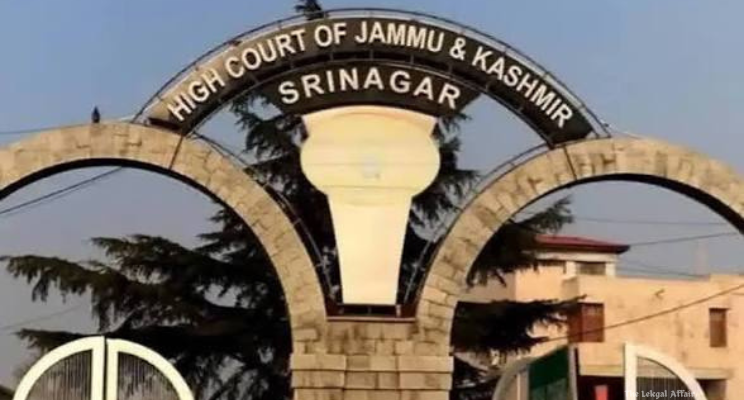
In a significant ruling concerning the scope of judicial interference in criminal investigations involving allegations of corruption and abuse of official position, the High Court of Jammu & Kashmir and Ladakh has refused to quash an FIR registered against former senior executives of Jammu & Kashmir Bank Ltd. in connection with an alleged irregular insurance deal involving M/S IFFCO TOKIO General Insurance Company Ltd. The Court held that where cognizable offences are prima facie disclosed against at least some of the accused persons, it would be impermissible to scuttle the investigation at a preliminary stage merely because the precise role of certain accused requires deeper scrutiny.
The judgment was delivered by Justice Sanjay Dhar in a petition filed under Section 528 of the Bharatiya Nagarik Suraksha Sanhita, 2023 seeking quashing of the FIR registered under provisions of the Prevention of Corruption Act and Section 120-B of the Ranbir Penal Code relating to criminal conspiracy.
The petitioners included Pushap Kumar Tickoo, former Executive President (HRD and CPO), Rajesh Kumar Chhiber, former Executive President, Mohammad Younis Pottoo, former President of the Insurance Department, and Khan Roshan Khayal, former Vice President (Law) of Jammu & Kashmir Bank Ltd. All four petitioners had served as members of the committee constituted to evaluate bids submitted by insurance companies pursuant to a Request for Proposal process initiated by the Bank.
The allegations stemmed from a source report claiming that the Bank had entered into an agreement with M/S IFFCO TOKIO General Insurance Company Ltd. in February 2019 in circumstances suggesting favoritism and abuse of official position. According to the investigating agency, the insurance contract was allegedly structured in a manner that enabled the appointment of Mr. Asif Manzoor Beigh, a close relative of the then Chairman of the Bank, Shri Parvez Ahmad Nengroo, in the respondent insurance company on a substantially enhanced salary package.
The prosecution alleged that before the deal, Mr. Beigh was employed with Bajaj Allianz General Insurance Company Ltd. at an annual salary package of approximately Rs. 8.75 lakhs. However, shortly after the insurance agreement between the Bank and IFFCO TOKIO was finalized, he resigned from his earlier employment and was appointed by IFFCO TOKIO at a package exceeding Rs. 19 lakhs annually, nearly two-and-a-half times his previous remuneration.
The investigating agency further alleged that the selection process had been manipulated by awarding disproportionately high marks to IFFCO TOKIO during the evaluation stage in order to facilitate this arrangement. It was also claimed that the Bank suffered financial loss due to reduced commission earnings under the insurance arrangement.
While the petitioners maintained that their role was limited to technical evaluation of bids and that they had no involvement whatsoever in the appointment of Mr. Beigh, the prosecution argued that the surrounding circumstances disclosed a larger conspiracy involving abuse of official position and undue favour extended to the insurance company.
The case thus raised important questions regarding the limits of judicial intervention during investigation, the evidentiary threshold required for quashing criminal proceedings, and the principles governing corruption investigations involving public financial institutions.
Arguments of the Parties:
The petitioners, represented by Senior Advocate Z.A. Shah, challenged the FIR primarily on the ground that the allegations against them did not disclose the commission of any cognizable offence. It was argued that the petitioners had merely acted as members of an expert committee constituted for evaluation of bids submitted by various insurance companies pursuant to a formal Request for Proposal process initiated by the Bank.
According to the petitioners, the Bank had lawfully decided to engage multiple insurance companies after obtaining necessary permission from the Insurance Regulatory and Development Authority of India (IRDAI) as well as approval from the Board of Directors of the Bank. The evaluation committee had assessed proposals received from different insurance companies in accordance with prescribed criteria, and IFFCO TOKIO emerged successful on the basis of marks awarded during the evaluation process.
The petitioners contended that their role was confined strictly to technical and administrative evaluation of proposals. They emphasized that they had no connection whatsoever with the employment decisions taken by IFFCO TOKIO regarding appointment of Mr. Asif Manzoor Beigh.
It was further argued that mere coincidence in timing between the insurance contract and Mr. Beigh’s subsequent employment could not by itself establish criminal conspiracy or corruption. The petitioners submitted that there was no material to show any meeting of minds between them and the former Chairman of the Bank or officials of the insurance company.
The petitioners also challenged the allegation regarding financial loss allegedly suffered by the Bank. They argued that calculation of commission earnings depended upon several fluctuating business factors and that the prosecution’s theory of loss amounting to Rs. 71 lakhs was speculative and unsupported by objective material.
Senior Advocate Z.A. Shah additionally contended that evaluation of bids by expert committees inherently involves subjective assessment. It was argued that different evaluators may legitimately assign different marks to the same proposal without implying favoritism or illegality. The petitioners maintained that disagreement with the evaluation process cannot automatically convert administrative decision-making into criminal misconduct.
The petitioners therefore sought quashing of the FIR on the ground that continuation of investigation against them amounted to abuse of process of law.
Opposing the petition, Senior Additional Advocate General Mohsin Qadiri argued that the material collected during investigation clearly disclosed a prima facie nexus between the award of the insurance contract and the subsequent appointment of the close relative of the former Chairman of the Bank.
The prosecution contended that the investigating agency had gathered statements of witnesses, including officers and employees of the insurance company, indicating that unusual steps had been taken to accommodate Mr. Beigh on an exceptionally enhanced salary package.
According to the prosecution, Mr. Beigh was initially offered a salary package of approximately Rs. 15.35 lakhs per annum, which he accepted. However, shortly thereafter, the package was revised upward to more than Rs. 19 lakhs annually under unusual circumstances and allegedly as a “special case.”
The State argued that these events occurred in suspicious proximity to the finalization of the insurance deal between the Bank and IFFCO TOKIO. It was submitted that the sequence of events disclosed a prima facie quid pro quo arrangement involving abuse of official position by the then Chairman of the Bank.
The prosecution further contended that independent expert analysis conducted during investigation demonstrated that undue favour had been extended to IFFCO TOKIO during the evaluation process while more reputed insurance companies were unfairly downgraded.
The State maintained that even if the exact extent of involvement of the petitioners required further investigation, the material collected so far clearly justified continuation of the probe. It was argued that quashing the FIR at this stage would effectively prevent the investigating agency from uncovering the complete conspiracy and gathering further evidence.
The prosecution therefore urged the Court not to interfere with the investigation, particularly when allegations of corruption, abuse of official position, and conspiracy involving a major public financial institution were involved.
Court’s Judgment:
Justice Sanjay Dhar dismissed the petition seeking quashing of the FIR and held that the investigation should be allowed to proceed so that the precise role of the petitioners could be properly examined by the investigating agency.
At the outset, the Court extensively referred to settled principles governing exercise of inherent jurisdiction for quashing criminal proceedings. The Court relied upon the landmark judgments of the Supreme Court in State of Haryana v. Bhajan Lal and Neeharika Infrastructure Pvt. Ltd. v. State of Maharashtra.
Reiterating the law laid down in these decisions, the Court observed that powers to quash criminal proceedings must be exercised sparingly, with great caution, and only in exceptional cases where the allegations do not disclose any cognizable offence whatsoever.
The Court emphasized that at the investigation stage, the High Court cannot embark upon an enquiry into the reliability, correctness, or evidentiary value of allegations made in the FIR. Judicial interference at this preliminary stage is permissible only when continuation of proceedings would amount to manifest abuse of process.
Examining the material collected during investigation, the Court found that there existed strong surrounding circumstances establishing a prima facie nexus between the award of the insurance contract and the appointment of Mr. Asif Manzoor Beigh in IFFCO TOKIO.
The Court particularly noted witness statements recorded by the investigating agency indicating that the insurance company had taken unusual steps in revising the salary package offered to Mr. Beigh. The Court observed that it was not ordinary for a company to substantially enhance an already accepted salary package without special reasons.
Justice Dhar observed that once Mr. Beigh had accepted the initially offered package, the subsequent enhancement at the highest level of the company, coupled with the close timing of the insurance agreement, certainly raised legitimate suspicion warranting investigation.
The Court therefore concluded that prima facie material existed showing misuse of official position by the former Chairman of the Bank to confer benefit upon his close relative.
The Court observed:
“Thus, offence of criminal misconduct is disclosed against Shri Parvez Ahmad Nengroo, who has, prima facie, misused his official position to confer benefit upon his close relation.”
The Court also noted that the respondent insurance company appeared to have connived in the arrangement.
At the same time, the Court acknowledged that some submissions advanced on behalf of the petitioners carried prima facie merit. The Bench accepted that evaluation by expert committees can involve differences of opinion and subjective assessment. The Court also recognized that different members of the same committee had awarded varying marks during the evaluation process.
Similarly, the Court found some force in the petitioners’ argument that the alleged financial loss to the Bank might not be conclusively established because commission earnings depend upon multiple business considerations.
However, despite these observations, the Court held that such issues required detailed investigation and could not justify quashing of proceedings at the threshold stage.
Importantly, the Court observed that the petitioners, as members of the evaluation committee, had facilitated the selection of the insurance company that ultimately employed the Chairman’s close relative under suspicious circumstances. Therefore, their precise role required deeper scrutiny.
The Court held that once cognizable offences are disclosed at least against some accused persons named in the FIR, it would not be appropriate to terminate the investigation against other connected individuals before the investigating agency is given full opportunity to complete its probe.
Justice Dhar cautioned that quashing the proceedings at this stage would effectively amount to stifling a potentially genuine prosecution, which is impermissible in law.
Accordingly, the petition was dismissed. However, the Court granted liberty to the petitioners to pursue appropriate remedies at later stages of the proceedings, including approaching the competent court for discharge if a charge sheet is ultimately filed against them.
The judgment is significant because it reaffirms the judiciary’s consistent approach that corruption investigations, particularly those involving public institutions and allegations of abuse of official position, should not ordinarily be interrupted at an embryonic stage unless the allegations are entirely baseless on their face.