


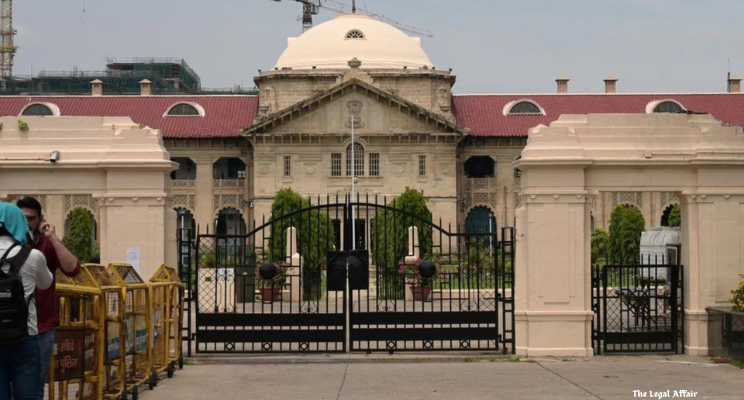
Introduction:
In Vinay Kumar Singh Versus Suresh Chandra, Principal Secretary, Irrigation Department and Others [Contempt Application (Civil) No. 2555 of 2017], the Allahabad High Court delivered a strong and institutionally significant ruling clarifying accountability within the State machinery for non-compliance of judicial orders. The judgment arose from prolonged litigation relating to land acquisition proceedings initiated decades earlier and highlighted a recurring governance issue where administrative confusion between departments is cited as a justification for defying binding court orders. Justice Salil Kumar Rai decisively held that such confusion cannot shield the State from contempt proceedings and that in cases of failure arising out of inter-departmental ambiguity, the highest officer of the State Government would be personally liable. The petitioner, Vinay Kumar Singh, whose land had been acquired in 1977, had been denied compensation for years despite awards passed in 1982 and 1984. After the enforcement of the Right to Fair Compensation and Transparency in Land Acquisition, Rehabilitation and Resettlement Act, 2013, the petitioner invoked Section 24(2) claiming lapse of acquisition due to non-payment of compensation and continued possession. Although the writ court ruled in his favour and the decision attained finality, the State authorities persistently avoided compliance, compelling the petitioner to initiate contempt proceedings. The case thus placed before the Court a fundamental question concerning the sanctity of judicial orders, the doctrine of finality, and the personal responsibility of senior bureaucrats when executive inertia frustrates justice.
Arguments:
On behalf of the petitioner, it was argued that the land acquisition proceedings stood lapsed by operation of law under Section 24(2) of the 2013 Act, as neither physical possession was taken nor compensation paid to the landowner for decades. The petitioner relied heavily on the Supreme Court’s decision in Pune Municipal Corporation v. Harakchand Misirimal Solanki, which categorically held that deposit of compensation in the government treasury does not amount to payment within the meaning of Section 24(2). It was contended that despite a clear and binding judgment of the writ court declaring lapse of acquisition and directing consequential relief, the State authorities failed to restore the land to the petitioner. The petitioner pointed out that even after dismissal of the State’s Special Leave Petition by the Supreme Court, no steps were taken to implement the writ court’s order, thereby allowing it to attain finality. It was further submitted that repeated assurances were given before the contempt court, time was sought, yet the authorities continued to delay compliance under one pretext or another. The petitioner argued that the defence based on administrative confusion between the Irrigation Department and the Urban Development Department was a sham excuse and a deliberate attempt to deny the petitioner the fruits of litigation. Stressing that contempt jurisdiction exists to uphold the majesty of law, the petitioner urged the Court to hold the highest administrative authority accountable, as failure of governance cannot override judicial commands.
On the other hand, the State authorities sought to justify their inaction by relying on the subsequent Constitution Bench judgment of the Supreme Court in Indore Development Authority v. Manoharlal and Others, which overruled Pune Municipal Corporation and held that acquisition proceedings would not lapse merely due to non-deposit of compensation or deposit in treasury. The State argued that in light of this later authoritative pronouncement, the earlier writ court order had become legally untenable and therefore could not be implemented. It was further contended that the land had originally been acquired by the Irrigation Department and was subsequently transferred to the Urban Development Department, leading to confusion regarding the authority responsible for compliance. According to the State, this administrative complexity negated any element of wilful disobedience, and at best amounted to procedural delay rather than contempt. The State also submitted that contempt proceedings cannot be used to re-examine or enforce an order which, according to them, had lost its legal basis due to change in law declared by the Supreme Court. Hence, it was urged that contempt jurisdiction should not be invoked against senior officers, particularly the Chief Secretary, in absence of mala fide intent.
Judgment:
Justice Salil Kumar Rai rejected the defences raised by the State and delivered a strongly worded judgment underscoring constitutional discipline and executive accountability. The Court categorically held that administrative confusion or internal distribution of work among departments cannot be pleaded as a defence for non-compliance of court orders. It observed that the State Government functions as a single legal entity and is duty-bound to ensure that judicial directions are implemented in letter and spirit. The Court held that if confusion within the administrative machinery leads to non-compliance, responsibility must be fixed at the highest level to prevent erosion of judicial authority. Addressing the reliance placed on Indore Development Authority v. Manoharlal, the Court clarified that while Manoharlal overruled the precedential value of Pune Municipal Corporation, it did not reopen cases that had already attained finality between the parties. The Court emphasised that the writ court judgment declaring lapse of acquisition had become final after dismissal of the SLP by the Supreme Court and in absence of any review or recall application, the State was legally bound to comply. The Court held that subsequent change in law cannot be used as a tool to defeat a concluded lis. Justice Rai found that the conduct of the State authorities was not bona fide and that non-compliance was intentional, conscious, and calculated, aimed solely at depriving the petitioner of the benefits of a favourable judgment. Observing that every possible excuse and procedural trick had been employed to stall implementation, the Court concluded that a clear case of wilful disobedience was made out. Importantly, the Court held that in matters relating to land acquisition under the 1894 Act and the 2013 Act, the Chief Secretary of the State is the highest authority and therefore accountable for ensuring compliance. While refraining from immediately framing contempt charges against the Chief Secretary, the Court granted one final opportunity of one month to comply with the writ court order, failing which the Chief Secretary was directed to remain personally present for framing of charges. The matter was accordingly listed for further proceedings on 05.01.2026, sending a clear signal that constitutional courts will not tolerate defiance masked as bureaucratic confusion.