


Introduction:
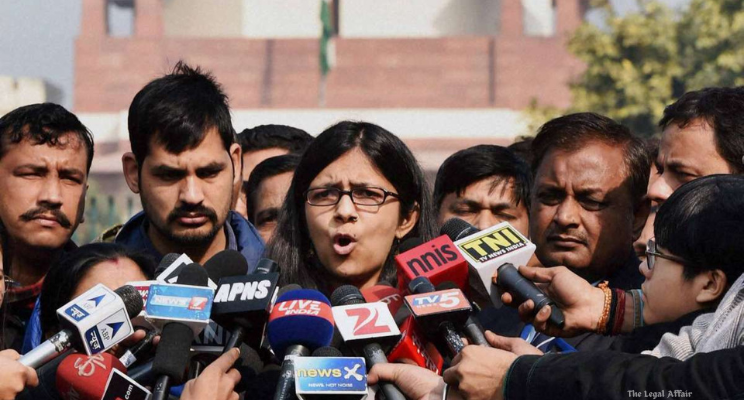
The Delhi High Court recently refused to quash the FIR registered in 2016 against Rajya Sabha MP and former Delhi Commission for Women (DCW) Chief Swati Maliwal for allegedly revealing the identity of a 14-year-old rape victim. The case stems from an incident in the city’s Burari area, where a minor girl was brutally raped by her neighbour, who forced a corrosive substance down her throat, leading to her tragic death. The FIR was initially lodged under Section 228A of the IPC, which prohibits revealing the identity of victims in sexual assault cases. However, the charge under this section was later dropped, and instead, charges under Sections 74 and 86 of the Juvenile Justice (Care and Protection of Children) Act, 2015 were applied. Justice Neena Bansal Krishna ruled that the disclosure of the victim’s identity through an official notice issued to the concerned SHO, which was later shared in a WhatsApp group and circulated to news channels, prima facie constituted an offence under the Juvenile Justice Act. The Court also disposed of DCW’s plea seeking a Special Investigation Team (SIT) probe into the rape case and other related matters, stating that as chargesheets had already been filed, the request had become infructuous. Additionally, the Court held that the compensation for the victim’s family could be claimed under the Delhi Victims Compensation Scheme, 2018.
Arguments of Both Sides:
The petitioner, DCW, argued that the FIR was a misuse of legal provisions, as the intent was never to reveal the minor’s identity but rather to highlight the inadequacies in the investigation. It was contended that the notice issued to the SHO was internal and inadvertently found its way into the public domain, and Maliwal had no role in its publication in news media. The petitioner further claimed that the charges under Sections 74 and 86 of the Juvenile Justice Act were misapplied, as the provision primarily aimed at preventing media disclosure rather than administrative errors in government communications. Additionally, the plea sought a reinvestigation of the rape case through an SIT, emphasising that the original investigation had been deficient and further scrutiny was required to ensure justice for the deceased minor.
The State, in response, strongly opposed the quashing of the FIR, contending that the disclosure of the victim’s identity was not inadvertent but a direct consequence of Maliwal’s actions as the then-Chief of DCW. The government submitted that the official notice containing the victim’s identity was widely circulated in WhatsApp groups, ultimately leading to media disclosure. The prosecution further argued that under Section 74 of the Juvenile Justice Act, any disclosure of a child’s identity in conflict with the law or in need of care and protection constitutes an offence, irrespective of the medium of transmission. The State also pointed out that an SIT investigation into the rape case was unnecessary, as chargesheets had already been filed in 2016, and both cases were pending trial. The defence’s attempt to link the FIR against Maliwal with the victim’s case was, according to the prosecution, a diversionary tactic to dilute the legal repercussions of the disclosure offence.
Court’s Judgment:
The Delhi High Court, after considering the arguments, held that the FIR against Maliwal could not be quashed as there was a clear prima facie offence under Sections 74 and 86 of the Juvenile Justice Act. The Court observed that the petitioner’s argument about inadvertent disclosure lacked merit, as the notice was intentionally circulated to various stakeholders, leading to the subsequent publication of the victim’s name. It emphasised that the law on child protection was stringent and did not differentiate based on intent; rather, it focused on the consequence of identity disclosure. The Court reiterated that the purpose of Section 74 was to prevent any information that could lead to the identification of a minor victim, and the widespread circulation of the notice containing the victim’s details violated this principle. Regarding the plea for an SIT investigation, the Court ruled that since the chargesheets had already been filed and the cases were under trial, further investigation would not serve any fruitful purpose. The request for re-investigation was deemed infructuous as it was for the Trial Court to decide the necessity of any further scrutiny. Furthermore, on the issue of compensation for the victim’s family, the Court noted that Rs. 50,000 had already been provided by the Delhi Legal Services Authority and clarified that the parents could seek additional compensation under the Delhi Victims Compensation Scheme, 2018 by filing an appropriate application before the Trial Court. In conclusion, the Court dismissed Maliwal’s plea, affirming that the FIR and chargesheet against her would stand and any further legal relief should be sought in the Trial court.