


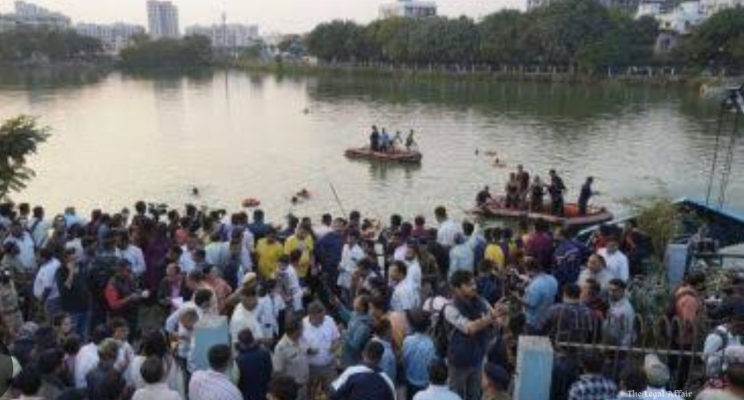
Introduction:
On February 17, 2025, the Gujarat High Court issued a significant order, directing the partners of M/s Kotia Projects to deposit over Rs. 3.5 crore in compensation for the victims of the tragic boat capsizing incident in Harni Lake, Vadodara. The boat accident occurred on January 18, 2024, leading to the deaths of 12 children and two teachers who were on a school picnic. The tragedy occurred under the responsibility of M/s Kotia Projects, the contractor tasked with the development of the lake by the Vadodara Municipal Corporation (VMC). The court’s decision came after a detailed examination of the compensation amount and its payment schedule, which was to be paid in four instalments, with the first 25% deposit due by March 31, 2025. The compensation calculation was based on the Motor Vehicles Act’s principles, as no specific statutory provision existed for boat tragedy compensation. The court also deliberated on the insurance issue, rejecting the firm’s plea to involve the insurance company in the proceedings.
Arguments of Both Sides:
The petitioner, representing M/s Kotia Projects, argued that the firm was facing internal disagreements among its partners on the responsibility of bearing the compensation amount. The counsel for Kotia Projects requested the court to permit the inclusion of the insurance company as a party, citing the fact that the lake was insured. However, this request was denied, with the court making it clear that the partnership firm was solely responsible for the payment, and the issue of internal disputes among the partners was not the court’s concern. The firm’s counsel also pointed out that, by the analogy drawn from the Motor Vehicles Act, the firm had not been allowed to cross-examine witnesses and documents, potentially affecting the fairness of the compensation calculation.
On the other hand, the state counsel emphasised that the compensation had been calculated reasonably and that the fault for the incident lay with M/s Kotia Projects, as the firm had been tasked with the development of the lake. The state argued that the court had already fixed liability and that the analogy to the Motor Vehicles Act was appropriate for determining the compensation due to the lack of specific provisions for boat accidents. The state counsel also stated that the compensation would be disbursed only after the entire amount was deposited in full to avoid cumbersome calculations for partial disbursements.
Court’s Judgment:
In its ruling, the Gujarat High Court emphasised that M/s Kotia Projects, as the responsible contractor firm, was liable for compensating the victims of the tragic boat accident. The court recognised that, although there was no specific statute for compensation related to boat accidents, the principles under the Motor Vehicles Act could be applied as an analogy for determining the compensation amount. The court also noted that the amount of compensation calculated by the authorities appeared reasonable, considering the victims’ families’ losses.
The court further ruled that the compensation must be deposited in four instalments, with the first 25% to be paid by March 31, 2025, and the remaining amount to be paid in three further instalments at one-month intervals. The court ordered that the deposited compensation be held in a fixed deposit with the Vadodara Collector’s office until the full amount had been received. This approach was designed to ensure that the entire compensation was secured before any disbursement could occur, thereby preventing any potential complications in distributing the funds.
The court also addressed the issue of insurance, making it clear that while M/s Kotia Projects could pursue recovery under the boat’s insurance policy, this was a matter for the firm to resolve internally and was not the court’s concern. The court’s primary focus was on ensuring that the victims’ families received timely and adequate compensation, which was the responsibility of the partnership firm.
Additionally, the court rejected the argument that the firm had not been allowed to cross-examine witnesses or documents, stating that the analogy drawn from the Motor Vehicles Act was sufficient for the compensation assessment. The court also clarified that the compensation calculation did not preclude the victims from seeking further claims through other legal means, such as filing claims in a Motor Vehicle Court, where they might potentially receive higher compensation.
In summary, the Gujarat High Court firmly placed the responsibility for compensating the victims on M/s Kotia Projects, acknowledging the contractor’s fault in the tragedy. The court laid down a structured payment plan for the compensation and ensured that the victims’ families would receive the necessary funds without delay while maintaining clarity on the procedural aspects of the case. The decision highlighted the importance of corporate accountability in ensuring justice for individuals affected by avoidable accidents, especially those leading to loss of life.