


Introduction:
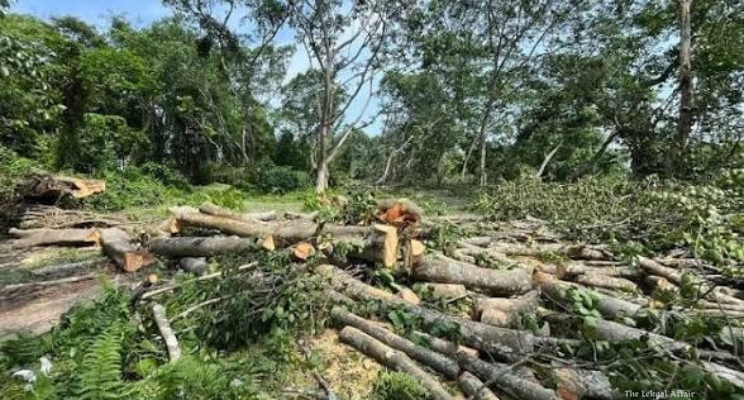
The Gauhati High Court, sitting at its Aizawl Bench, recently took cognizance of a matter of significant environmental and cultural concern involving the large-scale felling of century-old trees in Mizoram’s capital city. The case, registered as XXX XXX v. In Re–The State of Mizoram & Ors. (PIL (Suo Moto)/1/2026), arises from a public interest litigation initiated in response to alarming reports of tree cutting in the vacated land previously occupied by the Assam Rifles.
The division bench comprising Justice Michael Zothankhuma and Justice Kaushik Goswami issued notice to the State authorities and passed an interim direction restraining further felling of trees until the next hearing. This judicial intervention came in the backdrop of a proposed road widening project in Aizawl, particularly along the stretch from Bazar Bungkawn to Treasury Square, which reportedly necessitated the removal of a substantial number of mature trees.
The petition, filed by environmental activist Saizampuii Sailo, highlights the ecological importance of these trees, many of which are over a century old. The area in question is not only ecologically sensitive but also historically significant, as it includes structures dating back to the late 19th century, including barracks constructed around 1897. The convergence of environmental and heritage concerns places the case at the intersection of sustainable development and conservation law.
This case underscores the evolving role of constitutional courts in addressing environmental degradation, particularly in urban settings where developmental pressures often conflict with ecological preservation. It also raises critical questions about the State’s duty under Articles 48A and 51A(g) of the Constitution of India, which mandate the protection and improvement of the environment.
Arguments of the Parties:
The petitioner, an environmental activist, approached the Court with a plea grounded in ecological preservation and public interest. It was argued that the trees slated for felling serve as vital “carbon sinks” in Aizawl, a city increasingly characterized by rapid urbanization and concrete infrastructure. The petitioner emphasized that such mature trees play an irreplaceable role in maintaining air quality, regulating temperature, and supporting biodiversity.
The petitioner further contended that the proposed road widening project failed to adequately consider alternative measures that could minimize environmental damage. It was submitted that the State had not conducted a comprehensive environmental impact assessment or explored less destructive options such as rerouting or partial expansion. The indiscriminate cutting of trees, particularly those with historical and ecological value, was described as arbitrary and violative of the principles of sustainable development.
Attention was also drawn to the historical significance of the site. The petitioner highlighted that the vacated Assam Rifles land includes heritage structures and trees that date back to the colonial era, with some trees reportedly planted as early as 1850. The destruction of such assets, it was argued, would result in an irreversible loss to the cultural and environmental heritage of the region.
On the other hand, while the State’s detailed response is awaited, the context suggests that the proposed felling of trees is linked to infrastructural development aimed at easing traffic congestion and improving connectivity in the city. The road widening project is likely part of broader urban planning efforts to accommodate increasing vehicular movement and population growth.
However, the absence of a transparent and consultative decision-making process appears to have weakened the State’s position at this preliminary stage. The Court noted that the State must justify the necessity and proportionality of its actions, particularly when they involve the destruction of long-standing natural and historical assets.
Court’s Judgment:
At this interim stage, the Gauhati High Court has not delivered a final judgment on the merits of the case but has issued significant directions that reflect its concern over the environmental and heritage implications of the proposed tree felling. The Court’s order demonstrates a cautious yet firm approach aimed at preventing irreversible damage while allowing the State an opportunity to present its case.
The bench took judicial notice of media reports indicating that more than 400 trees had been identified in the area, with approximately 174 marked for felling. It also noted that many of these trees are around 100 years old, with at least one reportedly planted in 1850. Such observations underscore the Court’s recognition of the intrinsic value of these trees, not merely as environmental assets but as living witnesses to the region’s history.
Importantly, the Court highlighted the presence of heritage structures within the same परिसर, including barracks constructed in 1897. This dual significance of the site—as both an ecological and historical zone—prompted the Court to question the rationale behind the State’s decision to permit large-scale tree cutting.
In its interim order, the Court directed the State to ensure that no further trees are felled in the area until further orders. This direction serves as a protective measure, preserving the status quo and preventing any irreversible action that could render the proceedings infructuous. The issuance of notice to the State indicates that the Court seeks a detailed explanation regarding the necessity, legality, and procedural compliance of the proposed actions.
The Court’s approach reflects established principles of environmental jurisprudence, including the precautionary principle and the doctrine of sustainable development. By intervening at an early stage, the Court has emphasized the need for a balanced approach that harmonizes developmental objectives with environmental conservation.
Furthermore, the case illustrates the judiciary’s willingness to act on public interest litigations that raise issues of collective concern. The involvement of an environmental activist and the Court’s reliance on newspaper reports highlight the accessibility of judicial remedies in matters affecting public welfare.
The matter is scheduled for further hearing on May 18, where the State is expected to present its justification and possibly outline mitigation measures or alternative plans. The outcome of the case could have broader implications for urban development policies, particularly in ecologically sensitive regions.